
The phrase is “capitalist recuperation”.
It may not be immediately recognizable to you, but you’ve seen it. A subculture is formed. It develops symbols, an internal shared language. Newcomers become part of the community by adopting these symbols – be it fashion, knowing the “right” bands, or being able to perform particular dances. Then it happens. Inevitably, a subculture cannot stay “sub” for too long. Rave scenes go from underground warehouse events to Ticketmaster experiences at $80 a pop. Radical leaders have their images reprinted on unethically made shirts. Every countercultural idea is deranged, images bought, sold, duplicated until the end of time for profit. More straightforwardly: “selling out.”
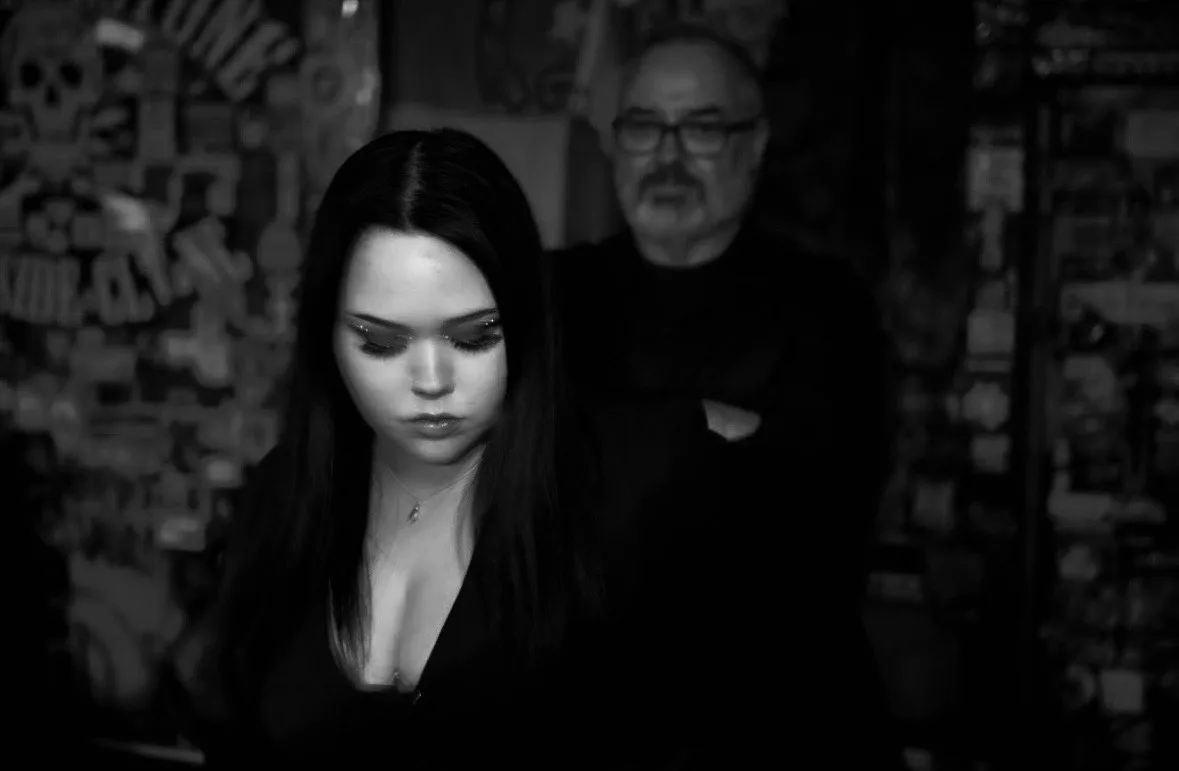
But that’s not the end of the story. Subcultures don’t end after recuperation; many reinvent themselves in spite. Punk is Dead, as much as it’s alive. The black box-dye stepchild of Punk is Goth, a dark, danceable genre that is alive and well in NC. Charlotte alone has three separate monthly nights: Digital Noir, Requiem, and Shadow Play. In this installment of gothic interviews, we focus on the father-daughter DJ duo at the center of Shadow Play, DJ DIL3MMA and Christian Hoefle.
Entering Crown Station, the typically bright pub now has a gothic atmosphere. The smoke machine makes the overhead lights feel especially thick. At the center of it all, on a stage, is DJ DIL3MMA, eyes focused on the decks. Her jet black hair frames her face as she bobs slightly to the beat.
It’s early in the night, so the crowd isn’t dancing quite yet – but they’re far from unfocused. A few regulars, dressed in all black, of course, turn their heads to face the stage every so often. Seemingly basking in the ambiance of the bass. It’s strangely meditative. After her first set, we sit down to talk about her journey as a DJ.
So how did you get started DJing?
Emma: I grew up with a father in the music scene, so hearing him definitely inspired me a good bit. The first night, I got to go out and see him DJ, really changed my perspective on it. Beforehand, you know, I was underage (laughs) and not really able to go out and see how it works. So being able to watch it and see how he could make the energy shift within a crowd was really intriguing to me.
And what show was that?
Emma: It was at Skylark, so it was just kind of a random pop-up show. A different venue, different crowd. And then, of course, I started taking his controller and playing around with it. And once I started learning the tricks and what all I could do with it, I was all in.
Speaking on energy shift, you’ve gotten people on the floor already. How do you maintain a good vibe, and why is that so important?
Emma: We want to please everybody. Obviously, that’s a very hard goal. Everybody has different tastes. I try to read people’s energy and the vibe of the room so I can make everybody as happy as I can. You gotta get a feel for it and, you know, trial and error. There have been nights here when I’ve played certain songs, and they don’t work at all. But in different venues or different places, that song might do amazing. So just learning your audience, really changes the energy of the event.
What about this venue, what do they tend to like here?
Emma: Definitely some new wave vibes. I would say true ’80s and ’90s. We do have newer events too, where we play the newer music, which is really important as well. For Shadow Play, we do try to stick pretty true to the 80s and 90s vibes. Definitely anything synth pop and New Wave; everybody here loves goth music too. So I always try to sneak in at least a little bit.
How would you describe your relationship with music as a whole?
Emma: Honestly, I, ever since I was a toddler, I was very art focused. That was my way of expressing my feelings. Being able to create an emotion and sharing that with people is really important, even if it is through art and not necessarily a physical form. Whether it’s makeup, portrait art, mixing, I always find peace and joy in that.
I think a way of telling your story and putting yourself out there without having to use your words – which I haven’t always been great at. So for me, it was always a really easy outlet, and it’s always had a really big place in my heart, especially growing up with all genres. I have a very deep appreciation for music. Whatever somebody has the energy to create is important in the world. So even if it’s a genre I don’t usually listen to on the every day, I still have a deep appreciation for it, and I think that’s important.
And you go to a lot of live concerts.
Emma: All the time. [laughs]
How would you describe the difference in emotion between streaming music and going to live shows?
Emma: For me, streaming is fine. It’s playing in the background, but usually you’re not fully in the moment. You’re always distracted by something, whether it’s your phone, or anything on a day-to-day basis. Live concerts, really put you in the moment, and I think that’s important. You’re able to listen more. You’re able to appreciate it more.

You listen to a lot of genres, how do you search for new music to include in your sets?
Emma: Honestly, a radio type of feature on your streaming services is a big one. I love picking a random song that I like and creating a radio from it. You really will hear a lot of new artists and new songs that you haven’t heard before. I try to find things that aren’t as mainstream. I love to play a song that hasn’t been played or heard before.
Also, just going to record stores. I love the used section, taking a random record, taking it home, playing it, listening to the full album, try to really tend to that emotion that they’re trying to portray through the album. Shout out Lunchbox Records. Definitely check them out, shop local. They’ve always been amazing, and they are super kind over there. That’s been an amazing way to find new things.
Goth – and more broadly the 80s era – has had a revival in the past few years. Where do you Goth/New Wave/Post Punk going in the next few years?
Emma: I feel like it’s very, very nostalgic. It’s just before social media, so, in order for people to have those connections, going out was a big part of it. In general, the music back then was just a little different from what it is now, and people notice that, especially with how social media is now, it’s a little bit easier for [songs] to resurface. You’ll hear snippets, older songs, and that’ll kind of get you hooked and, you’ll want to explore it a little bit more. That’s definitely played a big part in it as well.
This night has a very intergenerational audience, and you’re one of the youngest DJs in the scene. With this new revival, how do you think new audiences are going to change the scene?
Emma: I want to say how grateful I am for the OGs in the scene that have put blood and tears into keeping it alive for as long as it’s been; it’s pretty incredible. For the newer generation, we do try to spin in a lot of new music. I think it’s important to keep the traditional stuff as well. So people are used to it. They hear it, they kind of know where it came from. I do think it helps the newer generation connect
I know it’s kind of be intimidating sometimes to come out to a new scene or a new place, but I will say, you’d be very graced with an extremely kind and, non-judgmental community. Showing up is the first step, and [finding spaces] through social media and things like that – I’d love to connect more with them.
What is your favorite thing about the way that your dad DJs?
Emma: There are a lot of options that I could choose from. I would say, though, for him, it comes so naturally. I am a very over-analyzing type of person. So no matter what I do, there’s always a little voice in the back of my head, second-guessing myself, at least a little bit.
For him, though, he can get up there and not even think twice and give the people what they want. That’s something I hope to get to at some point. I’m sure over time you get more comfortable, but, between his technical skills and just his energy, it’s… yeah, he’s been amazing. To look up to and learn from. I’m very, very grateful to have that.
It’s now 11 P.M., and the dance floor is packed. Groups of people split their time between the floor and cooling off outside. It’s a blur of leather, silver jewelry, and cigarette smoke. Goth is alive and well in NoDa. Christian Hoefle steps off the stage. I meet him outside. We lean against the metal railing and chat.

Let’s get into it. How did you start DJing?
Christian: I worked at a Reggae record shop in Virginia Beach. The guy who owned it. I taught me how, so I started DJing in the shop and at house parties. We moved to Charlotte, and I started DJing clubs around Charlotte in the ‘90s.
Whoa, a Reggae Record Shop, you said?
Christian: Growing up in Virginia Beach, there’s a lot of reggae, a lot of punk. Yeah. So, I was a little punk rocker working in reggae.
And what were some records that you enjoyed from that shop?
Christian: Steel poles. Um… Yellow man. Of course, Bob Marley.
How do you go from Reggae, Punk, to what you’re spinning now, New Wave, ’80s, and Goth?
Christian: I grew up in that time, so that’s all the music. So, you know, I was a kid in school that had all the records. It was like, what’s new? I was always reading fanzines from L.A. and New York. My older sister helped a lot with that, too. She brings me the stuff. She and her little brother are just a punk rock family.
What does the recent 80’s revival feel like for you as someone who grew up during that time?
Christian: So there’s actually been a couple of different revivals. In the early 90s, I did the first retro 80s night at an old club in Charlotte at the underground – not associated with the music venue – but it was kind of based on Polly Esther’s in New York City. So we did that for a couple of years, and then there was the Baja, which had an ’80s night. I DJed that. Then the Breakfast Club opened, which is now defunct, as well. And, you know, I did the Thursday night kind of new wave night there, but it was strictly an ’80s club. Hmm. So, and this is, like, the third or fourth resurgence?
And how do you feel about this one?
Christian: I like the younger crowd coming in. The other resurgences had always been people my age, but, bringing dilemma in, she’s bringing some of the younger crowds. She grew up in it, you know, she had to listen to it. Plus, I’ve had her in nightclubs, and she was… maybe, three? (laughs) I used to take her when I practiced sets and all. She’d just sit up on the speaker. That’s how she kind of got the love for the music, I guess.
How has that been watching her, like, come into that?
Christian: One of the things I like is, is she finds her own tracks. She doesn’t just play what I’m playing. She has my entire music library at her disposal. She finds stuff that she likes, and stuff that her generation likes. You know, it’s been fun to watch, I’ve talked to some of my friends that she’s been around, and they said some of the same stuff, She’s finding her own way, finding her own tunes, not playing the same stuff that we would. It’s been fun.

You talked me very, very briefly in the past about the importance of being able to control the audience and make them move. How do you manage that?
Christian: You gotta pay attention to what the crowd likes, like, the nice, the nice thing about tonight is we have three DJs. So, I can see, like, what Chris (KRAFTWARD) is playing right now and what they’re dancing to and what they’re not. So I can kind of base off my sets off, what I see that they’re dancing to. A lot of times, when your dances are going, you get kind of crowded. You were here, Halloween, we’rent you?
Yeah, yeah. (I was, in full costume too)
Christian: So there was no place to move. I guess, like, that you want to “dump” the dance floor – push people to the bar…. As a DJ that’s hard to do, because, you know, you always want to pack the dance floor, but… If you want to work with the clubs, make sure they’re making money so dumping the dance floor occasionally is ideal. You just gotta pay attention to the crowd and see that they like.
I’ve seen your Instagram, you have a nice vinyl setup at your house.
Christian: I’ve been plucking records since the ’70s. I have, I guess, right at 10,000 records. So my home setup is an audio technique, LP 120. Its a direct drive turntable, closer to, like, a old technique that every DJ uses. And then I got a set of clips, the five speakers. It was just… They’re Bluetooth, but I have records. You saw the Sam Cooke album – My love of old, oldies, and doo-wop, and Rocky Billy all started from my dad. So…
Talk more about that.
Christian: Growing up, my dad was in the Navy. So he was gone a lot, but whenever he was home, he always made sure he had time for me, so we’d go out fishing, and we’d always listen to the oldies station, tape in his truck. He was just… I can remember that he had this Sam Cooke tape. Just where my love of all that old school stuff started.
During the day you work in IT, and at night you’re a DJ, how do your two skills play off of each other?
Christian: I run an IT department, making sure my guys are doing all their stuff. I do a lot of email. [laughs] I worked at Microsoft for a few years. So I’ve been in Charlotte since… 98? Windows 98 just came out? Told you I was ancient. [laughs] There are some similarities, and there are differences. I think the technology is where they intersect, and for one, you’re stuck in a cubicle, and the other, standing in one spot watching people dance.
On your knowledge of tech, my final question for you: What’s your current setup?
Christian: Current setup is a Pioneer DDJ-FLX10. One of the things that really attracted me to that was the first standalone controller the Pioneer came out with, it had the stems, which allow the vocals, or the drums, and you can just move it, or you can just sit affecting just that piece of it. So basically mentioned off of that. Vocals, instruments, and drums
One thing I love about it is the quick setup. I walk in here at 8:10, and I was set up at 8:25.
It’s 1:10 A.M and the warm LEDs are now fully on in Crown Station, exposing the colorful, rustic, and not-very-goth interior. Last call has motivated even the most dedicated of gothic dancers to slink out of the pub and into the maw of the night. Breakdown was just as quick as setup, with Hoefle fully packed and out of the door by 1:25.
The night may be over, but Goth is far from it. It is impossible to fully opt out of a system as dominant as recuperation, but culture exists in response to the world as it exists. Goth has reinvented itself through every era – and with artists dedicated to its survival – thrives in this one. DJ DIL3MMA and Christian Hoefle have successfully capped off the main trio of Charlotte’s Goth nights for the month. The pub will be transformed once more on March 27th.
This interview has been edited for length and clarity.

Leave a Reply