
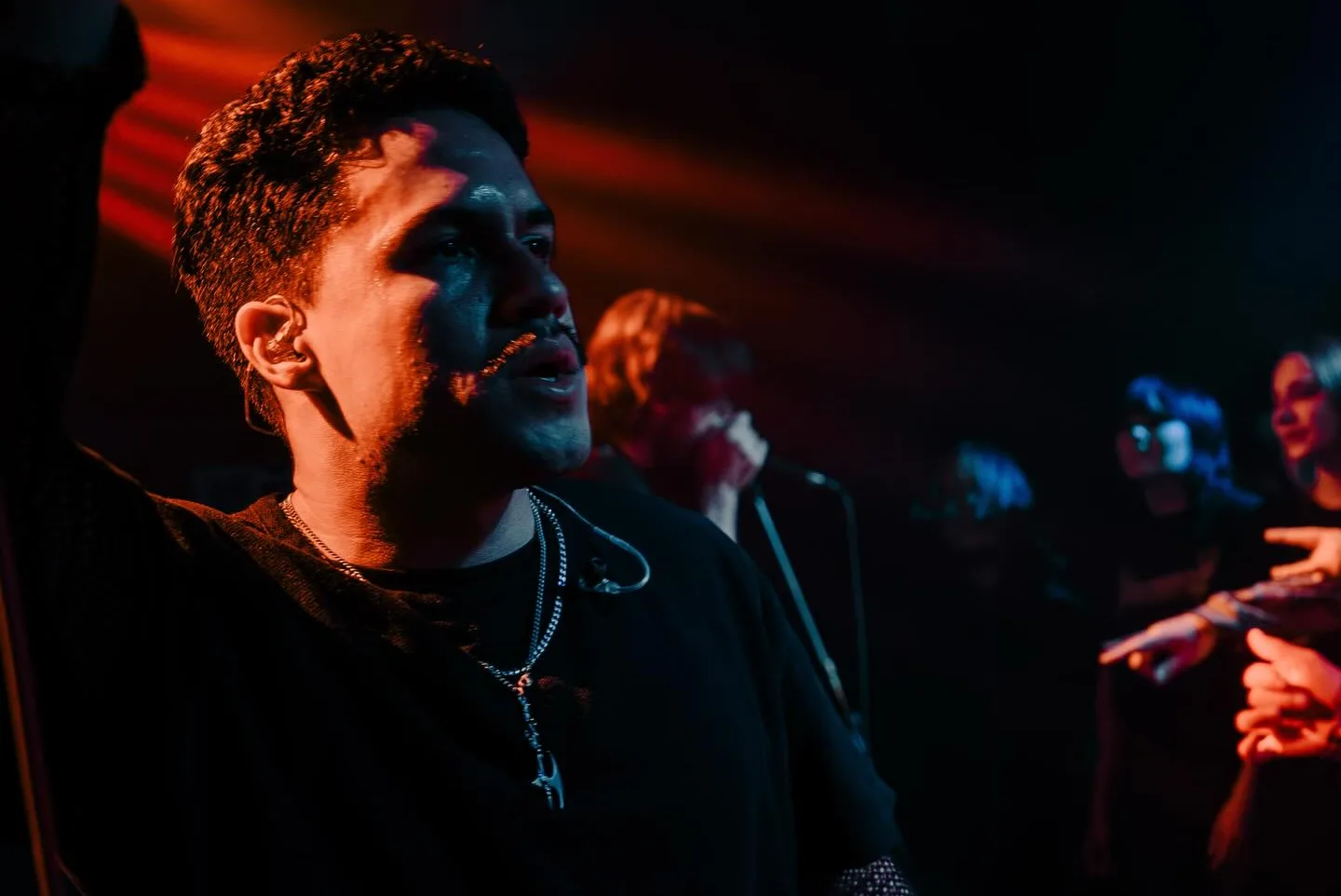
Header photo credit: Kristen Pittman
On November 8th, Charlotte’s music scene faced a “problem”: two banger local shows on the same night. Except it wasn’t a problem, because both sold out. Emo Royale 3 packed in fans at The Milestone for a stacked lineup featuring blankstate., Moving Boxes, and a Condado reunion, while American Theory filled Snug Harbor with their own devoted crowd. For Eric Barrera (drums, vocals) and his bandmates, the simultaneous sellouts weren’t a source of competition or anxiety — they were proof that Charlotte has an eager appetite for local music.
It’s fitting that American Theory would share the spotlight rather than fight for it. Over the past eight years, Barrera has transformed from a high school drummer into a screaming frontman commanding half the band’s latest album. That evolution happened organically, driven by curiosity and a willingness to experiment.
The band, which released their debut album before ever playing a proper show, has become a fixture in Charlotte’s scene. Now, they’re selling physical copies of their new record at shows before dropping tracks on streaming platforms and championing the kind of community-building that makes dual sellout nights possible in the first place.
What have you been listening to lately? Or, if you prefer, what’s been one of your favorite albums from the last year?
Eric (drums/vocals): My album of the year for 2025 was Lonely People with Power by Deafheaven. I’d also say Pirouette by Model/Actriz, and Thornhill‘s Bodies. Those records have been a big influence on me recently.
When you think back to getting into music, who was the first musician you remember discovering on your own and obsessing over?
Eric: Early on, it was probably Tré Cool from Green Day. I started playing drums when I was 10 years old, and he was a big influence. His style was attainable for me; I could actually play it. Some of my other early influences felt like they’d take forever to reach, but he made drums look fun and effortless while keeping it in the pocket and having a great stage presence.
After that, I got into Linkin Park and System of a Down, then went down a rabbit hole into early post-hardcore, metalcore, and the hardcore scene.
At what point did you start connecting with the local scene and going to shows?
Eric: Whenever American Theory first started. This is actually my first band. I met them in high school. At the time, I didn’t really know the local scene, and my high school didn’t have any other bands.
Being under 18, you can’t really go to bars or venues. Maybe there were all-ages shows, but it didn’t feel like it at the time. After we put out our debut album, we started getting offers to play at venues and started connecting with the scene. That’s when I learned, “Oh, these are the places. Oh, The Milestone. Now we can actually play there because we’re old enough.”
I’d say after I turned 18 is when I started to really learn about the scene as we were becoming part of it. We’re still evolving and connecting with bands. I found a band from South Carolina this year called Excide; they released an album this past year, and it’s so good. I just found out they’re from South Carolina, literally right next door. They recently got signed to a bigger label and have been an influence on us, too.
You mentioned starting the band in high school. I saw that your first album came out in 2018. What’s been the evolution of the band over the last seven, now eight years?
Eric: It’s been a crazy journey. We actually released an album [Your Local Politics] before we played a proper show. We were in high school, doing different things like marching band and chorus, so we had a lot of musical friends who were supportive. We put up a GoFundMe to record our first album because we wanted to go full send and had 10 songs we wanted to record.
Our music has evolved so much since then because we were still young. What I was listening to when that album dropped versus what I listen to now has evolved, and that has shaped our sound over time. We were maybe a little happier in high school, less angsty.
We had maybe two screams from our singer, Devyn, across the entire first album. I was always screaming for fun, and one day we decided it’d be fun to have me scream on a song. Devyn wanted me to teach him to scream on this one track. I did a reference track, and he was like, “Actually, that sounds sick. You’re going to learn how to scream and play drums on this.”
That song ended up being “Devil”, and I’d say that’s truly the start of the next era of the band. Before that, most stuff was written in high school or right after. It just took a while to release. After “Devil,” our sound matured, and we knew exactly what kind of music we wanted to make. From that song onward, our evolution skyrocketed.
Eventually, I was screaming so much that it made sense for me to not even play drums on some songs. I met our bass player, Jonathan, in the high school drumline. Since he’d been playing drums for so long and already collaborated on writing drums, he was like, “I’ll hop on kit for some songs.” Devyn, our singer, played bass and sang, and since I was screaming the majority of the song, it made sense for me to be up front.
It’s crazy seeing it now. In 2018, I would have never imagined screaming half of an album. The album we just released on physical media, Where Did All the Flowers Go? — soon to be on streaming — I basically front on most of that album, more than half. It’s crazy to see that evolution.

Image credit: Kristen Pittman
That’s so awesome. Not something you see a lot of—to have that progression occur organically.
Eric: Yeah, and that’s how we write, too. Our bass player, Jonathan, writes a lot of guitar riffs and drum parts. Our guitar player, Mike, will send full demos with drums included. Sometimes I write drums and vocals, sometimes I don’t. Overall, our singer, Devyn, is a producer at heart and takes all of our crazy ideas and makes them into cohesive songs Since our writing process is all hands on deck, we’re all down to play different instruments, which makes the live show fun for the audience and for us. It’s so fun playing multiple instruments and taking a break from one. It keeps our shows dynamic and interesting. .
I noticed you released your first album, then you were on a good cadence of releasing singles. Having done both singles and full records, which do you prefer? And in this world of TikTok-based attention spans, do you think the album still has a place in modern music?
Eric: I still love the album. I’ll stand by it. The reason we started with an album in 2018 is that we thought, “This might beto be the only thing we ever drop. If it flops and nobody wants to book us, at least we can say we did an album.”
After that we wrote another album, but ended up releasing it as singles that turned into an EP. That’s because we started that album pre-COVID, but then after quarantine, we got sick of it. It taught us the hard lesson that holding onto music for too long isn’t necessarily a good thing. We only released the songs we were most proud of, which became an EP called We Still Have Time.
Soon after that, we released “Devil”. That’s when I started screaming, and switched from six-string to seven-string guitars. We wanted to just write a really good song without trying to force it to be too technical.
We released “Love You to Life” to show our poppier side, and “Drowning” as a straightforward heavy metalcore song. We wanted to test our songwriting and have variety. After we figured that out, we were ready for another record. That’s when we started writing Where Did All the Flowers Go?, taking what we learned from those three singles and really dialing in what worked and what didn’t.
It’s awesome to see the progression, especially with you having the vision to explore different areas and not just be a one-trick pony.
Eric: That was our way of hitting the extremes: How can we bring them together? The best way is through an album, because it’s hard to make one song that hits everything. We got to express that within an album.
We’re still releasing singles, but part of why we decided to release physical copies first is for people who’ve been with us and who enjoy physical media. Even people seeing us for the first time who want to buy a CD can get something special and hear something we worked hard creating in its entirety, in the form it should be consumed in. We’re still doing the singles game to promote the album, but the full album is what we really want people to hear.
There’s something special about being at a show and having a new record that’s not on streaming yet, but you can buy it right now and listen to it in your car.
Eric: Exactly. That’s how I grew up listening to music, too, mostly through CDs. I collect some vinyl, but CDs are more budget-friendly, more compact, and offer better audio quality. We’re actually pressing some vinyl right now, so those will be available soon.
With albums, you put it on, and you don’t really skip. You learn to love the songs you might not have liked on first listen. With streaming, it’s easy to take it for granted. Even in the industry, you release an album and there are focus singles that get playlisted, so people listen to those but not the rest. It takes a long time to make an album, and you want people to listen to the whole thing.
You’re front-loading the reward for the more invested crowd, the true fans or people who are out in the community going to shows.
Eric: A hundred percent. That’s something we’ve done a lot in the local sense: handing out stickers, going to shows, and talking with people. Sometimes I’ll go to The Milestone on a random night without hearing any of the bands beforehand, and end up discovering my new favorite band by the end of the night. It’s all about community, especially in the scene.

Image credit: Kristen Pittman
That’s a perfect segue: What do you love about the Charlotte music scene? And how do you think local bands could be better supported?
Eric: There’s such a strong scene in so many different genres, and it’s grown over time. I love Milestone and Snug Harbor; these are amazing venues. Then you get to Amos, which is much higher capacity. You kind of jump from DIY smaller cap venues at 150-170 capacity to Amos at about 700 capacity.
What I’ve noticed in some other cities is that there’s some middle ground. I think bands could be better supported if there were a progression of venues you could move up through.. A mid-sized room for Charlotte would benefit the scene, especially for festivals.
That progression of capacity is an underrated aspect of successful music scenes.
Eric: I agree. It would help the artists within the scene without hurting the smaller venues. We always rep Charlotte, though. We grew up here, so it feels right.
Looking ahead to 2026, do you have any specific goals other than getting the record out on streaming?
Eric: Our goal is to play way more shows than we did last year. We’re in the process of setting up some smaller tours. We’re really trying to play more shows in the Carolinas and beyond. Definitely more touring is our main priority. Also continuing to write and collaborate with other artists. We’re already writing another album right now. It never stops.
Last question: Who are your favorite local or North Carolina-specific artists?
Eric: Stellar Circuits from Winston-Salem. We played our first show with them at 1614 in High Point. Then they blew up after releasing a few amazing albums, toured Europe, and got signed to Nuclear Blast Records. Seeing how far they went from our first show really inspired me and the band. It showed us the potential.
Our homies in LANiiDAE. We recently co-headlined with them when we sold out Snug Harbor on the same night as the Emo Royale show. They’re super sick and coming out with an album soon. You’ll definitely see more from both of us very soon. There might be some potential collaboration.
INFINXTY is another artist. We’re playing with them at The Milestone on the 23rd. They’re super sick. They’ve got the hustle, they’re young, they stay busy, and that’s very inspiring.
There are also like 500 other bands I could mention. [laughs]
This interview has been edited for length and clarity.

Leave a Reply