
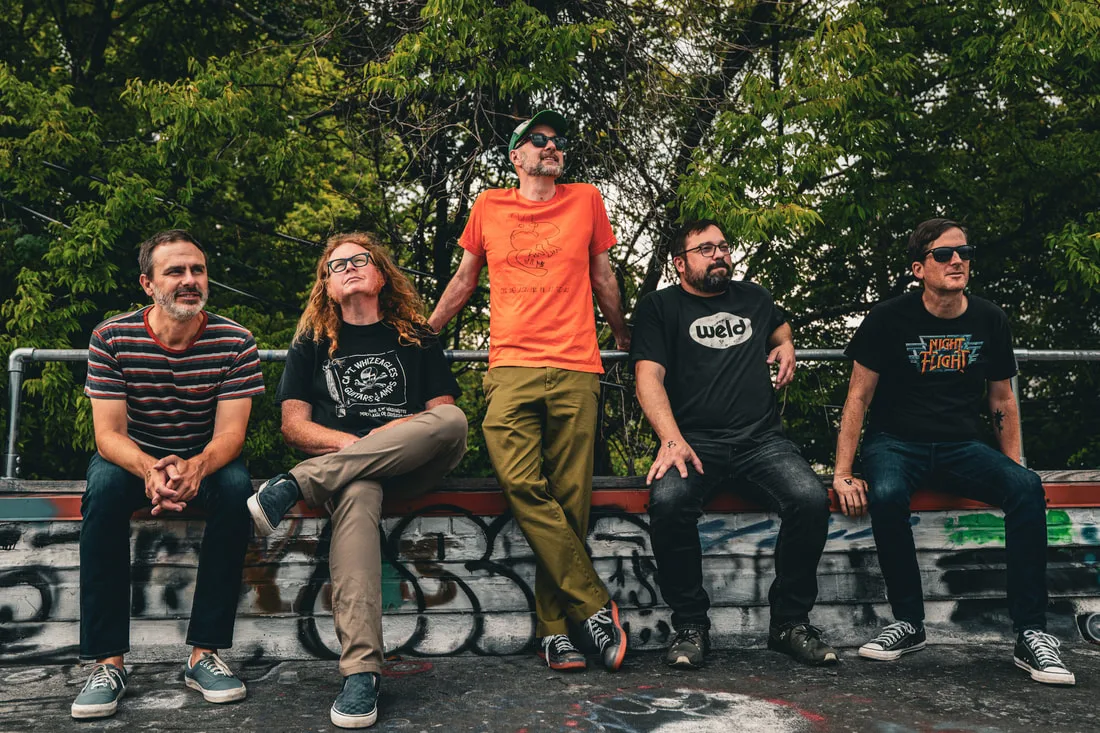
Header photo credit: Jim Brantley
When meeting Eric Roehrig for the first time, it’s hard to imagine the man ever being in a hurry. The Carrboro songwriter spent years shuttling between law school, marriage, and parenthood before finally completing Erie Choir‘s second album in 2017 — nearly a decade after recording began. With his third record, Golden Reviser, Roehrig continues his patient approach to songwriting, allowing melodies and arrangements to reveal themselves in their own time rather than forcing them into existence.
What began as Roehrig’s acoustic solo outlet during his Sorry About Dresden days has since evolved into a full-band endeavor, one enriched by longtime collaborators and special guests, including Tim Kasher of Cursive, Sara Bell, and former Dillon Fence member Greg Humphreys (to name a few).
I couldn’t help but wince a bit when he admitted the album format isn’t much of a modern approach. And yet, his commitment to the careful assembly of songs that speak to one another defines Golden Reviser. It’s a record steeped in classic rock warmth and new wave experimentation, concerned with how we reckon with our own histories. With so much to cover, Eric and I dug in for a park-side chat on a beautiful fall day in Chapel Hill.
What have you been listening to lately?
Eric: I really like Sharp Pins. It’s one main guy who’s also in a band called Lifeguard. Very power pop meets Guided by Voices kind of stuff. They opened up for The Hard Quartet at Cat’s Cradle a while ago. The way I discover a lot of music is I just listen to WXYC and they would play their song “Bye Bye Basil” all the time.
Who is the first musician that you remember discovering on your own and obsessing over?
Eric: One of the first albums I remember enjoying was Cargo by Men at Work. I was really into Paul McCartney‘s Tug of War, which is not really a great record. And I spent a lot of time watching MTV when that came out in my youth. It’s crazy how I saw the music video for “Burning Down the House” by The Talking Heads when I was 9 or whatever.
Do you recall what made you transition from being obsessed with that to playing music?
Eric: I took guitar lessons when I was 9 years old. I don’t know what prompted me to do that or ask my parents to, but it didn’t stick. It wasn’t until I was in 6th grade or so when I saw Back to the Future, and that scene where [Marty McFly] plays guitar kind of pushed me to start taking guitar lessons again.
That’s around the same time I got into more music, like The Beatles and Bob Dylan. I went more backwards than what was on the pop charts at the time. Pretty soon after that it was Jimi Hendrix, all sorts of classic rock, Van Halen, and then at some point, R.E.M. exploded into my world.
What has been your journey with Erie Choir, from the beginning to putting out this third full-length record?
Eric: The arguable seed was planted years ago when I was in the band Sorry About Dresden. We had recorded a split 7-inch with our friends in The White Octave, and our friend James had put it out on his label, then we were going to do a release show. I remember it was in January 2000 because this big snowstorm hit. Matty [Oberst] lived in Raleigh, and James and [Matt] Tomich lived in Durham, so they were not going to be able to make this show.
Because it was a few days into the snowstorm and people were bored and wanted to go out, we decided to put on the show anyway at Go! Room 4 in Carrboro. I played one song by myself, which got me thinking, “Maybe I could do this.” I’d just also written a bunch of songs, a lot of which were more acoustic-based, slower tempo, not so rockin’.
With Sorry About Dresden, me and Matty sort of split, half and half, the songs we brought to the group. I had all these extra songs, so I started playing with my friend Ben for a while, and then another friend Robert, who was in The White Octave. We recorded some things, made little CD-Rs, and then eventually decided to start playing shows. The original lineup may have all been my roommates at the time, which were The White Octave’s rhythm section, plus Zeke Graves.
Sit-n-Spin Records put out the first record [Slighter Awake], after we took a few years to get our shit together. We started recording the second record at some point, like in the late 2009/2010, but I had to go to law school, get married, and have kids. I moved away for a while, but we moved back and finally finished up that record in 2017.
Now we’ve been functioning, but again, all of us have lives; otherwise, we’re not the most efficient band. [laughs]
As you’ve journeyed out and back to the Triangle between albums, what themes have stood out as this particular batch of songs came together?
Eric: Some of these songs are really pretty old. At least one is from the very early 2000s, and most of them date back to before the pandemic. In that case, you start picking up on themes between them and finding others that fit in.
There’s a lot of dealing with the past, memories, not being overwhelmed by nostalgia, and getting into really living in the past, but coming to terms with it. You can’t disavow it; you are who you are, in large part, for all these things that have happened in the past.

Image credit: Stephen Charles
Golden Reviser pitches itself as a classic rock record, but it also incorporates elements of New Wave, punk, and even jazz into the mix. What drew you to those other genres, and how did they contribute to the sound of the album?
Eric: Part of it is playing with a live band. A song that I originally recorded with just a bass drum and acoustic can suddenly become more jammy. It depends on who you’re playing with, how you’re playing the songs, and how you’re learning them as a group.
Bob Wall has been in the group for a long time now on guitar and there’s a lot of great things he can do. I try to incorporate all those things as best I can. This record is the first one that’s entirely created post-Sorry About Dresden. Previously, there was always an idea that some song could be for that back, but it’s not that outlet anymore.
What was the process of returning to these “older songs” to track them for the record?
Eric: It was back around May 2022 that we picked it back up. There was the whole process of writing them and bringing them to the group, then learning them as a group and getting comfortable enough with them. Then we went into the studio towards the end of 2022.
Again, it takes us forever to do it, and it’s odd that we’re still married to the album format where you have to complete nine songs. The album isn’t really necessarily the format of 2025, but I still can’t help but think of things that way.
The album features a roster of guest collaborators, including Tim Kasher of Cursive, Greg Humphreys, and others. How did those come about, and what did each of these musicians bring to the record that you couldn’t have achieved on your own?
Eric: The first person was Sara Bell, because she was doing Regina Hexaphone and Lud. She has actually been on every Erie Choir LP, so I feel like now we just have to keep her on. The first one she played banjo, the second one she sang, and so this one she’s a co-lead vocalist.
There was a Lud song that she sang on years ago, maybe before she was even in the band, that I always liked the way her voice sounded with Kirk’s. So when I had this song [“Old Enemies”], and I thought it needed another voice. She was very gracious and came in, and she’s going to sing with us tonight at the release show tonight.
Reid Johnson from Schooner has such an amazing voice and came up with a part fitting of his Roy Orbison-esque vocal talents. Greg Humphreys, who was in Dillon Fence and Hobex, wound up years later playing on a rec league soccer team with me. I wrote the song [“Summer Bummer”], and I referenced a Dillon Fence song in the lyrics, so I knew I had to get Greg to sing on it in some way. He was able to do that up in New York, where he lives, and send those.
Cursive and Sorry About Dresden, way back in the day, were on the Saddle Creek label together. Tim [Kasher] is very kind and I’ve been able to keep in touch over the years. And so asked him if he’d want to contribute and he has vocals on “Bad Luck”.
There’s also Jeff Herrick, who has been part of the horn section before. He’s also the longstanding goalkeeper of our rec league soccer team and a friend of mine. Whenever we need a horn part, he’s the first person to call. So he came in and he had just gotten a flugelhorn, so he plays both trumpet and flugelhorn on the record.
I really love the records that Joshua Carpenter makes. He’s in Carpenter / Cohen, is one of my favorite songwriters, and he has a really great voice. I thought his voice could sound excellent on the song “Artifacts”.
And then Brandon Whitefield plays piano, organ, or some combination of both on eight of nine songs. He’s been on everything except the first record. Just a great guy to call in when we need somebody who actually knows how to play a keyboard.

Image credit: Jim Brantley
From your POV, how has the local music community evolved?
Eric: I think it’s really hard for me to get a good sense of where things are in terms of the scene, just because of being a little bit older and in a place where the idea of being part of the music industry or trying to make it a career or anything has long since evaporated. It really is just about doing the thing that you love and want to do.
We’re very fortunate that what we have here — and I always give credit to Kurt Ross from Lud for being the first person I heard say this — is that it’s not a scene, it’s a community. We do have this community that makes it possible for people like me to keep making music, having places to record, like Jerry’s Duck Key, and venues to play.
There was that period where we all thought The Cave was going to close down, and I’m really glad that that’s continuing. There’s all these people who make the infrastructure, from the Cradle and Local 506 to the Pinhook, Rubies on Five Points, and Shadowbox. We’re lucky that it really isn’t that hard to go to a show.
You always worry how long something good will last. That’s why it’s important that there’s new blood in there, and that there are younger people getting involved. I don’t think they need old folks like me up in their business; they’re creating their own communities. Hopefully the infrastructure that we’re a part of helps them to flourish.
There’s the artists who are able to sort of rise to national prominence. Consistently, decade after decade, there are bands that do that from this area. It’s always great to see, but it’s that infrastructure and community underneath it all is what enables them to do that. That level of attention and success is always going to be up and down and not guaranteed. There are many great artists that I’ve seen that never got that attention.
Do you have any favorite local or North Carolina bands you’d want to shout out?
Eric: Carpenter / Cohen. Every Dave Cantwell band. Every Clark Bloomquist band. Those two guys are in just a lot of bands and are just like engines of feeding the lifeblood into the scene. They’re involved in just a lot of music. We’re playing with Blab School tonight, which is one of Dave’s bands.
I’ve also got my Entrez Vous pin right on now. Always loved Lud. I could go on for hours with all the amazing musicians we have.
This interview has been edited for length and clarity.

Leave a Reply