
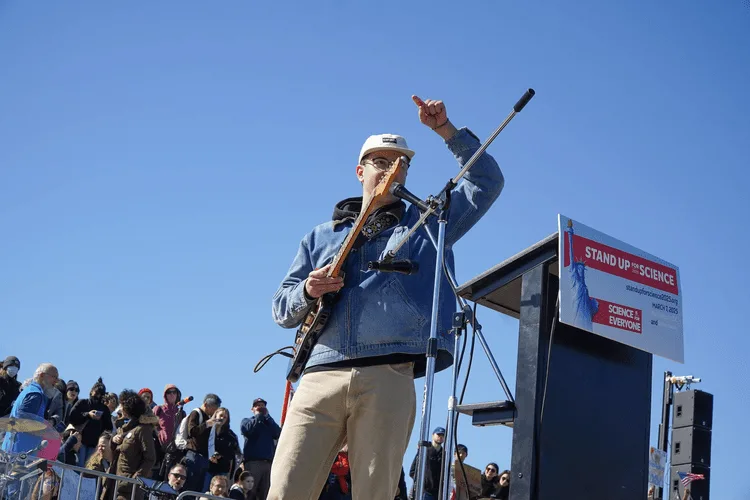
There’s a lot to respect about an artist who can pull in a crowd’s focus with their music to such a point that you could hear a pin drop. John DiSabito — better known as Johnny Sunrise — fits that mold. There’s an intimacy to his performance that draws people in, whether he’s fingerpicking through a Jim Croce-inspired melody or leaning into the bluesy grit he first discovered through The Black Keys.
DiSabito’s journey to North Carolina’s Triangle music scene was far from linear. After cutting his teeth as a drummer while at UMass Amherst, he spent years bouncing between Massachusetts, Rhode Island, and a pandemic-era stint in Asheville—places where community remained just out of reach. It wasn’t until he walked into Steel String Brewery in Carrboro three years ago, initially just looking for a job, that everything started to click.
Now, with a new live session EP capturing the raw energy of his solo performances, plus a growing roster of talented collaborators, DiSabito is finding his footing as both a songwriter and bandleader. We caught up at Open Eye Cafe for a wide-ranging chat, from the strange vulnerability of teaching people your songs to why sometimes the best recordings are the ones you don’t overthink.
What have you been listening to lately?
John: Nick Hakim released a version of his Where Will We Go album that’s half demos, half recorded stuff. Also, the new Caroline Rose record [year of the slug]; it was recorded on an iPhone in GarageBand, and she just liked how it sounded and put it out. It’s really inspiring to listen to because it’s straightforward. Just simple production, catchy songs, and I keep going back to it.
Who is the first musician that you remember discovering on your own and obsessing over?
John: One of the first artists who made me really want to play music is The Black Keys. That was what helped me find my voice when I started singing. It felt like I could sing like Dan Auerbach, and that felt good because I didn’t know how to sing, so I kind of emulated him to teach myself.
Weezer is another one. I used to listen to The Blue Album and Pinkerton with my headphones on, just blaring them to myself while I was playing drums. I also love Cake; that’s something my siblings and I would listen to. I always love how it’s very genre-bending and serious but unserious. That’s kind of how I write, too. I like the flexibility in songwriting that Cake inspired.
What inspired you to pick up drums?
John: I sort of started guitar and drums at the same time. I’m the youngest of five, so all my siblings picked an instrument. When I joined the school concert band, I didn’t want to play the same thing as one of them, so I picked percussion. And then I ended up getting a drum set as a surprise gift in sixth grade.
Drums were always the focus of what I practiced to get better at. Guitar was more like “read some tabs, learn a song I like, have some fun,” and then slowly but surely became able to play it. I didn’t really switch to guitar until COVID.
When did you go from playing in the school band to being in a more “extracurricular” act?
John: I was part of forming a band called Sunshine Brothers Inc with a couple college friends at UMass Amherst. I was on drums, so a lot of my gigging and songwriting experience was from behind the drum kit, which is obviously different than writing the chords, lyrics, and all that. We’d play parties, house shows, the local VFW. We just kept playing whenever we could.
In that band, I was sort of along for the ride in the sense that I would practice, show up to the gig, and play. And it was all collaborative and very fun. But I didn’t learn about having to reach out to venues until I started taking Johnny Sunrise more seriously.
What was your journey from graduating college in Massachusetts to moving down to North Carolina?
John: Post-undergrad, I was applying for a master’s program while living at home and working at a Homegoods. My partner was still at UMass, which is only like 40 minutes away from where I grew up, so it was back and forth like that for a while. Then COVID hit about a year after I got out of college and threw everything for a loop.
My partner and I ended up moving in together and bounced around. We lived in Plymouth, Massachusetts, for a while; moved to Asheville randomly for half a year; went back up to Providence. Three years ago, we came back to North Carolina so my partner could go to law school.
It was a strange time. The only thing it provided musically was a greater focus on guitar and singing because that’s what there was to do. It helped me actually improve on the guitar as opposed to just playing it when I felt like it. I had a huge Jim Croce phase; he has a unique fingerpicking style.
I got really into M. Ward. I saw his Tiny Desk From Home video, and I remember being blown away by the songwriting and the guitar playing. I got obsessed with it and started trying to play that way. He also plays in alternative tunings, so that was like my first experience learning the instrument from a different perspective.

Image credit: katherine apuzzo
How different was it to move to Asheville during a pandemic versus moving to Chapel Hill years later?
John: I didn’t really have much community in those places because of COVID. When we lived in Providence, I worked at a brewery there and had gym friends, but that was it. I wasn’t playing music live anywhere, so I didn’t branch out that way either.
When I moved to Chapel Hill, I went in to Steel String Brewery to ask if they were hiring. I saw they had an open mic night, so I decided to hang out and eventually play some of those song I’d been practicing. And then it just took off from there, getting used to performing again and meeting other musicians. It was the launching point for the whole Johnny Sunrise project.
Over the last couple of years, how has your songwriting developed? Have you noticed a cultivation of your own voice since building community in the Triangle?
John: I write very spur of the moment. What I’ve been listening to or who I’ve been playing with will kind of drive maybe like a taste of an idea. If it feels like a good idea, I’ll try and run with it. It comes down to a confidence thing. Just being comfortable with writing, playing, and not knowing if you even really like it yet. Just getting it down and playing it a few times.
What’s great about open mics and performing in front of people is you can kind of you can see what it inspires in people when they’re watching you. When you’re playing it live and not just for yourself, it evokes almost a different headspace. You’re feeling the song more than thinking about it. And if the feeling’s good, that’s usually how I know this is what I think I’ll keep working on or keep playing.
If I play something and it’s just like I don’t feel even connected to it while I’m performing it I’m like, yeah maybe that was an okay idea but I like performing when I really can get into it and feel like I’m sharing something that there’s no disconnect between me thinking about it or feeling it. Trusting that intuition has been a big thing I’ve learned in the past few years.
Do you notice any changes when collaborating with others in a full band setting?
John: It’s much more fluid. Until I feel really comfortable with how the song is turning out and how we’re playing together, it feels like you’re on uneven ground. You still feel in control of it, but you gotta let your friends put their own spin on it, absorb that, and let it be a part of the process.
I try to let each person bring in their own thing because they’re all experts in their own world and their own instruments. So, Gabby [Messner] will play something on bass that I would never think of because while I play bass, I’m not a bassist. I don’t have that brain of connecting chords and making lines. Jake [Richter] is a prolific jazz drummer, and he plays in this rock band with me, so it’s cool to see where his head goes. Paco [Marvelli] plays lap steel, and he’s quick to formulate a new idea and express it.
When you’re writing for yourself for so long, it’s really cool to see how other people can put their own flavor on it. It’s scary, though, because you want everyone to put their own flavor on, and you have to try to make a good meal out of that too. It’s also more distracting when you’re trying to focus on what other people are doing while you’re playing. But the more we’ve played, the more it just is part of the sound.
Also, it’s just trippy teaching people your songs. It’s like pantsing yourself in front of your friends. [laughs]

What inspired the live session approach for your new EP, and how did that come together?
John: The songs I chose for it were ones that I would usually play alone. They would be a transition into another song, with the band coming back in. I thought about building them out more with the band, but they were cool how they were. Maybe I’ll release fully recorded versions eventually but I just thought, “It’s been almost a year since I put out my last single and I do have this material; let’s get something else out there.”
I felt confident enough about them that the live session seemed like the best way to do it. Sure, I could go nitpick it and fix a little guitar fumble here and a little vocal fumble there, but the point of the song entirely gets across in the recordings.
I had the idea to do the video because I love going and watching my favorite artists play live, even on YouTube. It kind of brings you a little bit closer to the artist similar to watching live music. It’s where you can see them and you can see how they’re performing and their expressions. It puts a vibe and a face to the music. I would hope someone who stumbled across me who hasn’t seen me live might see that and it might help them connect the dots a little faster.
When you look ahead to 2026, what kind of things are on your radar?
John: For the past couple years, I was really gigging all the time. Which is great as you get better and more comfortable with different variables. I’ve sort of slowed down a tiny bit to bring that energy back because it’s fun to play all the time but you get burnt out and then that energy turns into resentment. That’s a guilty and awful feeling to have when you’re not excited to go play so I took a step back.
The good news is it has been helping. I’m excited to play more shows again and right now the most exciting thing is one coming up at the Cat’s Cradle Back Room in January. I’ll be playing with Supermutt from Durham and that’s going to be really cool. I’ve organized a few shows there but I’ve never like made it “the Johnny Sunrise show”, so I had my little ego moment putting my name on the top of the poster.
People who have seen me play know even with this EP, there’s still like seven other songs that I play all the time that I’ve been wanting to record. I’m just looking for the right time to be in the head space, work with the right people, and have it be organic, fun, and not too stressful. I’m hoping to do that record more probably in the early early next year.
Who are some of your favorite local/North Carolina musicians?
John: I’m wearing an Indigo De Souza shirt; I love her music. Wednesday and MJ Lenderman are great. I’ve played bass guitar with With Love, and sometimes back up Nicole Tester on guitar and Sam Thorn on drums. There’s Eric Lee Hardt, Lonnie Rott, Sugar Snap Peas, Ol’ Joey Scrums, The Rattletraps, Paco and the Panhandlers. I can’t forget Matty Frank and Chris Chism!
There are so many people I’ve played with that inspire me all the time. I genuinely enjoy their music, and it’s cool to be a part of that community.
This interview has been edited for length and clarity.

Leave a Reply