
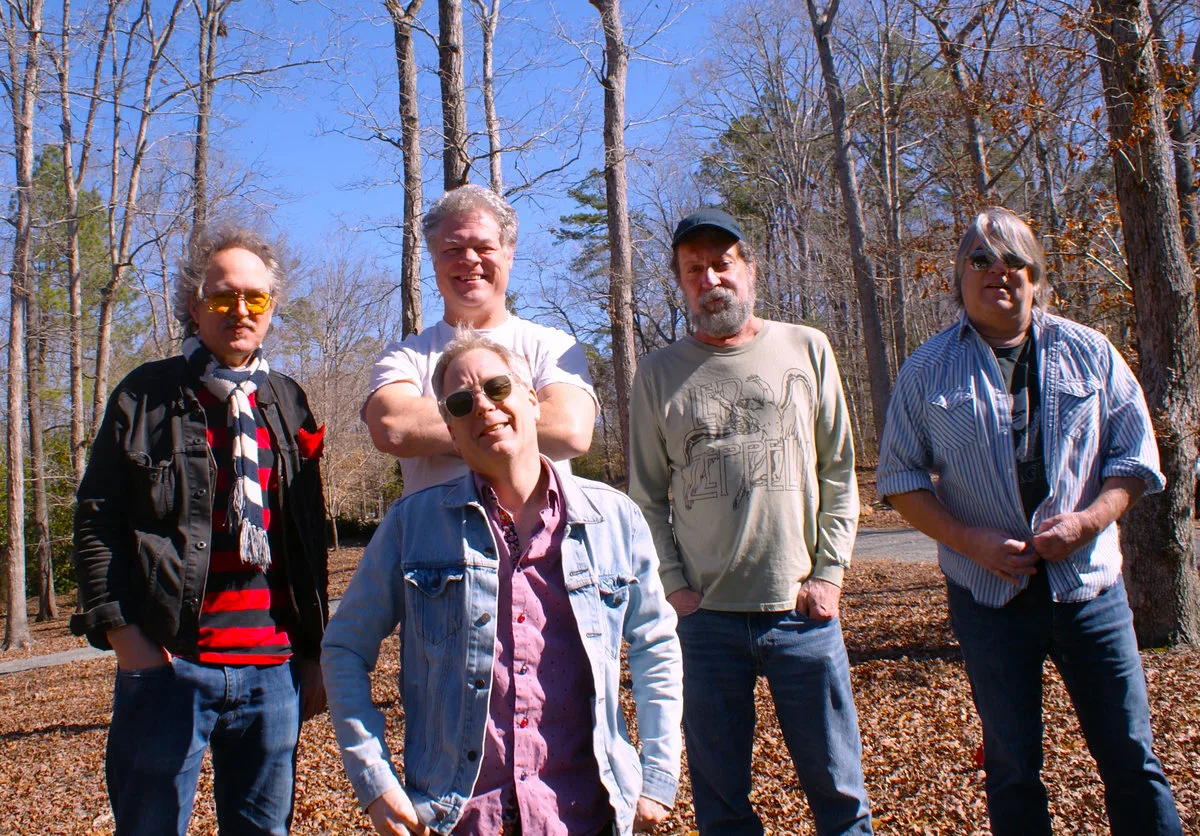
When you ask the members of Knockout Artist to describe their sound, they’d call it a cross between the Velvet Underground and the Flying Burrito Brothers. Thought they’re quick to clarify that’s inspiration, not aspiration. What they’ve built together is a bit harder to pin down, given the band’s decades of collective history in the Triangle scene, each hearing the same influences differently and refusing to let any one of them have the final say.
The result is a debut LP that earns its title. Ramshackle Deluxe moves from garage rock to psychedelia to country without losing its footing, held together by drummer Rock Forbes’s swinging, AC/DC-esque thump, bassist Matt Neal’s soul and reggae-informed melodicism, and pedal steel guitarist Simeon Berkley’s ability to wail, pick, and prod as the song demands. Singer and guitarist Phil Venable calls it “glorious instability,” but it clearly works.
What’s easy to romanticize about the album is how it was made the way records used to be: obsessively rehearsed and tested on local stages, then captured on tape (at producer Tim Harper’s barn studio outside of town).
What is something that each of you has been listening to lately?
Sim (pedal steel): Lots of stuff. Though, to be honest, I’ve been busy mixing an album for a band called Shelles; I’m actually in that band, so most of my listening has been my own mixes, criticizing them, and then simultaneously trying not to listen to them too much.
Danny (guitar/vocals): Yeah, “lots of stuff” would be my answer too. Lately it’s been the Mekons and James Blood Ulmer. Ulmer just passed away recently, and I’m a big fan, so I’ve been deep-diving back into some old favorites: Odyssey, Black Rock, Music Revelation Ensemble. And Sim is in Shelles, by the way; he’s sort of become the pedal steel man about town. We actually went to a gig of his last night with Mystery Ranch, who were great.
Phil (vocals/guitar): For me, I’ve really been into this band Verity Den from Carrboro. Their record [wet glass] is just transcendent, meditative without being new-agey, if that makes sense. And Gary Stewart, the country singer. There was a book written about him recently, and I just committed to the whole catalog. He’s probably best known for…
Danny: [singing] “She’s Acting Single and I’m Drinking Doubles.”
Phil: He’s quite an interesting guy.
When you were first getting into music, either as a fan or when you decided to play an instrument, who was the first artist or band you discovered on your own and obsessed over?
Sim: The Beatles. My parents were more into folk and Irish music, which I listened to a lot as a kid, but a friend of mine had all the Beatles records and a couple of tape recorders. We got really into the art of how those recordings were made and tried to replicate it ourselves. I actually learned drums listening to Ringo.
Danny: I grew up listening to the Beatles on the radio too. There was a record store around in the ‘70s called Record Bar that had an archival singles section, so I could go back through the whole Beatles catalog and buy 45s, which my parents were much more willing to spring for than full albums. But I think the first thing I truly obsessed over on my own was David Bowie, when I was around 12. None of my peers were listening to him. I was already into the glam rock thing and reading rock magazines, and the first guitar hero I ever had was Mick Ronson. So yeah, that’s probably my first real obsession.
Phil: I think for all of us, we got exposed early to what people now call classic rock. My parents listened to a lot of Stones, Beatles, Dr. John. My dad was an album guy; my mom was into singles, so I got these weird Neil Diamond 45s. There was one, “One Toke Over the Line” by Brewer and Shipley, that I was weirdly into at age seven or eight. But the band I felt like I really discovered for myself was Guadalcanal Diary, from Georgia. They were maybe a year or two behind REM career-wise.
They came to Roanoke, Virginia, where I’m from, and played at this renovated 1930s movie theater called The Grandin. For the first time in my life, music felt like an actual possibility. Growing up, I always assumed it was something impossibly out of reach, that you just weren’t good enough. But watching those people on stage, this weird mashup of country and punk and something spooky… it fixed me to my spot. They were the gateway drug.
Sim: When I moved from drums to guitar in high school, it was REM. I learned Murmur and Chronic Town front to back; the guitar parts were simultaneously complicated and attainable, which made them perfect for a beginner. From there I went to Jimi Hendrix and then Sonic Youth.
Danny: The first album that gave me that feeling, complicated but attainable, was Marquee Moon by Television. That was the first time I really tried to play along with a record and learn solos. I totally get what Simeon is describing.
Sim: Yeah, that feeling of ‘oh, I can do this too.’ The Flat Duo Jets had something to do with that for me. The Bad Checks too. You’d see them and think, okay, anyone who’s really into it can just make the sound they want, and maybe some people will like it.
Phil: And the cool thing about those guys, you’d see them walking down the street. They weren’t living in some mansion. They were trying to get the cheapest beer possible. It was relatable.
Danny: My first real band was a hardcore band, so my main role model at the time was probably Black Flag. They really did their own thing, drew outside the lines, but still provided that initial rush, especially in their early days. And then they evolved beyond it.
Phil: And as much as I love Guadalcanal Diary, Hüsker Dü was probably the band with the most direct influence on me. It was that same combination of DIY and isolation, scenes developing on their own, people finding their three or four kindred spirits in another town, building a network across the country. Hüsker Dü was one of those bands. They taught me the importance of work ethic and taking responsibility for your art, not waiting around for some mystical record-industry god to tap you on the shoulder and say, ‘you’re up, kid.’

Image credit: Michael Galinsky
What inspired you all to start this project and make music together?
Phil: We’re of a certain age. Danny and Sim and I have played in a lot of bands, and we’ve known each other for a long, long time, multiple permutations, different kinds of stuff. I had a band for a while that broke up. Danny and Sim and I also had another project with a great singer named Ben Mace.
Sim: Ben was in Sex Negative, an excellent band who are unfortunately no longer together.
Phil: Around 2012, I got together with my now-longtime partner, the poet and photographer Shannon Jackson. She had a son from a previous marriage, and then we had a son in 2014, so I got busy with that. Then just about the time I thought I could maybe step back out, COVID hit. But after that, I started playing free jazz; I play upright bass too. But I had all these songs.
The initial idea was just me and Sim getting together, because Sim had become this pedal steel wizard. One day he got a lap steel, and then we basically didn’t see him for about three years; he disappeared into it like a mad scientist. So he’d been doing that.
Meanwhile, Danny and I kept trying to link up, but something always got in the way. Since Sim lives down the street, I started going over to his place to work on these songs. But I have adequate guitar skills, and it just wasn’t quite happening. I wasn’t looking for some hot-shot guitar player; I was looking for someone to work with, someone I could bounce ideas off. Danny’s that guy.
Danny: What, I’m not a hot-shot guitarist?
Phil: He’s a great guitar player. Just not that good-looking. So the three of us started getting together, and we didn’t really know what we were doing at first. We did a couple of decent gigs as a trio, but we felt like the music needed a little more…
Sim: …thunder.
Phil: Exactly. Matt Neal joined up, and then Rock Forbes, actually; Rock and Matt may have come in simultaneously. Rock is just an amazing drummer. Sim mentioned the Bad Checks; Rock played in that band. And in Spider Bags. Those two guys really altered the trajectory in a fundamental way. What was once a little more laconic suddenly had this pulse and drive.
Sim: You could add Rock to a barbershop quartet, and it would turn into AC/DC. He just transforms everything into heavy rock and roll.
Phil: And he has swing too, he’s not some precision metronomic guy. There’s an ebb and flow. And Matt isn’t your standard bass player either. He comes more from a soul and reggae background. So his bass lines aren’t four-to-the-floor Dee Dee Ramone stuff, there’s space, push and pull.
Danny: And melody. He’s kind of like our Paul Simonon, a punk primitivist. He comes up with these really cool ideas. The bass line to “Lyudmila”? That was amazing.
Sim: He hasn’t been ruined by spending years learning all the standard bass-player tropes. He just plays what sounds good to him, which is where new stuff comes from.
You just put out a new record. What was the process of those songs coming together, and who did you work with to record it?
Danny: The songs came together because we practiced them for a long time. And Simeon recorded every practice for a while, which was really, really helpful. We could listen back and go, “oh yeah, why don’t we try this?” It was a great process.
Sim: We actually used one of those pre-production rehearsal tapes for one of the final performances on the record. Danny felt that a take from practice was just too good to replicate in the studio.
Phil: The song is called “Steppin’ On My Grave.” We’d done a couple of studio takes, and Danny wasn’t feeling it. Our general rule is to operate as unified as possible, and I kind of felt the same; it felt lifeless. Because you’re in the studio…
Danny: You’re self-conscious.
Sim: I call it the “ride the snake to the lake” song. It’s improvisational, a little voodoo, a little wildness. When your drummer is in a drum booth, and your guitarist is across the room, that particular voodoo is hard to conjure.
Phil: We ended up using the version where we’re all crammed into the practice space, looking at each other and just throwing caution to the wind. Sometimes that’s where it happens. The other problem with the studio is you can hear that clock ticking inside you: come on, it’s got to be magic. And trying to force magic is the quickest way to kill it. It’s a Zen thing; you have to let go, which is awfully hard when you’re feeling the pressure.
We worked with Tim Harper, who is just an amazing guy. He’s known a lot for his work with The Connells and the Mayflies USA. Really easygoing, good-humored; his studio is kind of an old barn out in the country, very Neil Young. He’s worked on so many projects you maybe don’t even know about, and he does it with such graciousness. Danny’s favorite Tim Harper story: whenever we’d do a take, he’d say, “That’s great. How about we do another?” with a big smile on his face every time.
Danny: Big smile on his face.
Phil: Rock basically did his parts and said, “See ya.” Sim was the same. The rest of us were sweating. I got supremely anxious about my voice. Danny got caught in his own head over a couple of guitar lines; I personally couldn’t tell the difference between takes by that point, but I get it. Tim made what could have been a much more explosive situation very easy.
Danny: We were pretty well-rehearsed going in, so we do deserve some credit for that. It’s just the fine details you sweat when you’re a lead guitarist or a singer.
Sim: Recording your rehearsals is a great way to work on songs, too; you can hear all the details, go back and re-overdub your parts, and fine-tune things in a low-stakes setting. And it helps you cut out the fat. One of us would think we were playing something really hot, then listen back and go, “Oh God, that was one of the worst decisions I’ve made.” It cleared the dead ends, so we had more room to explore.

Image credit: Rodney Boles
It’s clear these songs were also refined by playing them out live, tested in front of people, not just in the practice space. It sounds like there were really three dimensions of refinement before you got to the final product.
Danny: Yeah. Our home base for gigs is The Cave, that long-standing Chapel Hill venue, small, intimate. We were all there last night, actually, watching Sim’s other band. From the first time we played there as a five-piece, we got a really supportive, enthusiastic response. That was a huge confidence builder. It’s been our testing ground for a lot of these songs.
Sim: I think of The Cave as kind of the living room. The clubhouse. The comfy place to go and play.
Phil: It’s where everyone plays first in this town. You play The Cave, and then maybe you do well enough for Local 506 or whatever comes next. But it’s a hub, all kinds of different music scenes, all kinds of people. A let-your-hair-down place where people are kicking back, drinking beer, watching a band. And we’ve actually had dancing. That’s new for us. I’ve never really seen that before.
Danny: And dancing.
Sim: It’s working when you’ve got people moving and having fun and just… stopping thinking.
Who are some of your favorite local Triangle or North Carolina musicians you’d want to shout out?
Phil: The Rattletraps. They’ve been nothing but supportive of us, and we feel the same way about them; mutual admiration all the way. They’ve got this sleazy country thing that I can’t quite describe. No other band in the area has whatever it is they have.
Danny: I was the first one in the band to see them play; I think it was after a Mayflies gig, I went over to The Cave. I described them as: imagine Bob Dylan and The Band, except fronted by Jim Dandy Mangrum. They’re a role model for me. You can tell they all live it completely. They’re not performing a lifestyle; their life is their art.
Phil: And Sonic Blooms from Greensboro; we’ve played with them a few times. Heavy psych, droney, a little doomy but not too doomy. They’re excellent.
Sim: Entrez Vous. Clark in that band also does the C. Albert Blomquist project. And Danny Grewen, a local trombonist who has a jazz outfit that’s omnipresent around town. They do cool old standards and original jazz pieces that sound like they belong right alongside the classics. They’re just that good. He’s also in Certain Seas, an excellent ethereal pop band.
Danny: On the jazz and free jazz tip, I’d tip my hat to my pal Crowmeat Bob, a musician of amazing intensity and diversity. And Hex Files, though I think they may have moved to Raleigh. Unique band, kind of no-wave. And tonight Phil and I are seeing MAKE at their record release show, and TOOTH from Durham. And Shirlette Ammons. Got to talk about her.
This interview has been edited for length and clarity.

Leave a Reply