
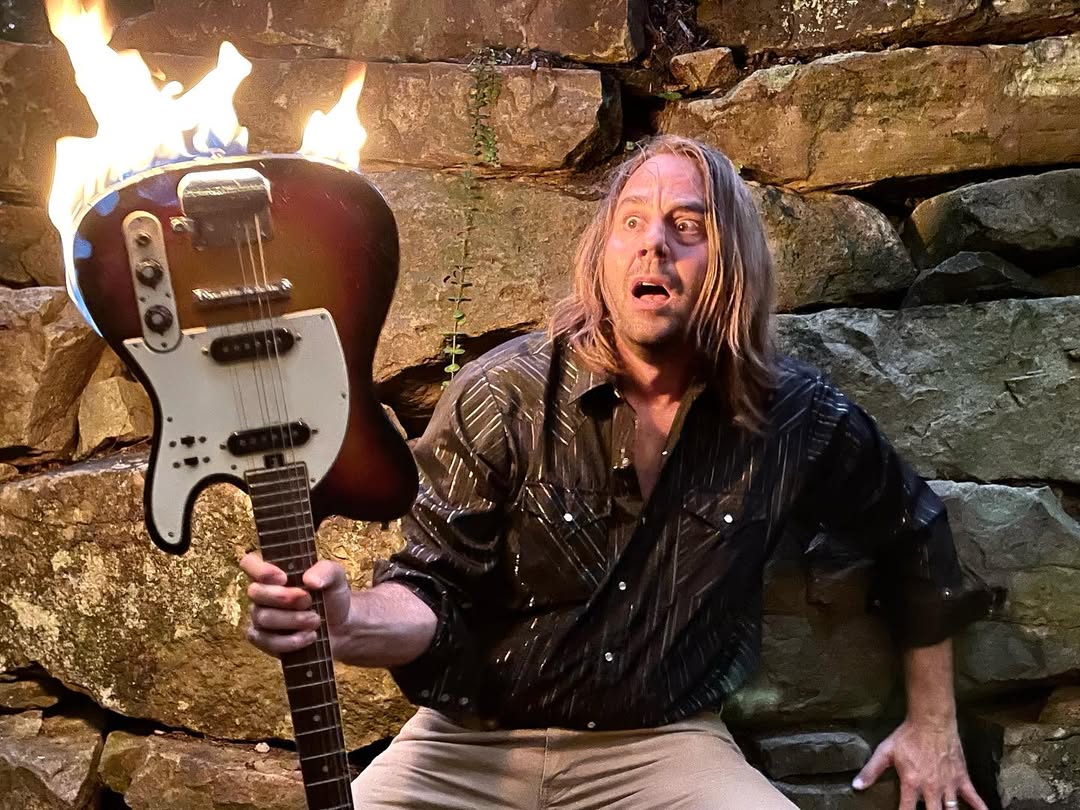
Ryan Anderson has been playing music for 30 years, but he’ll tell you he only figured out how to really be on stage in the last five. That kind of hard-won self-awareness runs through everything about Minorcan, the “basement arena rock” project Anderson has been steering (under various configurations) since 2010. Named for the Minorcan settlers of his native North Florida, the band has always been something of a one-man vision, even when there were other people in the room.
These days, it really is just Ryan, with a guitar, drum machine, and PA speaker in a basement. His latest album, Rock Alone, released in February 2025, reflects that stripped-down setup without ever sounding small. It’s a record about loneliness and community, domestic contentment and quiet defiance, and it’s earned some of the best reviews of his career — including the truly industrious Rosy Overdrive.
I caught up with Ryan ahead of his show at The Pinhook to talk about growing up in the Florida all-ages scene, getting involved in the Asheville scene, and why putting your phone in a drawer for an hour might be the most radical thing you can do right now.
What have you been listening to lately?
Ryan: Dish Pit Violet‘s self-titled album has been on repeat.
Who is the first musician you remember discovering on your own and obsessing over?
Ryan: I mean, probably Michael Jackson at age 5; that was my first concert. But a band I discovered completely on my own was Nirvana, just turning on the TV after school and seeing the “Smells Like Teen Spirit” video. And then, of course, Pearl Jam followed after that.
What first drew you to music and playing live?
Ryan: Nirvana led me to finding bands like fIREHOSE, Dinosaur Jr. When I heard stuff from the Chapel Hill scene — Merge Records, Superchunk, Polvo, all that — something clicked for me. I was like, “Oh, I need to actually do something with this guitar.” That’s kind of where it all started.
I realized this year would be my 30th year playing live. My first paying gig was with our band Atari Star — we played at a roller skating rink and got paid just enough to go to Rally’s Burgers afterwards.
What was the first instrument you were drawn to, and what was your early experience playing in bands?
Ryan: I had to play bass because everyone else wanted to play guitar. We also had this incredible drummer who had been playing since he was a kid. His dad had gotten him a huge double-bass drum kit, so he was the drummer everyone wanted. Nobody wanted to play bass, so that fell to me.
I still love playing bass and play it on all my recordings. But then, around ’95, when I was about 15, I got into Superchunk and that guitar-driven sound and thought, I’ve got to play guitar to express what I hear in my head.
Archers of Loaf was another one. I was obsessed with the way Eric Bachmann strung his guitar, with the high E on top. I was deep into all that Chapel Hill, North Carolina stuff.
It sounds like those bands weren’t just a sonic influence but also a visual and physical one. A way to watch how someone plays can send you down your own path.
Ryan: Absolutely. And I was really lucky. I grew up in North Florida, and we had this club in Jacksonville Beach called Einstein’s A-Go-Go. They just released an awesome book about it last year [Occupancy 250: Fans, Bands and Fried Chicken]. Nirvana and all kinds of people played there. It was a common tour stop because it was an all-ages club, so Superchunk and bands from North Carolina, or Atlanta acts like the Rock*A*Teens would come through.
A lot of times, they’d let teenage or high school bands open for those acts, so we got to play on the same stage and figure it out. We had a really good local scene in Jacksonville around that time, too. I feel lucky.
Those all-ages venues really do seem crucial for cultivating young musicians.
Ryan: If you were there, it didn’t matter whether there was a show or just a dance — that’s where you hung out on weekends. One of the weirdest, most awesome shows I ever saw was Mercury Rev on the See You on the Other Side tour. For a teenager who was into heavy guitar stuff, it was like, whoa, this is something else entirely. Really inspiring.

Bringing it to the present, what was the origin of Minorcan as a project? Was it always a solo outlet?
Ryan: I released some albums in the early 2000s under my own name, just solo recordings on cassette and four-track. My first album, Trains Take Away Old Friends, was released by a label in Iowa called Bi-Fi Records. Then, around 2008, I had a bunch of new songs, and my friend Patrick Fleming, who’s in Poison Control Center and ran Bi-Fi, offered to record these new songs in his basement. He said, “Why don’t you fly up, we’ll record all your new songs.”
I was about to have my first kid and had no idea when I’d be able to play music again. So I hopped on a plane to Iowa and we recorded these new songs directly to a tape machine with a bunch of Ames musicians. And after the songs were complete and I was listening to them, I realized it was time for a band name [the album titled, Keep at Hand].
I came up with Minorcan because Minorcans are people from the island of Menorca who were brought to Florida by the British to settle near and around New Smyrna Beach. Growing up in North Florida, there’s Minorcan history and signage everywhere. I was living in Austin, Texas at the time of these new recordings and wanted a band name that spoke to where I was from. So I started using Minorcan.
From there, it kept evolving. I had a great live band in Texas with musicians from The Channel and some members of Fishboy — picking and choosing people for live shows as needed. Then, around 2010, I moved to Asheville. My brother eventually moved here during a low period in my life when I had stopped playing music, and he basically said, “I’m just going to play drums,” even though he’s not a drummer. Eventually, we became this really tight three-piece with a friend on bass. We got to share the stage with Ex Hex, Mike Watt, Sheer Mag, Downtown Boys, and then we were set to open up for Archers of Loaf in the spring of 2020. Of course, that show didn’t happen, and the trio fell apart after COVID.
My brother eventually moved away, and I had to figure out how to keep going on my own. One day, I was in the basement with a little drum machine, playing through a PA speaker with an electric guitar, and I thought, this is really, really fun. I need to book a show. So that’s just where it’s been going.
And Rock Alone is your first full-length since that post-COVID shift?
Ryan: Exactly. It’s a bit like my first couple of albums when I was playing everything myself. I was really into Emitt Rhodes, East River Pipe, those one-man-band records with a full-band sound, always low budget, always recorded at home. I wanted to do that again. But now I have an electric guitar incorporated into the mix.
I just knew I had to keep doing this because it keeps me sane. And the challenge of, alright, let’s book a show and see if I can pull this off solo. I’ve played the Orange Peel and the Grey Eagle as a one-man band. That’s been pretty fun.
There’s a real underrated skill and courage to being a solo performer, especially managing a drum machine and additional instrumentation while playing guitar and singing.
Ryan: I’ve been playing for 30-something years, but I’ve only figured out how to really be on stage, maybe in the last five years. I’ve played so many bad shows and embarrassing solo acoustic sets. Even now, I still get nervous, still worry I’ll forget something. I remember one time in Austin, I played EMO’s, a fairly well-known venue at the time, and I honestly don’t remember a single thing I did. I’m pretty sure I didn’t sing the right words to any of the songs.
But that fear is also part of what makes it fun. You push yourself, you connect with people, and there’s something great about that moment when a crowd realizes you are not what they expected and begin connecting with what you are singing. That’s part of the challenge in Asheville, too. There are so many incredible musicians and bands here. So, I figure I would try something people aren’t usually expecting and give them a one-man show.

How has being in Asheville and playing in North Carolina compared to growing up in Florida or living in Austin?
Ryan: It’s been challenging. I moved to Asheville already in my 30s with a two-year-old, so just life itself was challenging, let alone trying to be a musician when the culture isn’t necessarily centered around that.
Asheville has taken a double hit, too: COVID and then the hurricane. It feels like everyone’s scattered. That said, there are great spots. Static Age Records in Asheville hosts shows most nights of the week. And venues like the Pinhook in Durham and the Cave in Chapel Hill — the Pinhook especially — has that same feel as the places I grew up going to. I’m playing there on March 14th, and I can’t wait.
Let’s talk about the connection with your mastering engineer — he’s based in Athens, Georgia, right?
Ryan: I’ve known Jason Nesmith for as long as I’ve been releasing music. He’s had some hand in everything I’ve put out. He plays in Casper & the Cookies and now with Pylon Reenactment Society. He’s always had a little home studio, and we actually recorded one album at his place [RED PAINT]. But now he’s the mastering engineer at Chase Park Transduction, a really nice studio in Athens.
I trust his ears more than anyone’s. He’s also the best guitar player I’ve ever seen live. When you’re listening to your own stuff constantly, your judgment starts to go, you can’t tell anymore if something sounds right. Handing it to Jason, I know it’s in good hands. He’s a significant figure in the Athens community, the whole Elephant Six world.
Your most recent record is now a little over a year old. How do you approach using music as social commentary?
Ryan: Earlier in my career, I’d lean toward protest songs, like making a direct statement about George W. Bush or whatever was happening. Now I try to turn things inward. So, for example, the isolation and loneliness that came with 2020, and missing having a band — those were real feelings. But I didn’t want to just stand up with an acoustic guitar and state how I feel. I wanted to find a story.
The story on this record is about admitting you’re lonely, sitting with that, finding a love for yourself in it, and then letting that spread outward. It’s a simplified version of the theme, but that’s the core.
Joy as a form of resistance is a theme that keeps coming up lately.
Ryan: I wrote a song during the pandemic for my wife after she said one day, “I just want to watch cat videos.” So I wrote “I’m Just Here for the Cat Videos”. I think what I was getting at is that we build these escapist spaces and then they get monetized. Instagram is a perfect example now; I post something, and nobody sees it.
But in a way, that made it easy to resist. The biggest act of resistance right now might be putting your phone in a drawer for an hour. I tell my kids that all the time. Nobody’s making money off your clicks for an hour. Pick up a guitar, pick up a pencil, and escape in a different way.
Who are some of your favorite local or North Carolina-based musicians right now?
Ryan: So many. Off the top of my head, there’s Little Champion, my friend Dustin. He may technically be in San Francisco now, but as far as I’m concerned, he still lives in Asheville.
I’m really excited to play with Lalitree Darnielle at the Pinhook show in Durham. I played with her in Chapel Hill last September, and she was already playing new songs that I could tell would be great. She has a really good band with cello and strings.
And Celestogramme, she’s from Winston-Salem. I played a show with her recently, and she’s been recording a new album in Athens, Georgia with some mutual friends. She says it’s hopefully coming out this year. I’m really excited about that one.
This interview has been edited for length and clarity.

Leave a Reply