
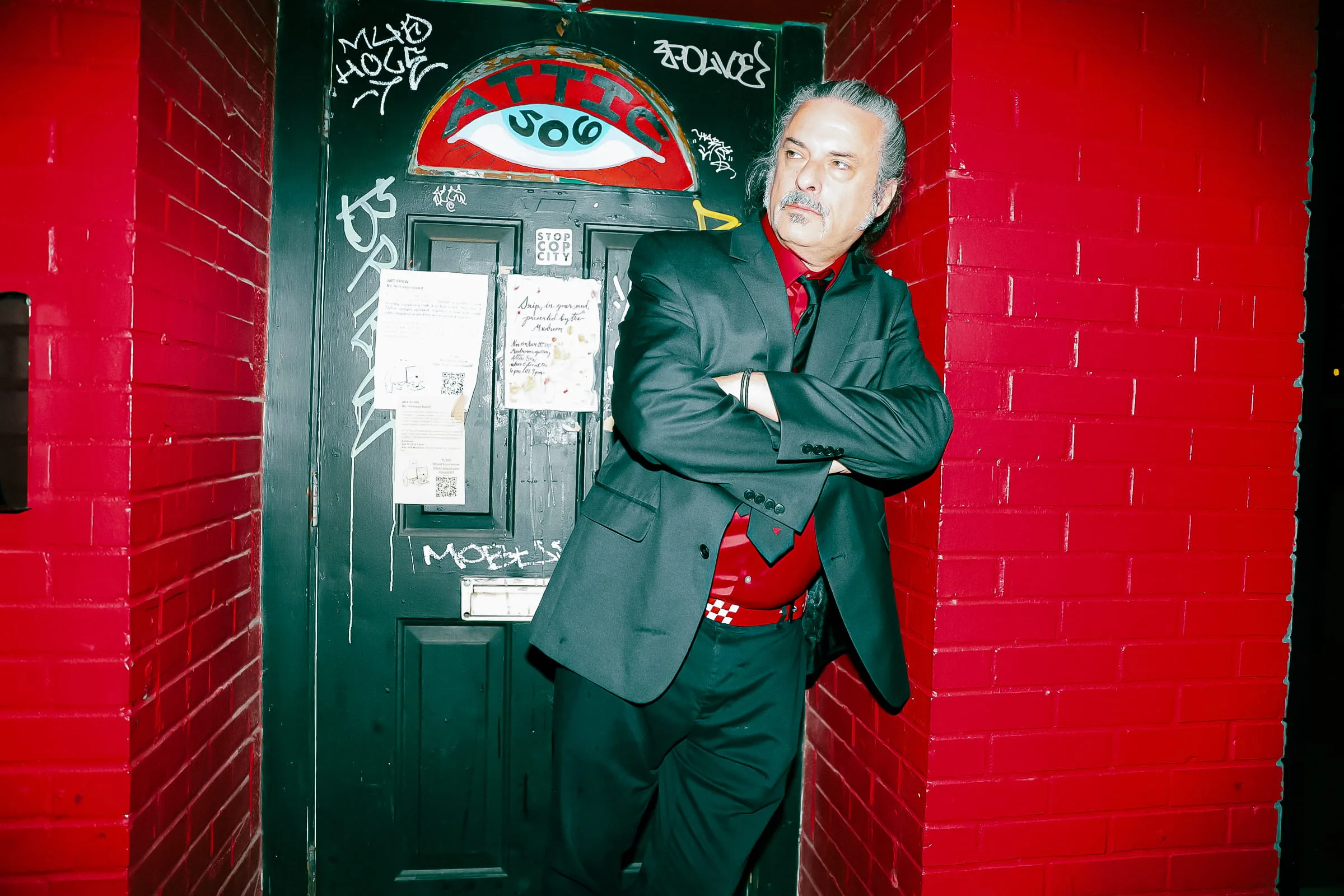
All photos credit: Emma Esser
The Cave in Chapel Hill is an iconic club to see bands. When the space and the artist share an energy, the performances become mind blowing. I was lucky to find myself in that space the first time I saw The King Teen. All the stars were aligned.
Since that first show, I have had the opportunity to hang out at a backyard fire and even play shows with The King Teen. It doesn’t take too long to see that he is smart, funny, talented, and 100% dedicated to making really good music.
The King Teen has a new EP out, True Stories of Time Travel, and will be playing at Rubies in Durham on March 20, 2026. I reviewed the new EP and wanted to get to know King more. Due to his schedule (and my own), we did the interview through a series of emails. At first, this made me a bit nervous, but King is a skilled writer and had fun answering my questions.
Where and when did you realize that you are a storyteller? Are there authors, artists, or other musicians that connected you to storytelling?
King: It’s funny because I don’t really think of myself as a storyteller. But I also just got a nice review in Add to Wantlist that says the songs are “proof that a good story beats a fancy trick.” So maybe there’s something to it.
I’ve spent 40 years or so as a journalist, a writer, editor, and podcaster, and I’ve also written or co-written a few screenplays — none of which got close to getting made, but I learned a lot doing them. I guess that’s where I got the feel for telling stories, or at least for trying to make it so that, as you’re listening or watching or reading, I’m giving you a reason to stick with it for the next few seconds, and the next few, and so on.
One thing I’ve always had a rule about, for myself and for any bands I was in where I was in a position to make rules: Once we start, every second is part of the show. So, for one thing, no dead air. I used to say to my bandmates: Pretend our show is being broadcast live on the radio. There should always be something happening that someone listening can enjoy. So if I need to tune my guitar, I tell a joke or something while I’m doing it.
You might get bored during my performance, but only because you find what I do boring. It won’t be because I’m not doing anything. I like musicians who are interesting between songs, not just during them. Lyle Lovett is about the best I’ve ever seen at that. He tells these long, rambling, hilarious stories in this deadpan manner, and it’s just as entertaining as his songs. I don’t think I’m that kind of storyteller. It’s more like “here’s some context for this next song” or “here’s a little joke I thought up.” I just try to keep things moving.
Where did the name come from?
King: Johnny Cash‘s ghost came to me in a dream in 1987. Johnny Cash wasn’t even dead yet, that’s how forward-thinking he was. He said, “Son, you’ve got to be The King Teen.” He also said, “Don’t mess around with that crypto bullshit,” which I didn’t understand at the time, but I’m glad I listened to that too.
Why come to Durham?
King: It was time to leave the Bay for various reasons, including that my wife was tired of living there and I like to hang around with her, which is easier to do when you live in the same city. She’d wanted to move to the Triangle for a long time. We have some family here, and it turned out I had kind of a lot of friends who had migrated here, so I thought, sure, I can tolerate that place. Turns out I really love it here.
What are your thoughts on the Durham/Triangle music scene?
King: It’s really lively. It has maybe a third as many people as the Bay Area, but there might be more artists and more places to play. You could just happily play a couple of nights a week at different open mics and go months without playing the same place twice.
That’s where I started, playing open mics. I still do, but now I mix in gigs. There are lots of little scenes, both geographically and in terms of musical style. I feel like I’m sort of flexible. I can play on a punk bill as a kind of weird old guy with punk energy, and I can also play singer-songwriter listening-room-type gigs. Then there’s a whole world of breweries where you play for a couple of hours. That’s not really for me, but I like that it’s out there as a possibility.
And there are so many great musicians. I feel like you can really see and feel the different influences in North Carolina music all the time. There’s the old Chapel Hill college rock era influence, along with shoegaze and other stuff that’s just out there and popular now, but there’s also mountain music and even beach shag influence. San Francisco is a city of migrants, so any show you walk into, you might find people from any musical or cultural influence worldwide. There’s some of that here too, but there’s also a regional feel that’s a lot stronger, and that’s new to me. I’ll be at a screamo punk show, watching the guitar player, and thinking, “I’ll bet she can play ‘Foggy Mountain Breakdown’.”

You seem like you have always been a part of the Durham scene. How did you navigate your way, as a musician, when you decided to start playing out?
King: I feel like I’m brand new here. I’ve been here for about two and a half years. Before we moved, I decided I was going to do a solo act, starting with playing open mics. It was something I’d thought about years before. I started out as a bass player in punk bands, and then I was playing acoustic bass guitar in a three-piece busking band.
At about the same time, the guitar player left and the singer/acoustic guitar player had to stop singing because of vocal polyps. I asked if he’d help me with my guitar playing because I wanted to do a solo act that was mostly music but with some comedy mixed in. He said he’d been planning to teach himself lead guitar, so why didn’t we form a duo — me singing and playing acoustic. So we did, and that became a full band and most of a decade of me being the singer-rhythm guitar player, but my guitar playing was never very good.
When the pandemic hit, I’d been “retired” from music for 20 years, and my version of sourdough baking or knitting was to pick up the guitar and teach myself fingerpicking. I failed at that, but in my frustration I’d just play — remembering my old songs and singing them — and after a while I found my guitar playing improving to the point of not being a joke. Still not great, mind you, but not some kind of performance art. So I thought I’d go to an open mic and see if anyone else thought so too. I played a couple and it went well, but I was still too busy with work, a kid still in the house, and some other family things going on to do much more than that. I decided I would get more serious about it after we moved.
I started playing at open mics right away. The first few were at breweries, and I eventually found my way to places like The Common Market in Durham, Yonder in Hillsborough, Steel String Brewery in Carrboro — which feels more like a café than a brewery — and The Cave in Chapel Hill. I started getting a few gigs here and there, and I joined the NC Songwriters Co-op, which among other things gave me a chance to play on various festival stages, including the Festival for the Eno. Getting gigs and getting people to come out to gigs is still the hardest part of this whole thing, but I love that when I walk into a joint, there’s a pretty good chance that at least a few of the amazing people I’ve met here in just two and a half years will be there.
After 2 years in Durham, have you felt a shift in your approach to songwriting or the content you are singing about?
King: I don’t think so. Maybe we need a literature professor or something to comb through my work and tease out themes and how they’ve evolved over time or whatever, but I don’t think they’re there. I’ve just always kind of made up songs as they hit me. What am I thinking about, what’s an interesting or funny phrase I just heard, what would be a fun thing to have a song about? The biggest difference in what I write about has less to do with moving to Durham two years ago than with the last time I was making up a lot of songs. Before this I was a young guy, so there was more hot babe and fast car content.
I do talk about my process for making up songs, among many other things, in my very entertaining, free, and not-too-frequent newsletter, The King Teen New Sledder, which all the fashionable sorts are signing up for this season.

You put together an amazing band to record with on the new EP, how did you end up with the musicians that played? Was it hard to take the songs you have written, practiced and performed live as a solo artist and to be able to record those songs with a full band?
King: It was three bands! And yes it was hard. The hard part was figuring out who to ask to play, and then working out everyone’s schedules. Once the people were in the room the actual arranging of the songs, building them out from my solo thing, wasn’t that hard. With one exception, which I’ll tell you about, it wasn’t that different from being in a band, having a song I came up with on my own, showing it to the others, and working it up into a full-band song.
One part of organizing it was easy. I asked Chicken Ranch Road Show if they’d play on the country song, “Stupid”, and three of them said yes. The two who didn’t were the rhythm section, and I can play bass and the guy I recorded with, James Phillips, is a drummer, so that worked out. I asked Paco Panhandle to play lap steel too. I sent him the song — the chorus goes “The problem is I’m stupid / I’m not the sharpest knife” and he said “King, this song speaks to me. I’m in.”
The rest was harder to wrangle. I had two rock ‘n’ roll songs, plus one, “The Ballad of Pnut & Salty”, that I liked when I played it solo — with a kazoo solo — but I wanted it to be a little more than that for the record. This was the one that wasn’t like anything I’d done with a band before. I knew the kazoo solo was standing in for horns, a trumpet and trombone, and as I was playing around with it at home I played piano and I liked it. But I wanted someone who, unlike me, knows how to play the piano to take my basic ideas and turn them into something more interesting. I saw that Lonnie Rott, who I know as a guitar player, was playing a gig only playing piano. He’s a great guitar player so I figured if he’s willing to play a whole gig on piano he knows what he’s doing so I asked him if he could play on my song and he said yes.
I knew Danny Grewen from meeting him a few times at the Cave, and he’d played with Em Gee at her record release show, which I played on. I asked him to play and asked if he knew a trumpet player. He hooked me up with Luis Rodriguez, who’s famous around here as a guitar player but I think trumpet’s his first instrument. Danny arranged the horns. Eric Sommer had played guitar on Us Ugly Guys Got Style so I asked him to play again. We all got together at the house of a friend of Eric’s to work up the song, and I didn’t know if we’d be able to do it in one night because I didn’t really know what I wanted, but it worked out. You get some good musicians together and it works out like that.
I had thought of it as me singing and I asked Mimi Kramer of Supermutt to sing harmony with me — she had done that on one song on the first EP, What Makes Life Worth It. But right before we recorded I found this video of Billy Bragg and Courtney Barnett singing a duet of The Velvet Underground‘s “Sunday Morning” and I loved it. They were singing in unison, not harmony, for most of it, and I wanted us to do that. Our voices are so different. Mimi’s voice is like the Mona Lisa, and mine is like the tomato soup some climate activists want to throw at the Mona Lisa. I don’t know if it works but there’s one person who I know loves it: Me.
The first and last songs, “Time Traveler’s Blues” and “Hard to Get Loaded”, are just basic rock’n’ roll songs. I just needed someone who could play some Chuck Berry kinda stuff. The Rattletraps had offered to help me record but the timing never worked out, so I asked Jimmie Ray Swagger & the Fussy Eaters if they could do it. Jimmie Ray agreed to play guitar and Pumpkin Spice, the bass player, also said yes. Flyin’ Crazy Dave of The Rattletraps agreed to play drums, so we had a nice little 4-piece rock’n’roll band, with me also playing guitar. Again, we got together once, worked up the two songs, and then recorded. Jimmie Ray said he didn’t think he was the kind of guitar player I needed and I said yeah you are, and he was.
The other song, “Luigi” — BANNED ON YOUTUBE! — was just me on guitar and James Phillips on piano. I played a little shaker thing too. Basically the same as singing it solo.

Where did you record the EP and how was the experience?
King: I recorded with James Phillips at his Mangum Street Grocery studio in Durham. He recorded my first EP too. He’s a musician himself — he’s in Bombadil. He has a great ear and he’s easy to work with and he plays a bunch of instruments and he’s a very nice guy. I’m planning to work with him again and at the risk of him getting booked up and me not being able to get in there with him, I’d recommend him to anyone.
Tell me about your music video for “Time Traveler’s Blues” — how did that come together?
King: It’s the first real, non-DIY video I’ve ever made. Before it’s always been me messing around with iMovie. This time I worked with someone who actually knows what he’s doing: Khalil Harrison. He and his crew were amazing. We shot it at the Flat Top Durham, a great house-show venue run by Colin Tart — who stars as the con artist who “sells” me a time machine. Two, actually, because I’m that dumb. At least in the video. If you watch it, see if you can spot the subtle nod to Back to the Future.
This interview has been edited for length and clarity.
Leave a Reply