
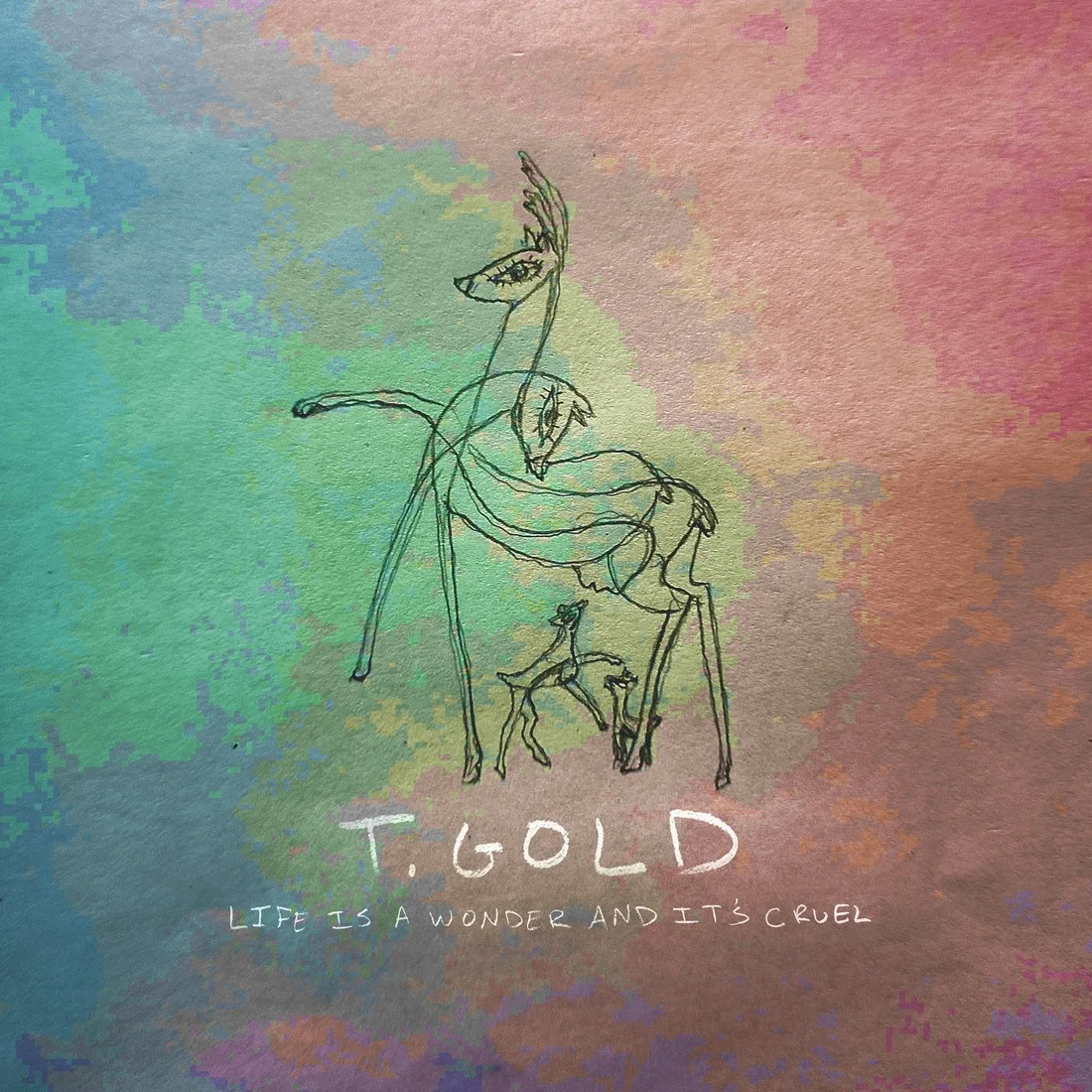
Genre(s): Alternative, folk, experimental
Location: Carrboro, NC
Label: Sleepy Cat Records
Released: January 23, 2026
“I’m a pessimist because of intelligence, but an optimist because of will.”
So wrote Italian Marxist philosopher Antonio Gramsci in his Prison Letters; a sentiment that Carrboro duo Saman Khoujinian and Gabriel Anderson describe as hitting them “like a freaking tidal wave.” It doubles as an encapsulation of Life is a Wonder and It’s Cruel, T. Gold‘s second album that investigates how imagination and radical community love can work against the grind of socioeconomic forces.
It’s a jangly, psychedelic folk-rock record wrapped in lush electronics, recorded in living rooms and lake houses with a revolving cast of collaborators who show up, contribute, and become part of the fabric. The more I’ve listened, the more it sounds like hope struggling against despair, and somehow winning.
Let’s back up a little. I first discovered T. Gold at Festival for the Eno in 2019 while working audio for the River Stage. Khoujinian’s voice makes an instant impression: it’s warm, human, drawing you in. The band’s self-titled debut became an immediate staple in my rotation. That record was rooted in acoustic folk, perfectly suited to a sunny afternoon by the river.
Six years later, after the pair spent considerable time running Sleepy Cat Records and supporting other artists through projects (like their synth-heavy collective Delver), T. Gold returns with an album that feels like a profound evolution. The acoustic guitar-led approach has given way to amplified, electronic textures that recall Bon Iver‘s progression from For Emma, Forever Ago‘s cabin intimacy to the layered production density of 22, A Million or i,i — except T. Gold has made that leap in a single bound.

At the heart of the record, Saman’s vocals and melodies remain an organic core wrapped in phenomenal production. The “radical community love” the band speaks of isn’t just philosophical posturing; it’s embedded in the album’s DNA. Their recording approach involved putting out calls for whoever wanted to come hang and play, working out songs based on who showed up that day. The result is a sonic cohesion that feels communal without sounding cluttered. Guest performances from Chessa Rich, Libby Rodenbough, Danny Abrams, Adam Schatz, and others don’t feel like cameos; they feel essential, as if these songs couldn’t exist any other way.
The album opens with “Getting to Know the End”, which balances electronic flourishes with organic instrumentation while exploring themes of endings and the unknown. Its abrupt conclusion — the literal result of running out of tape on a 4-track recorder — feels like a conceptual statement, a nod to our American comforts and the fear of what comes after we’re forced to give them up.
From there, the album shifts into “Jewel”, which is, without exaggeration, one of the catchiest songs I’ve heard in months. It kicks off with a groovy rock-and-roll vibe; Khoujinian’s effects-laden vocals bring Vampire Weekend‘s controlled experimentation to mind, while Chessa Rich‘s chorus harmonies and a stunning tenor sax break in the bridge elevate it to another level.
As the record progresses, the band is unflinching in how they flex their range. “Another Time” harks back to those self-titled vibes with its slower, alt-country vibe, while “Speak with Spirits” shifts into electronic soundscapes and field recordings that feel like a dreamy, guilt-ridden dialogue with ancestors. In the latter, Khoujinian croons one of the LP’s many subtle earworms: “They were shouting, ‘What did you do? Where did we go wrong? How did you get so far, being so dumb?’”
Another structurally simple yet devastatingly catchy song follows with “Assholes Only Take”. It’s a sub-three-minute psychedelic jangle-rock burst that plays with lyrical recontextualizing as it bounces between choruses. Saman sings of ideas and loves going by with time, while the adage of “Most assholes only take” remains unchanged. Yet another track eager to wind up on repeat if you’re not too careful.
The album’s political heart is most explicit on “New Land”, a bluegrassy jam with hearty grooves that explores Khoujinian’s early college years in North Carolina through the lens of his ethnicity and socioeconomic status. The poetic line of “False emancipators, killers of my young heart, looked me in the wallet and they sold me in college town” is a scathing rebuke. It’s an indictment of institutional promises that ring hollow for those on the margins and one of the album’s most lyrically potent moments.
“Gone All Night” offers perhaps the most self-titled-esque moment, a heartbreaking tale of love gone wrong: “Tell me what’s left to say / You’re gone all night and annoyed all day / Maybe late in the afternoon, we’ll pass but look the other way.” The aptly-named “Instrumental” proves it’s not a T. Gold record without a beautifully arranged instrumental track before “Spaceman” ventures into psychedelic territory that feels like the band channeling psychedelia a la Grateful Dead or Phish. “305 ‘Til I Die” follows as a more intimate reimagining of the band’s contribution to the Sleepy Cat Records Winter Mixtape from 2020. Khoujinian reflects on his Miami teen years in a way that feels like a Christmas song backed with references to The Casualties and Pitbull.
“Love is a Dice Roll” stands as the album’s most electronic moment, loaded with fluttering arpeggios and deep 808 grooves that showcase the Delver influence at its most pronounced. The album closes with “Wagoner’s Lad”, a traditional that Khoujinian and Anderson recorded together in a quiet room – an intimacy that radiates throughout the performance. Closing with a traditional also reframes everything that came before: this isn’t just about innovation, it’s about lineage, about taking what’s been handed down and making it speak to the present moment.
To that end, Life is a Wonder and It’s Cruel takes everything that made T. Gold‘s debut compelling and evolves in meaningful ways. The production — handled by Khoujinian, Anderson, Alex Bingham, and Joe MacPhail across multiple locations — is consistent despite the varied recording environments, ensuring listeners experience a sound that feels both expansive and intimate. There are moments that left my jaw on the floor, countless melodies that have nested in my head for days.
2026 may only be a few weeks old, but this is an album that has all but carved its name into our list of the year’s favorites.
Listen + Purchase

Leave a Reply