
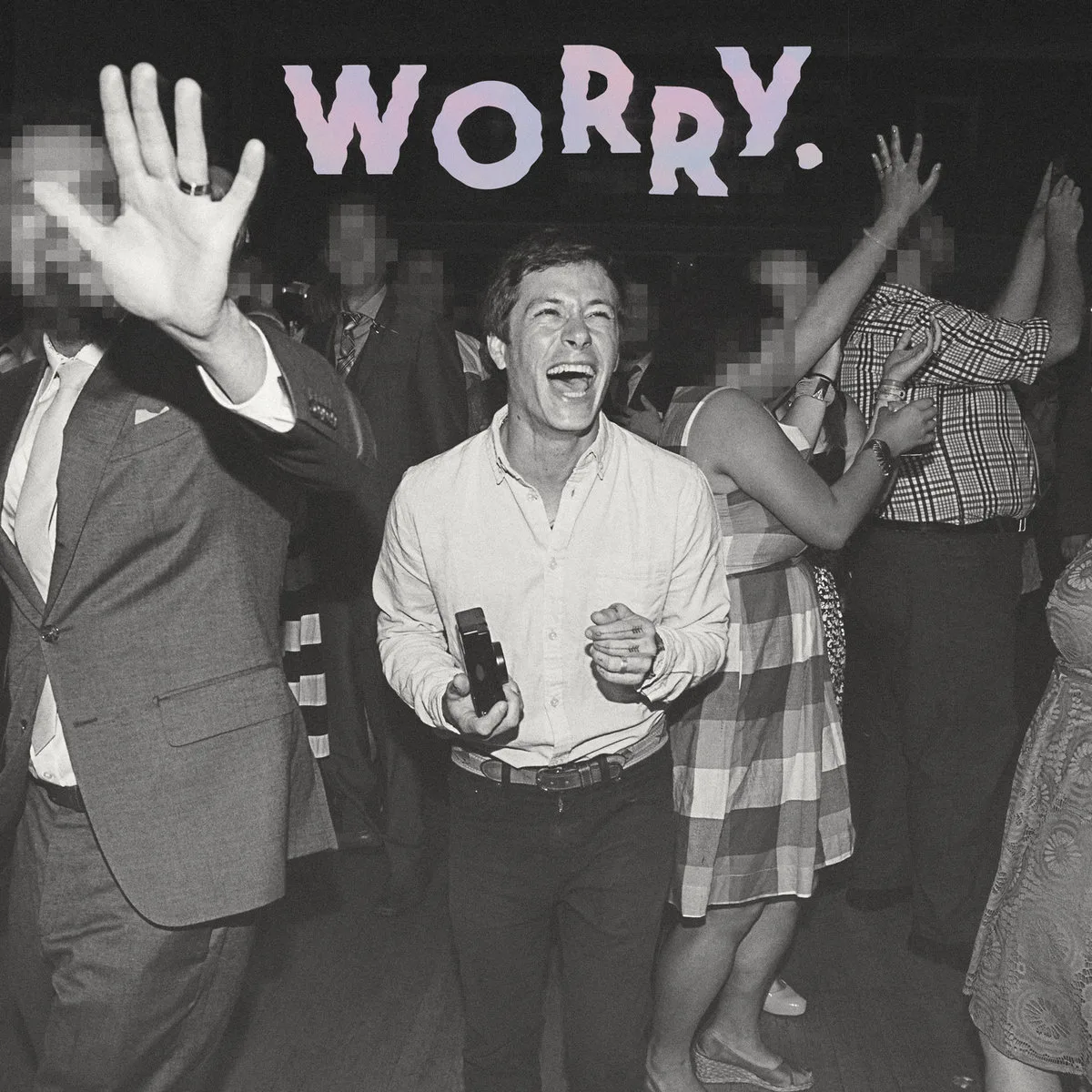
Genre(s): Punk rock, power pop
Label: SideOneDummy
Released: October 14, 2016
It feels weird that an album is such a core part of my identity. I say that as someone who runs a music website. Yet I still think one album shouldn’t carry that much weight. An artist, sure. A series of albums, a scene, that makes more sense. But just one album, not even an hour of music? It just seems absurd to me.
And yet, here we are, 10 years removed from the release of Jeff Rosenstock’s WORRY. – an album that has become a musical representation of the way I see the world, no matter how hyperbolic it sounds as I type it out.
It hits from its opening moments. On “We Begged 2 Explode”, Jeff sings, “Laura said to me, ‘this decade’s gonna be fucked.’” and cuts to the heart of that time in your life when friends settle down, pop out some kids, and start down the path toward happy retirement or bitter divorce. Fast forward to 2023 and “This decade’s gonna be fucked” topped my partner’s 30th birthday cake. It feels like an eternal mantra for being in your 30s, one that I couldn’t fully hear as a college grad in 2016. I was 22 then and hadn’t lived any of it yet.
Jeff recorded WORRY. in April and May of 2016 at a house in Stinson Beach, California, with producer Jack Shirley. It was his first album for SideOneDummy, which gave a bigger, more politically-charged audience to get real with. Just over a year after his 2015 “solo debut” We Cool?, Jeff put out this record packed with 17 songs across just over 37 minutes. Odds are if you ask a Jeff fan what their favorite record is, they would say WORRY. It’s not just great for fans, but it was easily the biggest critical success of his career.
Taken as a whole, the album is both an autobiography and a manifesto. It moves from very personal reflection to full-throated “fuck the cops, fuck billionaires, fuck gentrification,” but it isn’t just saying that outright. The message underneath is more complex, and it’s rooted in Jeff’s experiences living in Brooklyn when the writing was already on the wall. Development is coming in. Who stays, who goes, and who moves in?
Every city is grappling with that narrative, from here in Durham to Asheville, Charlotte, Raleigh, Wilmington, and more. Hell, anywhere people are moving to is dealing with it, and plenty of towns people are leaving are, too. How many places are seeing boxy, cookie-cutter apartments or townhomes go up where a cultural institution or a family farm used to be? Same with generic glass office buildings.
Like the Woman in White in N.K. Jemisin’s The City We Became, it’s a parasitic uniformity that strips cities of any uniqueness. Like today’s deservedly maligned AI “art,” it flattens the complexity of our world.
Overall, the record articulates those frustrations better than almost anything I know, in a deeply personal, self-referential way. “Staring Out the Window at Your Old Apartment” is a borderline sad song to a friend who moved out and hasn’t seen what’s been done to their place. Jeff has seen it through his window or when he walks by. He wonders what they’d think of the surfboard hanging where their records should be.
On the flip side, “Wave Goodnight to Me” is very cheery, which is part of the trick. Jeff nostalgically sings about drinking beer at the East River docks as cranes gradually rise and development creeps closer. As he puts it, “I should have been prepared; they spent the last five years yelling, ‘Come on, come on, get out of here.” It’s gentrification laid out year by year, chipping away at what makes a poor art scene unique and pushing everyone cool out.
“Festival Song” is the same fight on a different front. It’s an upbeat, anti-establishment power-pop bop, and much of it points out that what used to be cool art is being corporatized in an anti-art, exhausting way. The money behind music is now more private-equity than strictly corporate. The irony is that Jeff is big enough to play corporate-sponsored festivals and city skylines. He’s said the song isn’t about calling anybody a sellout; the farce is how normal it’s become. It’s also just a measure of popularity. If something is popular, it will be commodified. Just look at the pridewashing we’ve watched corporations engage in and then pull back from in Trump 2.0.
To me, the most nuanced song on the record is the one I struggled with most musically: “To Be a Ghost…” Jeff’s vocal melodies feel wrong. The more I listen, the more I think that’s the point. They reflect how wrong the lyrics are, building a discomfort that turns into anger by the end. As a result, the track becomes a core piece of the manifesto. “They,” the powers that be, “want you to be a ghost when they rob you of your hope.” They want you “born as a data point for targeted marketing” and be happy with it. They don’t expect anyone to listen until you “become a hashtag or a meme,” but even then, are people really listening? If you’re a hashtag, you’re a martyr. If you’re a meme, you’re a joke. In neither case do you have real power. You’re a brief blip of attention, meant to distract us from how badly we’re getting fucked.
The chorus holds out its big idea, that “we have power when they’re not expecting anything,” in a flat, dull, and slightly discordant delivery that honestly sounds amateurish the first time you hear it. Then the bridge hits with a “rush to my phone because I don’t want to feel alone,” and it starts building into something boiling under the surface.
You’re frozen with dread as their chatter becomes deafening
If you’re tired of being told
To stop complaining about the cold
Burn those fuckers in their homes
Burst their bubble and break their bones
Whatever you make of the language, it’s catharsis, not a plan. By the end, the song stops asking permission. It’s a reminder that we have power, and that “they can’t stop the things that they refuse to see.” We don’t deserve to be made to feel like ghosts, or like we’re only worth paying attention to if we’re a martyr or a joke.
Of course, I can’t gloss over the exhaustion of arguing with people “who love ignoring the reality, of unarmed civilians executed publicly.” We’ve watched it play out for years, and it’s only gotten louder under the current administration. Do you know anyone who has justified the death of an unarmed civilian, whether it was Philando Castile in 2016 or Renee Good in 2026? Yeah, me too.
That’s where the title hits. WORRY. came out weeks before the 2016 election and is a perfect example of someone seeing exactly where things were headed. It is inherently a political record, and you can’t escape that, because life is politics. Tearing down a cultural institution and replacing it with cookie-cutter apartments is a policy decision. The developers spent money to build as much as they could, but they couldn’t have done it without policy allowing it.
“The Fuzz” gets at the same thing from another side: specifically, the vulnerability you feel after being robbed and having to rely on cops who won’t help. Much of the album was written after the band’s gear was stolen on tour in 2015, so that vulnerability isn’t abstract. If anything, cops make you feel like you deserved it. They’re doing a job; sure, many of them are underpaid, but they’ll do the bare fucking minimum, with no energy to give a shit about you. The album understands that so much has been set up in advance for us working people to fail. We aren’t being flung into random chaos.
The second half is where WORRY. stops acting like a normal album. Starting with “Blast Damage Days,” it turns into a nine-song, roughly 15-minute medley where songs crash into each other before you can settle into one idea. “Rainbow” detours into ska punk before blasting through the hardcore punk of “Planet Luxury” in 30 seconds.
Jeff has cited London Calling as the inspiration for those short song structures, but to me it plays like anxiety in album form. There’s no time to sit with a thought before the next one shoves its way in, which is exactly what it feels like to live through everything the first half lays out. It’s also where the personal and the political stop pretending they’re separate. By the time “Perfect Sound Whatever” kicks in to close the album, you have so much to parse through that it’s almost instinct to play it again when it ends.
And yet, the lines that hit me hardest are the personal ones. “All these magic moments I’ve forgotten / will forget once the magic is gone” makes me cry as I get older. It feels like the thesis statement for the personal shit underneath all the real-world themes. My 20s were stressful. I wasn’t making enough money; at times I worked multiple jobs, and I was underpaid at my main job. It was exhausting. Sure, there was also plenty of opportunity to do fun things, and I cherish those memories. I’ve also forgotten a lot of memories because they were limited to the magical moment they existed in.
It’s hard for the magic to last when it’s weighed down by struggle. That’s not because I only think back on the bad times. As humans, we remember hard times as a survival mechanism: what did I learn here, how do I avoid this in the future? When you’re learning harsh economic lessons, straddling student loans, overpriced housing, and a job that underpays a college graduate to the point that you need a second one, you’re cognitively stretched. It’s easy for memories of strategic survival to overwrite the magic moments.
That’s why the record sits where it does in my identity. The more I’ve come back to it, the more it feels like a reflection on living through your 20s and looking at what feels like the cliff of your 30s, where everything’s going to change for the worse, and it was already hard. It’s also the angst of missing the simplicity of a friend living across the street before they moved away, and wanting to make out with your crush. As Jeff sings, “Our friends will disappear when they fall in love.” Being an adult means scheduling your time, planning trips, and having limited time with them. That was already on Jeff’s last record, We Cool?, especially in the song “You, in Weird Cities”: the sense of getting older, of friends moving away, of wondering if this is what I was hoping for. WORRY. adds the nuance of the powerful forces conspiring against us in what constantly feels like a losing battle.
This record is such a core part of who I am because its themes have resonated with me far more over time than they did when it first came out. They speak as much to an era of your life as to a time that culminated years of moments, and to the concern about where that would lead. Ten years later, we know. WORRY. was putting it lightly.

Leave a Reply