
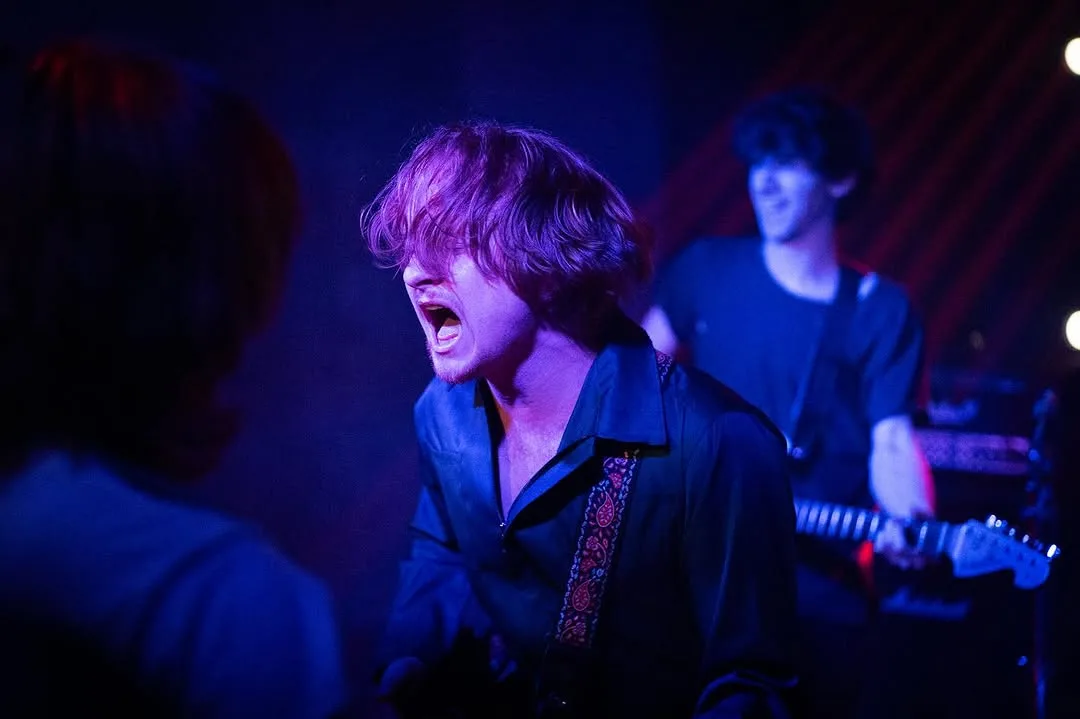
If there’s a prevailing theme that comes from talking to local musicians, it’s the stubborn persistence that keeps them creating in the face of, well, everything. For Ben McCoy, who makes dense, swirling noise-pop under the name Benz.Birdz.. that stubbornness emerges in the need to finish a song he started in college, book a show two hours away in Raleigh on a Tuesday night, or play every instrument on every record for ten years running.
Ben came to Charlotte via Charleston, South Carolina, and began building the project that would become Benz.Birdz., cycling through band names, bandmates, and completely different sounds to explore. What became a core part of the process was his belief that a song’s emotional weight matters more than its genre. That work ethic honed in the kind of isolation that the post-COVID years made inescapable for so many emerging artists.
Now, with a run of singles on the way and a full-length record that he describes as the culmination of everything he’s gone through in the last decade, he’s at an inflection point. The solo DIY ethos that carried him this far is starting to give way to something more collaborative: a development conversation here, a show spreadsheet work there. All while venturing beyond Charlotte and into the wider NC music community.
What have you been listening to lately?
Ben: Lately, I’ve been listening to Nujabes. He’s fantastic. If you’re an anime fan, you might know that he composed the soundtrack for Samurai Champloo. That’s where I’m at right now.
I’m also listening to Origami Angel. They’re great, a lot of power out of two people. You can get a lot done with just really good musicianship.
Who was the first artist or band you distinctly remember discovering, or having someone bring into your world, where you thought, “This is my favorite band”?
Ben: Honestly, it was AC/DC and their Back in Black record. I was taking Taekwondo as a kid, and as part of the test for my second rank, I had to create a movement routine that I could perform to music. My dad was a DJ in the seventies and eighties, and he said, “Buddy, I’ve got the perfect record.”
I’d been playing music since I was four, taking piano lessons, but I didn’t really care about it at the time. I wanted to be in the NBA, then I wanted to be an astronaut, then I wanted to do crime scene investigation work. I’m not smart or tall enough for any of those things, so I was just trying to figure out what to do at twelve.
My dad played that record, and I’d never heard a guitar played like that. Everything was so bouncy, and the energy was perfect for going for a black belt test. It was the perfect alignment. Give me a guitar, let me do this. And it just snowballed from there.
After that, I started reading biographies at the public library. I’m a child of the public library; support your libraries, they gave me everything. Through that, I got into the first Guns N’ Roses record, found Sonic Youth, and found John Coltrane. They literally give you everything, and you pay for it with your taxes. Go get a library card. The best life lessons I got were in biographies of artists I enjoyed; just nuggets of wisdom everywhere, especially what not to do in some cases.
What was that jump like into really committing to music once you had the guitar in your hands?
Ben: I’d been playing already. In piano class, I was taught the classical stuff, and I thought it was cool, but I started getting into jazz piano. It started with Vince Guaraldi and the Peanuts soundtrack, which is just a great piece of music. Then I heard Herbie Hancock, bits of John Coltrane, Miles Davis, and I was like, “How does music sound like this? I want to learn this.”
I’ve always been playing with instruments. My toy box was full of that kind of stuff. But when I heard the guitar, that was the one instrument I didn’t have. I told my dad, “This is the real deal. Help me get a guitar.” And he went way above and beyond. He didn’t invest in a crappy little Squier; he got me a good one, like a $500 guitar and an amp. It was basically him saying, “You’ve got a year to figure this out. Go for it.” And it’s been that way ever since.
Did you end up joining bands in high school?
Ben: I grew up in Charleston, South Carolina. At the time I was in high school, there wasn’t really much of a local scene. Charleston has a great music scene now, but back then, there were just smatterings of things. The claim to fame from Charleston is Hootie and the Blowfish. Once Band of Horses set up in town, things started coalescing, but that was right around when I was in high school, and it hadn’t quite caught on yet.
I was listening to Manchester Orchestra, Surf Curse, things like that. But I couldn’t find anyone in Charleston who was into the same stuff I was. If you were in music there, you either wanted to be Jimmy Buffett, Bob Marley, or Sublime. I was more on the Sublime and Bob Marley end of things.
I got my start doing songwriter-in-the-round shows, sitting on stage with two or three other people, all of them much older, just singing songs about their lives. And here I am, this sixteen-year-old kid trying to write songs that can capture an audience. Writing about a life I’m currently living — which ain’t much at that point — or imagining a life and getting real-time feedback on what’s working and what’s not. I loved the challenge of it. I’d even write a song between sets just to push myself.
There was a guy who put on those shows and had recently moved from Nashville. He’d been working as a staff songwriter for years, had done stuff with the Avett Brothers, Garth Brooks, a bunch of big names in country music, but was done with it and had moved down to Charleston. He was very encouraging and gave me some really good insights on how to move forward in music. Even though I’ve gone on to play much louder music in the emo and indie circuit here in North Carolina, I still see myself as a songwriter first and foremost because of that experience.

Image credit: @zacharysbrogna
At what point did you start to venture into the emo and alternative direction, or was it always there?
Ben: It’s always been there. In high school, I was getting into Fall Out Boy’s early stuff. They did their comeback when I was in high school, and at first I was like, “Oh, cool.” Then I heard the earlier catalog, and I was like, “Never mind, this is it.” That kind of hard-edged, groovy pop punk. I was also really big into Asking Alexandria, the whole metalcore scene — A Day to Remember was a big one, same with early Bring Me the Horizon.
But I was also getting into Frank Ocean when Channel Orange dropped, and that hit the same nerve for me in a totally different way. It’s just extremely raw, vulnerable, emotional music, but in the opposite dynamic range. Emo and indie are melodramatic, loud, and ostentatious. Frank is not that; he’s understated, aching, longing. That gave me an interesting dichotomy, but there’s such an overlap. It’s all about expressing yourself. Music has always been cathartic for me, an exercise in expression.
I wish I could write more detached pop songs, because those things pay very well if you can get a number one. I’d love to do it as a day job. But when I’m left to my own devices, it’s very much heart on my sleeve. That sound, combined with how much I love playing guitar, just makes sense for me.
What was the catalyst that kicked off the Benz.Birdz project in particular?
Ben: It’s kind of a big continuation of those early songwriting shows. I was fifteen going by Making Waves at that time. Then I got to college where I met my current bandmates and my fiancée, soon to be wife in a couple of months. I’d been going by my name, Ben McCoy and the Morning After, and it was a revolving door of musicians.
As I went on and started finding my sound a little more in college — mixing in some bedroom production, getting kind of freaky with the electronic side, adding textures — it didn’t feel right to just go by my name anymore. And pen names have always been a cool thing for me. It gives you an excuse to be a character a little more and detach yourself from what you do. I need that, especially as I get older.
There’s a certain amount of detachment I have to have from the successes and failures in music because I’m a sensitive little guy. I take these things very personally, and I’ve learned you have to just let it go to some degree. All you can do is make the best songs you can, create great moments for the people in the room, and, hopefully, they fall in love with it too.
So really, the project freed me up to play more with sound. Not just as a writer anymore, but as a producer, an arranger, a musician, just playing with texture. I’ve been doing it ever since.
At this point in the project, you’re working toward a full front-to-back record. What’s been the behind-the-scenes process of pulling that together?
Ben: It’s been going kind of alongside every other song I’ve written and released. Looking back, the whole project took all of my twenties to write. There are songs I began in college that I’m only finishing now. I was very frustrated for an entire decade: “Why couldn’t I get this thing to work, and why couldn’t I give it up yet?”
And now I’m getting to the point where I understand that I didn’t have the life experience to say what you needed to say yet. You had the idea, you had the angle, but you didn’t go through it enough. You didn’t sit with it enough. That’s the only way it can happen. You have to live a little bit longer.
As more and more things piled up, I just tried to get into the habit of making songs and finishing them. Certain ones stuck out to me that carried a theme and an overall story that very much mirrored a lot of what I’ve gone through throughout the last decade: struggling through an increasingly crueler, meaner world, feeling isolated in a much more isolating world, and trying to find purpose in working through all of that. Trying to find a reason to get up and choose to love yourself when the opposite is being communicated to you almost every day through no fault of your own.
I know I’m certainly not the only one who feels that way. Post-COVID, I think everybody had similar reactions in many ways. It was a weird, perverse moment of unity, and we’re still reeling from it. I see it in a lot of my students. Some of them missed out on the formative years of socialization and are still trying to make up for it.
I was in a pretty well-functioning band. We were going to go on tour after I graduated college, and then COVID broke us up. I didn’t have a real graduation, then I had to find a job in a market that didn’t exist and start paying back student loans with money I didn’t have. The message was “We don’t care about you.” And the journey of my twenties has been trying to find my piece of the world and learning to care about myself in spite of everything.
If all you’ve got is yourself, you keep going until you find the community that also has you, which I’ve been fortunate enough to live long enough to find.

Image credit: @zacharysbrogna
How has playing live shaped the project? And how has the Charlotte community factored into that?
Ben: For the last year or two, I’ve been trying to branch out and play around the area because I’ve loved playing in the Charlotte community. It’s been really cool. I love the Milestone, Snug Harbor, and everyone who works out there. But in 2023, I think that was the only place I played, so I’ve been trying to dip out more and more.
I’ve been refining that process because even the two-hour drive to Raleigh, as a working man, is time off work, with prices inflating. It’s an expense for local artists to be doing live shows now, which really sucks, because it’s such a great place to build community. I hope everybody goes to a show, pays for the ticket, buy the t-shirt of their favorite local artist.
We play live music because we genuinely enjoy giving an experience to everyone in that room. I try to think of it as a gift, which helps me get out of my own way and do a better job. I teach my vocal students all the time: the number one thing to be a good singer is you can’t be self-conscious. To do this is an act of generosity to everyone in the room. You’re a glorified waiter. You’re in the service industry to a degree as a performing artist.
That’s been the transition for me, going from just a songwriter writing for myself into a performing working artist, where it’s beginning to change how I write. I’m starting to write for others also, not at the expense of myself, but in collaboration with the public, with the people who latch onto what I’m doing.
Who are some local Charlotte or North Carolina musicians you feel deserve more love?
Ben: The number one that comes to mind is Between Two Trees. I love them. They were one of the first bands I played with when we were really hitting it in Charlotte. Gabe is the total package to me. The songs are gut-wrenching, and then going the extra mile with the visuals? Unreal. I’m such a fan. I want more music from them, ASAP. Moving Boxes are fantastic. INFINXTY is really cool; they make my high school heart sing.
I’ve been very fortunate to back Lacy Dooms up on guitar and drums a couple of times. They’re doing very glittery, girly pop punk, kind of Paramore, but with something a little extra, which is really cool. They’ve honestly inspired me a lot with their work ethic, too. Joey and Danny, the leaders of that band, taught me how to do a show spreadsheet just by watching them work. Consummate professionals, those two. They’ve really inspired me to up my game on the business side.
How does the business side of your music factor in for you right now?
Ben: Like I said, I’m about to get married, I would love to have children one day, and I’m not good at day jobs. I’m not good at jobs that don’t play to my strengths. My strengths are being a really good talker, daydreaming, and being a collaborative person. If I can do that in music, I will be very, very happy.
I’ve taken this project to the limits of what I can do alone. It’s all my brainchild. I’m playing all the instruments on every record, doing all the mixing, mastering, marketing, booking, all of it. The real DIY thing. And after ten years, I’ve hit the limit of what I can do alone. Once I kind of accepted that and just sent it out to the universe, it’s really cool what’s happened. I’ve finally been in talks with an A&R guy who found me and said, “Hey man, I really dig what you’re doing, let’s work together and figure out this development thing.”
This interview has been edited for length and clarity.

Leave a Reply