
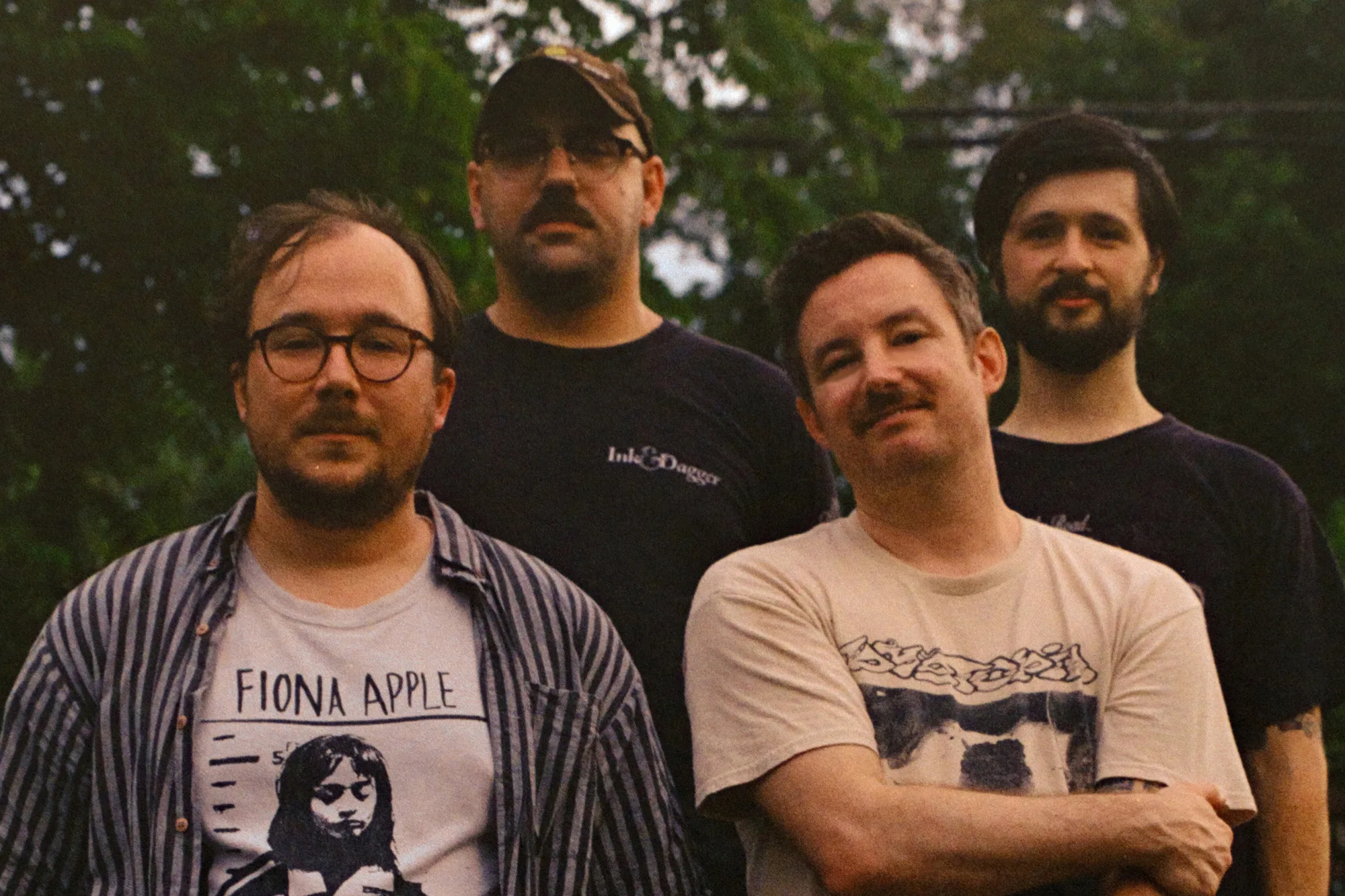
The most active musicians recycle its best musicians. Charlotte isn’t any different. Take the quartet of Josh Robbins, Garrett Herzfeld, Rusty Colton, and Michael Rice: they have spent years trading places across the city’s bands, from Late Bloomer and Petrov to Pretty Baby and Cabrón.
With a track record like that, a new project from the four of them never arrived unannounced, but it still came out heavier than their résumés suggest. Bible Belt calls itself “metalcore-ish,” and the “ish” matters: Deadguy and Jesus Lizard bleed into the writing, and the band has no interest in getting precious about what a hardcore band is supposed to do.
Early on, they landed a bill with NC hardcore legends Catharsis. On September 18, they released Demo 2026, a four-song tape recorded with Pretty Baby’s Ryan Halberg and mastered by Will Killingsworth at Dead Air Studios. Sitting down with Garrett and Josh gave glimpses into why musicians already stretched across two bands each said yes to a third, and what Charlotte’s scene looks like to people who’ve been watching it for 15 years.
What have you been listening to lately? New stuff or longtime favorites?
Josh (bass): I’m bad about keeping up with new stuff, but I checked out the new Dinosaur Jr. record a few times. I’ve also been on a Neurosis kick since I saw them in Asheville last weekend. That’s less “rediscovering” and more just a reminder, since I’m pretty much always listening to them anyway.
Garrett (drums): I’ve been deep in electro lately. Found an artist named Ninajirachi, I think she’s Australian, Gen-Z electro techno stuff. Also Overmono. And Mike put me onto a jazz project called SML. Plus the new Horse Lords album too, this avant-garde instrumental jazz rock thing with long repeating parts.
Going back further: who was the first artist you remember discovering and claiming as your own, fully obsessed?
Garrett: System of a Down. Not embarrassed about it anymore. Nu metal in middle school, spiking my hair, the whole seventh-grade personality package.
Josh: For me, it was NOFX, the first thing that felt like mine, not just what my parents or step-siblings were playing. I grew up pretty religious, so there was a lot of Christian music in the house, some of which was slightly cooler than the rest, like Audio Adrenaline. But NOFX was the first time it felt like I was in on something taboo. So Long and Thanks for All the Shoes is probably my favorite record of theirs, and there’s a song called “Murder the Government” that landed hard on a seventh grader who’d just decided he hated the government.
Garrett: System of a Down was doing something similar around the same time, dropping incarceration stats on me. Same idea, different outfit.
Before we get into Bible Belt specifically, can you give some backstory on your other projects and what brought you here?
Garrett: We’ve all crossed paths in some combination for a long time. Me and Mike were in a band together years ago; Josh and I were too. Everyone’s connected somehow through Charlotte. I’m 37, so this goes back to age 18 in high school. Mostly indie rock until I came to heavy music later than the other guys, and I’m still pretty surface-level on the history of it, but I’ve been in a couple of heavier bands with Mike, our vocalist, and that’s where I actually learned to write parts that fit. It’s mostly making it up as I go and retroactively learning about the bands people say we sound like. So far it’s worked.
Josh: I’ve been in bands since 17 or 18. The first one didn’t even have songs. It was called Momma’s Fault, basically an improvised joke band, one show and done. The same guys started a real band a year later, a metalcore band, though people’s definition of metalcore has shifted a lot since then. That’s actually the closest thing I’d played to what we’re doing now in Bible Belt.
After I moved to Charlotte, I played in a fast punk band that turned into something more hardcore called Obstruction, then a more melodic hardcore band called Meth Mountain. From there I branched out: an alt-country band called Pullman Strike, then Late Bloomer, which I’m still in more than ten years later, then Alright, which Garrett was also in. There have probably been other projects I’m blanking on, and a record label I still run. So when Bible Belt needed a bass player, it was really their idea. They bullied me into it.

Image credit: Zack Allen
What made this the moment to actually start the project, especially since heavy music isn’t your default lane, Garrett?
Garrett: For me, it comes down to Mike. The real start was at Snug Harbor, one of my favorite local venues, when a friend named Eric was kind of joking how he had come up with a cool band name: Bible Belt. We latched onto it immediately. I’d already been in two bands with Mike, Richard Parker and Cabrón, and his vocals are incredible.
It’d been eight or so years since Cabrón, so even if the name started as a joke, I wasn’t turning down the chance to sing with him again. His lyrics are genuinely really good too. I was already in two bands and didn’t need a third, but Mike being in it alone made it worth it. Add in that Rusty, our guitar player, comes up with riffs on the spot like it’s nothing, and there was no version of this where I said no.
Josh: Alright was slowing down, and I spent most of my free time on video games instead of writing for Late Bloomer or Alright. They asked me a few times and at first I wasn’t sure I had the bandwidth, since I didn’t want to be in three bands. It just took a while to line up schedules around everyone’s other projects. But it was refreshing to be the bass player without being the “band dad.”
In Late Bloomer, I sing and play bass, so it was a chance to show up with minimal responsibility. It had also been a long time since I played heavy music, and I’d always wanted to get back to it. Mostly it came down to finding the right people, and these were the right people. Even after Garrett left Alright, we’d bring him in as a fill-in. Mike and Rusty are people I’d wanted to do a project with for a long time. I’m pretty selective about time commitments, so that says something about how excited I was for this one.
Every band has a “band dad,” the one keeping things on track. Does that same dynamic carry into the songwriting, or did one or two people take the lead there?
Garrett: The band dad role is split about as evenly as it’s ever been in my other bands. Songwriting on this one has been a little different, though it’s still pretty normal at the base level: someone brings a guitar riff, we jam on it. Josh has brought in bass riffs we’ve built entire songs around. I don’t know that I’ve ever shown up with a beat that became the foundation the same way, but what feels different is how collaborative it gets once an idea is on the table. I’m just the drummer, but they actually listen. If I say, “What if we did this here and went into this part instead?” everyone runs with it.
Josh: Garrett’s a very hands-on drummer. Some drummers just play the obvious thing and move on. Garrett’s crafting the song with us, down to the parts and how many times we repeat something. Probably too insistently sometimes.
Garrett: Annoyingly so.
Josh: But all four of us bring ideas and put our own stamp on it. It’s genuinely collaborative. Lately Rusty’s been bringing a lot of the initial ideas, and we’ll take something we’d thrown out earlier and tack it onto a new part.
Mike works the same way with vocals, even though some singers treat writing and learning the part as separate steps: write it first, learn it later. Mike stays engaged the whole time, sitting there listening and thinking. He’ll sometimes get on the drums himself, or describe something with his mouth that ends up being exactly the part we needed. I love when an idea starts with someone who isn’t even playing that instrument.
I have a rule from my other band: don’t shoot an idea down too fast. Sometimes you don’t know if something’s worth pursuing until more of the pieces are in place. We actually had a song in our set for a long time that we eventually cut because it wasn’t up to snuff, but we saw the idea all the way through first. I like that approach, because sometimes a song clicks once the vocals lock in and you get a new appreciation for it you didn’t expect. We say “humor me” a lot in this band, and we actually humor each other, which I think is healthy.
Some bands get too precious, too early, about what they think their sound is supposed to be. That always feels a little silly for a new band. The best bands usually change how they sound as they go instead of locking in. Neurosis is a good example, so is Self Defense Family: they start as one thing and end up somewhere else entirely. That’s not true of every band, and a lot of great hardcore stays in its lane on purpose. But even within a lane, the question is how you push the edges without losing the thing that made it work in the first place, in a way that still serves what the four of you are trying to do.

Image credit: flashed_by_tuna
You mentioned in your outreach that you played a show with Catharsis, a band with serious history in NC hardcore. What did that mean to you, especially this early in the project?
Garrett: We’re lucky to have friends who’d put us on a bill like that. Even for our first show, a benefit, we didn’t have much of a case to be on that bill either, since nobody knew what we sounded like yet. With Catharsis, the second we heard about the show, it was: whatever else is happening that date, we’re making sure we can play it.
Josh: I try to stay appreciative without overcorrecting into false humility. There’s a balance. If you get written up in a small publication and think, “eh, it’s just a small thing,” there are people out there who’d consider that a huge win. You have to keep reminding yourself of that. In one of my other bands we played the Fillmore, then three weeks later played a much smaller room that doesn’t even exist anymore. Things cycle back around in ways you don’t expect. I’ve been playing shows for more than 15 years now, and it’d be easy to start feeling entitled to certain opportunities. I try not to. I’m grateful friends see the work and think of us, and I try to stay humble about it.
Any North Carolina artists you want to shout out?
Josh: Pretty Baby, Rusty’s other band, is genuinely one of my favorite local acts right now. Their new record this year deserves people’s attention. They’ve been a band for a while, but there’s been a real rebirth: it started as a solo project and has grown into something with Americana leanings, at times almost Jason Molina, before shifting more toward post-hardcore.
It’s a good reminder that a band can just keep growing into whatever it wants to be. Even with our own songwriting in Bible Belt, one part might land closer to Deadguy and another closer to Jesus Lizard, and you just follow whatever feels natural. Once you put a guy screaming over the top of it, it’s going to read as a hardcore band regardless. So there’s no reason to get precious about what a hardcore band is supposed to sound like.
Patois Counselors are another one, also just a really good band made up of good people. Honestly, we could do this whole segment just by naming the other bands we’re all in: Mindvac and Petrov, which Garrett’s in, and through the Petrov tree you get bands like Cave Shine and a bunch of newer bands, some led by people young enough that they’re barely on our radar but already drawing bigger crowds than us.
Charlotte’s punk scene in particular is doing really well right now, to the point where those bands don’t even need us shouting them out. What I appreciate about Charlotte is that if you don’t get too tied to one genre, there’s a huge range of bands doing genuinely different things. People move here expecting a specific scene, like youth crew hardcore or “the next Patois Counselors,” and the answer is usually: we already have that band, we don’t need another one. There’s room for a lot of different, interesting things, and that’s what makes it good.
That kind of range seems core to the broader NC scene too.
Josh: Definitely. You can draw a line through Asheville, Charlotte, Winston-Salem, Greensboro, Durham, Chapel Hill, down to Wilmington, a genuinely strong run of cities to tour through in-state or play outside your hometown. Good venues across all of them, and enough exposure to different scenes that it pushes you to stand out rather than repeat what’s already been done.
Take Asheville: Serrate is a great example of a band doing something in our lane, though I’m not sure how active they’ll stay now that their guitarist lives in Connecticut. If they keep going, that’s a band we’d play well with. There’s no shortage of bands working in this style, but they all sound different, which is the fun part. We don’t sound directly like the band we played with alongside Catharsis—
Garrett: Overturn.
Josh: Right, Overturn. They’re pulling from a lot of the same reference points as us but landing somewhere completely different. We showed up in basically the same t-shirts, so the shared taste is obvious, but it’s interesting to hear how two bands can both be listening to Converge, Botch, Shai Hulud, and come out the other side with different music entirely.
Let’s close with the demo. Walk me through it.
Garrett: The demo came out September 18th. It’s four songs, available as a tape, a tape-and-shirt bundle, and streaming. We recorded it with Ryan Halberg, a friend who plays in Pretty Baby and does a lot of great recording work on the side, and it was mastered by Will Killingsworth at Dead Air Studios. It’s available now on Bandcamp and streaming, and we’re excited about it.
This interview has been edited for length and clarity.

Leave a Reply