
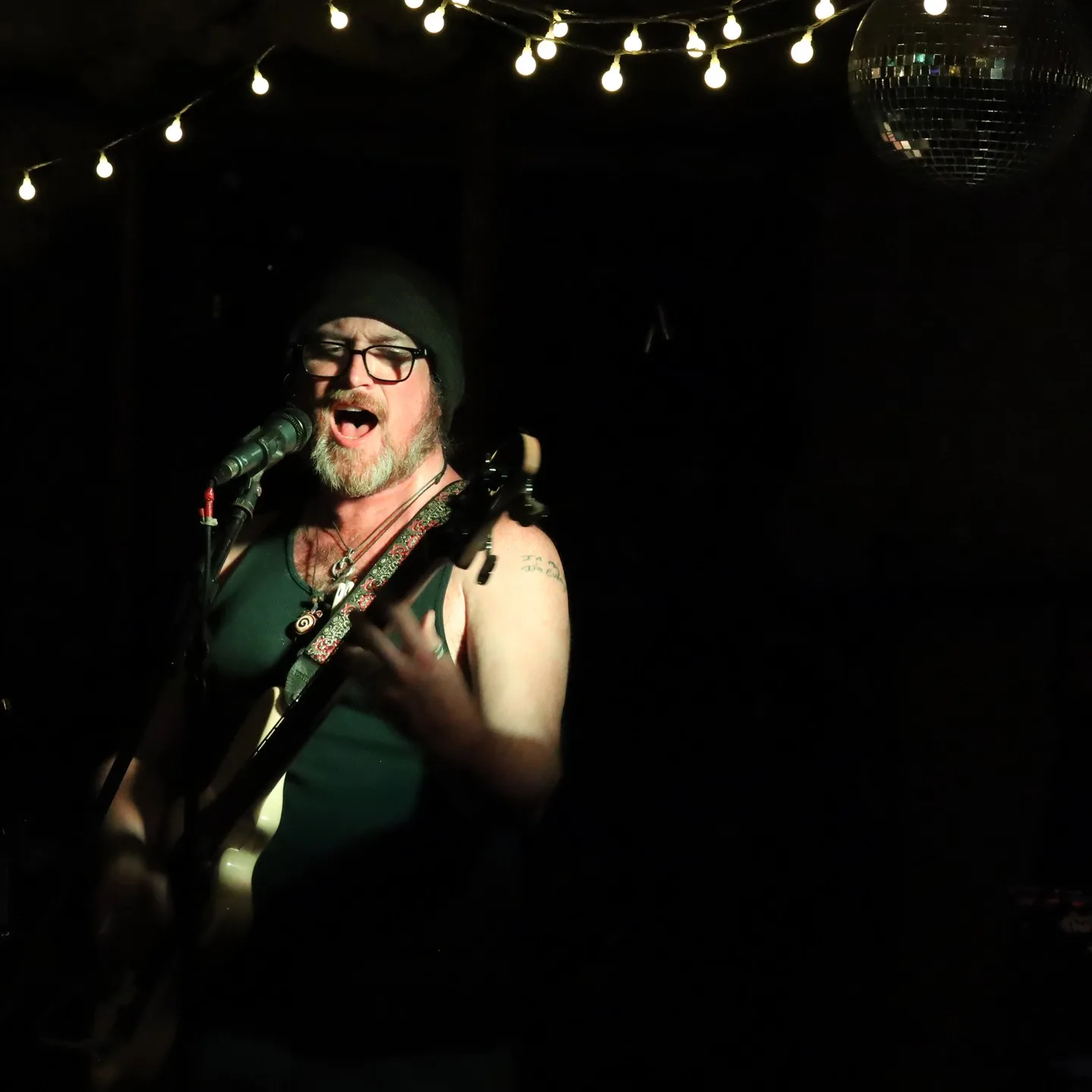
Header photo credit: Dex Madden
Getting tagged with a wacky genre fusion label like “jazz-grunge” has got to be a sign of doing something boldly creative. Steve Burham (aka Burns) certainly didn’t set out to be that, but he and his band have been running with it ever since.
After listening to the band and digging into how the project came to be, it fits their tendencies for improvisation and borrowed instruments. What started as a bass-driven solo project has evolved into grungy fuzz pedals stacked against extended jazz harmonies. Bass still drives the songwriting process, but overall the songs themselves thrive from a more patient, deliberate approach on their latest record, Object Permanence.
The current lineup also came together piece by piece, as the songs demanded it. Guitarist Chris Bullock signed on without knowing what key anything was in. Saxophonist Aiden Niemi got brought in for two songs and ended up on the whole record. Nobody planned the genre-bending, the four-piece, or the label that followed. They just kept saying yes to whatever made the songs better.
Burns and Chris dig into all of it: the studio session that took less time than most bands spend mixing a single track, the show that accidentally invented their genre tag, and the tangled web of Triangle bands they can’t stop joining.
What have you all been listening to lately?
Burns (vocals/guitars/songwriting): Sheer Mag and Daniel Romano’s Outfit are coming to town soon, and I bought tickets, but then I was like, “I actually haven’t listened to enough Daniel Romano.” What I’ve listened to, I really like, but he has all this other stuff. So I’ve been going back through a lot I wasn’t already familiar with, and it’s been a rewarding journey.
Chris (guitar): Hayley Williams‘ Ego Death at a Bachelorette Party. I finally got around to that almost-year-old album and just curled up into a ball on the floor. And the usual diet of Rodney Crowell, Guy Clark, and Leonard Cohen.
Who is the first musician you remember discovering on your own and just obsessing over?
Chris: When I was a kid, I wanted to be three people: Jeff Buckley, Eddie Vedder, and Jeff Beck. One of those has managed not to die or ruin his reputation. But I don’t really think of music as something I discovered on my own.
Burns: I went into college radio and went from getting music from friends in high school to being part of the biggest circle of people sharing music with each other. I remember certain bands that were a big shift in vibe early in college. First week, this kid from Austin handed me a Hum album. He said, “What, you’ve never heard of Hum?” And then I never saw him again. For all I know, he was a ghost.
I also used to pick up random CDs based on covers or titles. That’s actually how I got into Jeff Beck. I found Blow by Blow on the sale wall at Ralph’s Records in Lubbock and was like, “I think I’ve heard of Jeff Beck. Let me pick it up.”
Chris: I was raised by the internet, LimeWire, and an unhealthy obsession with Sonic Youth circa 2007 in the middle of nowhere, North Carolina. The first instrument I actually learned was drums. Some of the earliest pictures of me out of the hospital are just a fat naked baby slapping on a snare drum. And then every boy child got a harmonica when Free Willy came out, so technically harmonica.
What inspired you to start writing music under your own name and eventually form a band?
Burns: It all kind of goes back to the Toadies. They had some real big hits, but in Texas, it was like every song was a local anthem. Music has always been around for me; my mom is a classically trained singer, and my dad was a trombone player. I still play his trombone. So there was always music in my life. I did some writing when I was 18, 19, 20, but as college got busier, it was hard to find people consistently to play with.
Then I moved to North Carolina, started working, and as the frustrations of working life piled up, my spouse was like, “You have to find things to do. You’re just getting tireder and angrier. You need a hobby.” I did a little theater, which was fun. Then I joined a community jazz band, which helped me get back into music. Some friends asked me to arrange music for their wedding, and I ended up writing it for them, and later that year, I started songwriting again for the first time in about ten or eleven years.
From there, it was, well, if I’m writing these songs, I should play them. So late 2016, early 2017, I was just trying to write as many songs as I could, hitting up open mics, making friends — which is actually how I met Chris.
Chris: He said, “You want to play these songs?” And I said, “How do they go?” And he said, “It’s in G.” And I said, okay.
Burns: It was in G. Almost none of them are in G anymore. [laughs] But I got plugged in with the Night Sounds people, and Chris was organizing a songwriter circle. For a good many years, it was still mostly a solo venture, but I was getting frustrated because I had all this material and really wanted to do something more than just play open mics. It’s really hard to get booked if you don’t have recordings.
Finally, I scraped enough money together to make a record. I got David Barrett from the River Otters on drums, Chris on guitar, and Aiden Niemi on sax, which at first we didn’t even know was going to be a regular feature. There were two songs on that first record where I thought, “This would be nice with a saxophone.” And then she ended up playing on everything at rehearsal.
We’d play a show, and if she was available, she’d come play on everything. So it was like, okay, the next record needs way more sax, because that’s more of what we’ve actually become.
Chris: It’s sort of like going from Bruce Springsteen‘s Darkness, where there’s sax on two tracks, to The River where it’s everywhere.

How did the “jazz grunge” label come about?
Burns: It happened last year, somebody described us as jazz grunge. And that was actually the one show we played without any guitar at all. Chris got sick at the last minute, and we didn’t want to cancel. So we played without a guitar, still got called jazz-grunge, and I’m running with it. I don’t know if it’s the best descriptor, but it’s the most interesting one.
Chris: The grunge application is not dispelled by Burns using four different fuzz pedals.
Burns: And the jazz description does not get disabused by the fact that sometimes, instead of playing the chords, I ask Chris to play — because that’s what I’m playing — he plays a different chord stack. Between me playing chords in the bass and him playing a different chord stack, you end up with some really interesting extended harmonies. My favorite example is “Lessons Learned”, where we’re almost always playing different chords. It’s almost like a ten-string guitar being played on two hands.
Chris: That one, I’m mostly playing an F2 arpeggio. It’s not dissimilar from the approach on some of the more interesting Def Leppard recordings, where Phil and Steve would each play only part of the picture, and together it became a whole.
How do you see the trajectory you’ve been on in terms of albums, EPs, and recordings?
Chris: I’ve just enjoyed that we took more time to make the second record. The first album, Deeply Invested, all the drums and guitars were done in a day. And it’s not necessarily glaringly obvious. But you can tell we spent about as much time on the guitars on “The Fall” as we did on the entire first album.
Burns: Even that understates it. All the guitars, all the drums, and most of the bass on the first album were done at the same time on that same day. Then Burns went in on the second day to add two bass parts and some backing vocals, and we did a half-day for the two sax tracks. In total, that album was made in less than twenty hours. Like 18 or 19 hours.
Chris: That’s rock and roll, baby!
Burns: On the second album, we tripled that, which is still a lot less time than most bands spend. We did the same process, basically, but in thirds. If I had my way, we’d go into the studio every day for seven days to track, then seven days to mix, and two weeks later, it’s done. That’s largely driven by my anxiety. There are so many things that can derail a project. When I’m ready to go, I get very exuberant about getting it done. I try to keep that in check.
Chris: I don’t write anything here but my own guitar parts, so I’m not contributing to the structure other than fleshing things out. Like on “Moving On”, Burns plays about two or three notes at a time on bass.
Burns: I play four at a time. All four bass strings in the arpeggio. For the record. We rushed Object Permanence because we were finishing it with Ryan Massacre from Car Shop Studios, and he was about to go to New Zealand. So the record got pushed to the cliff.
Chris: I was there, can confirm.
Burns: We could have taken another week or two, but I wanted it out before the end of the year. And it’s my money, so.
Who are some of your favorite local Triangle or North Carolina artists?
Chris: Skylar Gudasz is my favorite. I love her first two records so much that it makes it weird to be friends with her. Oleander and Cinema are so special to me that I forget I can just talk to her.
Burns: I very badly want to play a show with Slow Teeth. I love those guys, I love their shows, and they also prominently feature bass. Justin’s bass is right on the front of everything. Their drummer, Rob Chamberlain, actually did my first demos. Rob got my foot in the door in the scene. It would be amazing to put together a show with them.
And I wouldn’t mind getting Hammer No More the Fingers on a big enough stage to do the same thing. They’re also local, and fairly bass-forward — partly because they’re a trio, but also the bass player Duncan, is the lead singer, so he’s a very forward-facing part of the group. He also branches out on some songs, playing baritone guitar instead of bass.
Chris: I also love Hex Files. And if you haven’t heard Sugaree String Society, Jodi on her own, or Brendan on his own, go find that stuff. They’ve been on the road for most of the month.
Burns: I haven’t seen them live yet, but somebody recently put me on to dreamscent and I’m trying to put together a show in August with them and Gio Mesto. And then this May we’re getting to play with Rafael Green and Island Moons, which is me double-dipping because I also play bass for Island Moons.
All my favorite musicians are becoming friends I’m making. That’s what I’ve been enjoying most as I’ve gotten deeper in the community; the bands I really love, I’m slowly becoming friends with all of them.
This interview has been edited for length and clarity.

Leave a Reply