
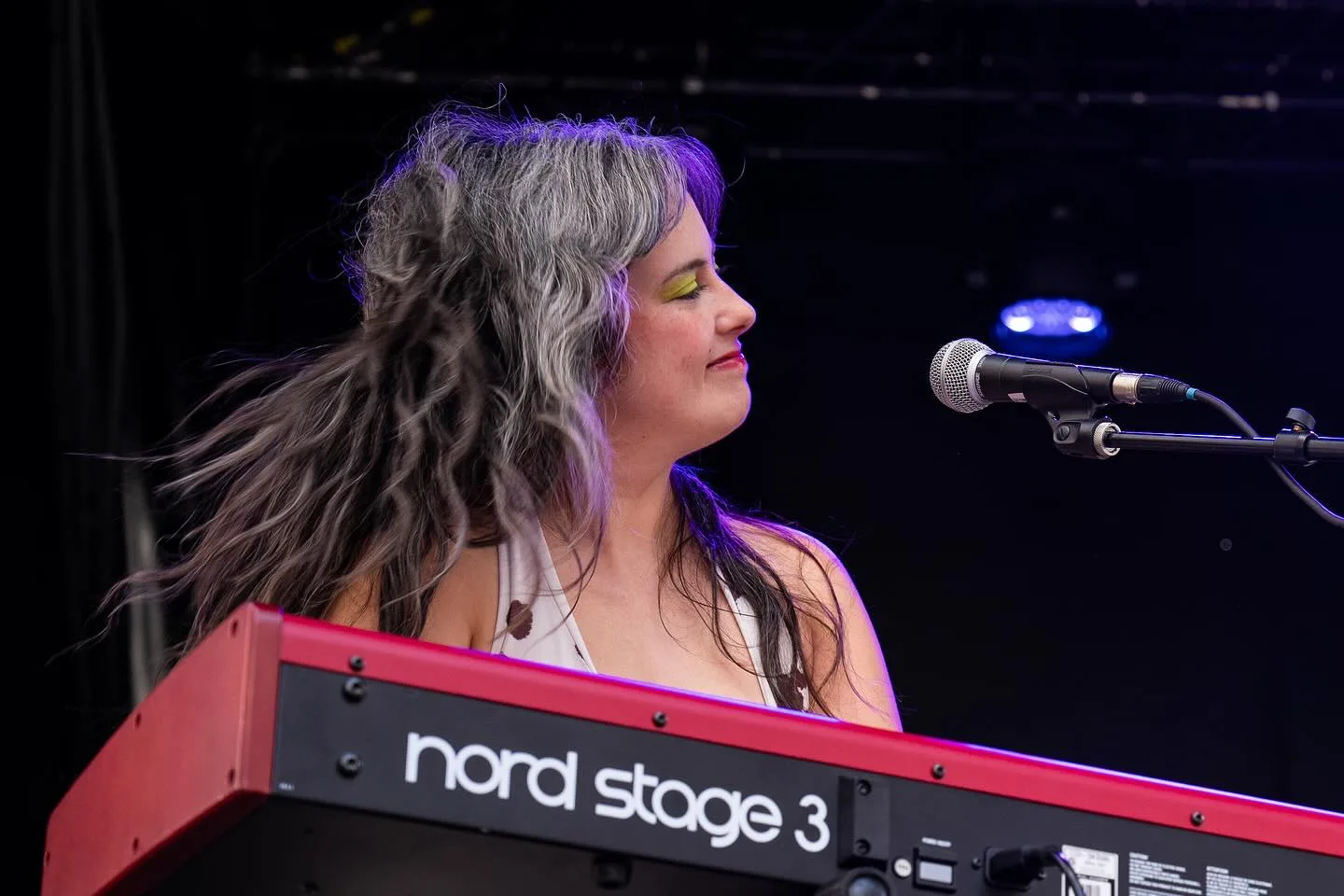
Header photo credit: Jen Hughey
Chessa Rich has become one of those artists whose name keeps surfacing in conversations around Durham’s music scene (and for good reason). The indie-pop songwriter, whose 2023 album Deeper Sleeper showcases her knack for blending infectious melodies with folk sensibilities, has built a creative practice that extends far beyond her own recordings.
In 2025 alone, Rich performed at South by Southwest with Skylar Gudasz, played the Hopscotch Music Festival with fellow Sleepy Cat Records artist Blue Cactus, and launched her inaugural Summer Recording Sessions — a project in which local kids wrote, recorded, and released their own songs under her guidance. She capped the year with a star-studded “Christmastacular” at The Pinhook, featuring Anne-Claire, Skylar Gudasz, Sijal Nasralla of DUNUMS, Isa Burke, Joseph Decosimo, Lonnie Rott, and Rachel Kiel.
As she prepares new material for 2026, Rich reflects on her evolution as a teacher, collaborator, and now producer/engineer; roles that have become just as central to her identity as being a performing artist.
What have you been listening to lately?
Chessa: Last year, I had my first “Joni moment.” I obviously knew about Joni Mitchell, but I never really connected with her music or felt like I wanted to. And for whatever reason, last year, it was like, “Oh shit, I get it.” Charles Cleaver just gave me a vinyl copy of her second record, Clouds, so I’ve been re-listening to that and enjoying it.
Joe Westerlund’s new record, Curiosity From the Shift, is also really good. And then there’s These Days by Emily Hines. My Tidal Wrapped said I was her sixth biggest fan. [laughs] I’ve been wearing that shit out. It’s a good wintertime EP. I have this unintentional tradition of going to Brumley Nature Preserve either on the first or second day of the year, and that record was the perfect soundtrack for a cold hike.
Who is the first musician that you remember discovering on your own and obsessing over?
Chessa: I don’t know if this counts as discovering them on my own because I was seven years old, but Ace of Base. The two albums that my parents had that I sort of found and connected to were The Sign by Ace of Base and Seal’s self-titled album. I remember holding the liner notes, looking at their faces, and being amazed that these were the people who made the music.
You had a busy 2025! Looking back on everything you had a hand in, what are some of the highlights that stand out the most?
Chessa: Every year around this time of year, within the first six days of the year, I do a year in review for myself. Throughout the year I put everything in my Google Calendar because if it’s not in there, it’s not happening. But it’s also a really great record for going back and seeing what I did in a given year. So I go through and I write down the things that I did that were meaningful, like “I got better at communicating and I’m closer with this person,” or “I finally did this thing I wanted to do.”
A standout for me was going to South by Southwest [with Skylar Gudaz]. It was super fun, and I’m really glad that I got to do that. The music portion of SXSW is not long for this world. I was having some health issues at the time, so it was also challenging. But still such a great experience to be there with all the Sleepy Cat folks.
It was a very fun music year. Sleepy Fest was so much fun; both of the sets I played were with people I love so dearly. A lot of times when I am feeling down or whatever, thinking about what’s missing in my life, I just need to have more fun. People are always like, “Wow, it seems so fun to be a musician,” and it is, but it’s not always that way, you know? So I feel grateful that there were actually so many really fun festivals and shows I played this year.
A major thing that I feel proud of accomplishing is recording the summer sessions. For probably six years, I’ve been like, “This is the year that I’m going to learn how to engineer!” Just for my own purposes of being able to make demos, messing around alone, or recording background vocals and sending them off to people.
I set a deadline for myself to do this project: have kids come over and record songs. So I had to fucking learn. I couldn’t put it off anymore, because they were coming. I am a person that needs a deadline to get basically anything done. And it timed out well that I got to do a gender equity audio workshop in Maine that a friend of mine put together. That was a bunch of women and non-binary people just learning from Allie Rogers, who’s an incredible engineer.
Whoa, what an incredible opportunity!
Chessa: It was awesome. And I’m never going to be an engineer that someone will hire. That’s not my goal. But I can do it now. I have some base level of knowledge. And seven songs were recorded by me this summer, which is pretty wild for me.

Image credit: Chris Frisina
What was your process of putting together the Summer Sessions, from announcing it to working with the kids and getting that hands-on experience?
Chessa: I teach piano lessons. I’ve been doing that for seven or eight years. So that project came out of my working with kids and writing songs. I have this one student with whom I’ve written nine songs. We don’t even play piano; it’s just songwriting with her. She is a creative powerhouse, and we’re cranking them out.
I’d floated the idea to the people that I work with and did a couple of surveys to figure out how many days it should be. What would they want, a half day or a full day? It was a little market research, but with people I have a relationship with and who I was sure would sign up.
Everything I do is self-employed. I’m my own boss in every way, which has its upsides and its downsides. Most of the time, honestly, it feels like more downside just because it’s you. Yeah. If you want something to get done, you are the only person who can do it. And if you want to delay it, you can. No one’s going to tell you to do it except for you. So it was a process of “just send the survey” and “just announce it and then figure out how it will work.”
How has your experience teaching harmony singing at Night School Bar been?
Chessa: It is so fun! I really enjoyed teaching that class. I have been a teacher for a long time, and a music teacher in a lot of different ways. I took piano lessons, which is a lot of the reason why I feel comfortable teaching piano. I was taught in that way so I sort of understand it didactically, but I’ve never been taught harmony singing. I wasn’t in school choir growing up, never did voice lessons or anything.
But I felt like I had stuff to talk about, and that I was excited about. It was really fun going through the process of planning this course, and being like, “Okay, when I am hopping in on a song and doing a pass or just hearing something, what is actually going on? What are all the different situations and exercises that I can put people in to have this be revealed?” That’s what I always want teaching to be, putting people in situations where the core of the thing can be revealed to them experientially.
Honestly, the part that I do not love about teaching is the prep, I would say. But that was not the case for this class. I had this running list in my Notes app, and I would lie in bed at night thinking about things that would be fun to do. When I sat down to do it, I had a lot of material to work through.
Has the experience shifted as you’ve gone from co-teaching with Skylar Gudaz to teaching on your own?
Chessa: Having another person in the room is always helpful, especially Skylar. I don’t know that we think about harmony that differently, but she sort of comes from a different side of it. I bring the very music-theory side of it, and Skylar brings a real awareness of the overarching goal and the power of the song. I think having two people in any creative pursuit creates balance and offers different perspectives on the same thing.
Doing it by myself, I’m just remembering to do more breathing stuff at the beginning and have people not look at their lyrics as much. That was a cool thing that Skylar brought in: just be present with this and sing whatever comes out. That’s what is important, even if it’s not right. We want to just get comfortable doing this thing.

Image credit: Rachel Kiel
I’ve been listening to the new T. Gold record a lot, and saw you contributed vocals to the project. How did those performances come together?
Chessa: There was this period of time where Alex Bingham’s Lakehouse was a recording destination. Someone would be like, “Hey, we’re going to meet at the Lakehouse,” and put out the call for anybody who wants to come hang or play. I was free for two of the days, so I went, and it was like, “Okay, who’s here today? What songs are we doing today? Do you want to play on this?”
Saman and Gabe had ideas of “I want Libby [Rodenbough] to play fiddle on this one,” or “I’m thinking about Chessa singing on this,” or whatever. Being at sessions at the Lakehouse is really special. It feels free and open. There’s not a control room and then a separate space; you’re sleeping and recording basically in the same space. There are breaks happening, but not really. We can do anything at any time, which is really fun.
I’m a hired gun on that record, I would say. I played flute on “New Land”. I did some vocal overdubs at Small Pond for “Another Time”, “Speak With Spirits”, and “Jewel”. “Jewel” is one of the background vocal parts that I’m most proud of. That song is sick and I feel really proud of what I did, using my voice in a different way than I normally do. I feel like it fits really well and I think I really sound like myself. Saman and Gabe create a space where I feel free to be relaxed and play, which is the biggest gift.
Saman’s songwriting is so great; there are some bangers on that album. He’s one of my best friends, so it’s cool to see him doing a great thing.
Looking ahead to 2026, do you have any specific goals you’re hoping to achieve?
Chessa: I have 11 songs that are 80% done. And this show at Motorco in March is a deadline to finish a lot of them. Beyond that, it’s time for me to set up recording time for the new album. The fall is a reasonable enough deadline to get some of that done.
I would really love to produce. I’m talking with a friend about probably producing something for them this year, which I’ve never done before. That feels exciting. Also, Alex Bingham and I have two songs that we need to finish that I hope come out this year!
Who are some of your favorite local/North Carolina artists?
Chessa: T. Gold, Canine Heart Sounds, Skylar Gudasz, Kaira Ba, and Dante High.
This interview has been edited for length and clarity.

Leave a Reply