
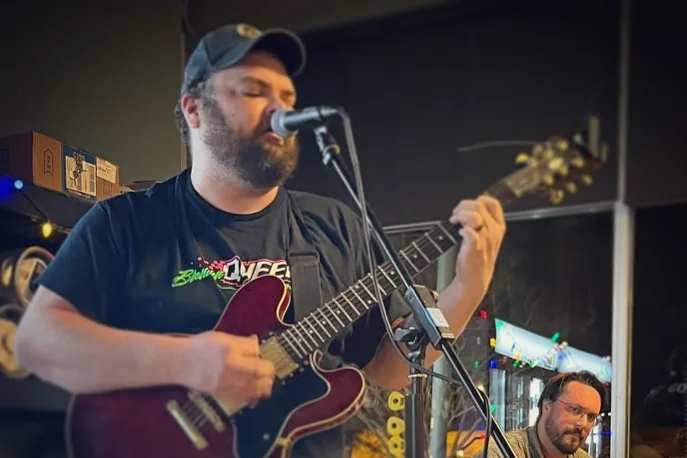
I have so much respect for anyone who has been playing music for about as long as they can remember. Maybe that’s why Jason Buel and I connected so easily. Shortly into our conversation, he casually flexes on his musical journey: violin at two, drums at four, guitar by the time he was nine. And yet, like plenty of musicians (myself included), there was a stretch where his instruments mostly gathered dust. It took the right people, a DIY home-recording attitude, and a gradual willingness to just see what stuck before Slow Run Club started to take shape.
Now, a couple of years into the project, the Raleigh three-piece is playing out more regularly, self-releasing singles on Bandcamp, and plotting a more polished debut record somewhere down the line. The sound leans psych-inflected indie rock, and the approach to making it is refreshingly unhurried. Songs may get set aside for years if they’re not ready and everything recorded so far has been done at home, incrementally.
With a baby on the way and a vibrant local scene to plug into, there’s a lot pulling at Jason’s attention right now. But he seems pretty okay with that.
What’s something you’ve been listening to lately?
Jason: I’m always in a heavy rotation of Silver Jews, Velvet Underground, and Ween.
In terms of newer stuff, I’ve really been into Angine de Poitrine lately. They just did a KEXP session a couple of weeks ago, which is starting to put them on the map a little bit. They’re this really weird two-piece: the guitarist plays a double-neck guitar-and-bass setup and does live-looping stuff, but it’s a microtonal guitar, and they do all kinds of mixed and odd meters. In a time when everything seems to be AI slop, I just love having something that only a human being could have possibly come up with. It’s so off-the-wall and fun.
I’ve also been listening to a lot of Big Thief. I feel like, especially this time of year, as the seasonal affective disorder transitions into just regular depression, they’re perfect for that. Especially those first two albums, I really love those a lot.
When you first got into music, who was the first artist or band you remember either discovering on your own or almost claiming as your own?
Jason: The one that pops to mind immediately is Nirvana. The first thing I remember hearing was their Unplugged CD. One of my cousins turned me on to them when I was probably younger than I should have been for that kind of heavier music, like second grade or something. It was a weird entry point because it’s so different from their typical sound, but you can really get into the songwriting more that way.
What it really did was open up the whole world of music like Meat Puppets, Melvins, Mudhoney, the Vaselines, the Pixies, all of that. That was also how I learned about Steve Albini, which opened up a whole other world of alternative music. I got into it really young and then went way deeper in high school, just fully immersed in that alternative sound.
At what point did you go from being a music fan to picking up an instrument and making music of your own?
Jason: That was really early for me. I started doing Suzuki method violin when I was still in diapers. I didn’t stick with that, but I only remember it because there are pictures of me holding a violin as a two-year-old. Then I got a drum set when I was four or five and started just teaching myself and playing. I started playing guitar when I was eight or nine, and that was the first instrument where I was really into it — not just my parents saying “go do this thing.” I started taking lessons right away.
So guitar was the first thing I was serious about. Then in middle school, I was writing songs with friends, which was the worst stuff I’m sure anybody’s ever heard. We didn’t even always practice in person; sometimes we’d just play ideas into the phone. I’d play a little idea on my acoustic guitar and he’d play something back on his bass, but we couldn’t hear each other at the same time, so we had no idea if it worked together. Of course, none of it ever did, but it was a hell of a lot of fun.
Has that trajectory continued? Was there ever a point where you weren’t engaged with music beyond just being a listener?
Jason: It kind of went in waves. In high school I really went off the deep end. I was in jazz band, symphonic band, and marching band through school, and I took it upon myself to learn at least basic scales on every instrument that a friend played. I never got around to tuba or baritone, but everything else I at least wanted to know my way around.
In college I was playing a lot, usually in two or three bands at a time. I had thought about going to school for percussion performance, but the idea of making a livelihood from gig-based work made me too anxious, so I didn’t pursue that.
Then once I moved down here for grad school, I wasn’t really playing for a few years. Just noodling on acoustic guitar every now and again. I went years and years without even having my drum set set up. It was just shoved in a closet. So I’m really glad that these past few years I’ve been making space for it again and going off the deep end a little bit more.

How did the band come together? Was that part of getting back into music, or more like the latest iteration of an ongoing thing?
Jason: More the latter. I started jamming with Barry, the other guy in the band who swaps off on bass and guitar. He’d been friends with my wife going back years. We’d just been casually jamming around, and then one of my close friends started dating a guy who plays drums and mentioned a few times that we should try playing together. So we gave it a shot, jammed a few times, and it just gelled.
We’ve been playing together for a couple of years now, but it’s only been in the last year that we’ve started playing out. Over that time, I’ve gradually been converting my office into a practice space and a little bedroom studio. Every couple of weeks it’s like, “all right, this is still fun — let’s take one more step down the rabbit hole.”
What’s been the process for putting songs together? Do you bring individual ideas to the table, or do you jam things out?
Jason: A little bit of both. For me these days, I tend to want songs pretty fully formed before I bring them to the band. Occasionally we’ll jam around on an idea and it’ll stick, and I’ll add a second part the next week. For Barry, I feel like his songs tend to start maybe a bit more 50/50; somewhere between jamming things out and bringing something fully formed.
For me it really depends on the song. A lot of what I’ve been writing in the last year or two comes out either fully formed or pretty close to it. But then there are songs I’ll sit on for two, three, four, five years because I’ve never quite figured out how I want the post-chorus to go. I don’t bother forcing it. Once something clicks into place, we can work with it. It’s much more fun and rewarding to set those aside rather than try to make something work before it’s ready.
When you recorded your first songs, did you work with someone, or was it done in your practice space?
Jason: Everything we’ve recorded so far has just been in my home setup, with me producing it. Mostly just grabbing at things and seeing what works, then two months later realizing what I did wrong and nudging it 2% in the right direction. You can probably hear that patchwork quality in some of the songs. There’s a piece of equipment that’s now really important to how we sound live that I didn’t have yet, and I hadn’t figured out how to hard pan the guitars. That’s kind of why we’ve been releasing things as singles. Hopefully at some point in 2026 we’ll put out something — either a full album or an EP — that sounds a bit more up to date. If I ever get tired of the DIY approach, I’d love to work with Drop of Sun in Asheville or Found After Dark in Raleigh.
It’s crazy that we’re almost four months into 2026. What are some goals you all have set out for the year?
Jason: My wife and I are actually having a baby in about a month, so my big goal for the band is to get more stuff on the books before that happens. Just try to stick with music and not get sidetracked by everything else going on. Beyond that, I’d really like to convert maybe one or two practices a month into shows. We’re at the point where there isn’t much need to re-rehearse old material, so we might as well start playing out more.
We’ve got a show this Friday and another at the end of June; those are the only ones currently on the books. I’ll probably be on baby duty for most of May and the first half of June, but hopefully we’ll have more stuff coming late summer and into the fall, with shows much more regularly than we’ve had so far.

What’s been your experience playing in the local scene? Have you kept it to the Triangle, or have you ventured out elsewhere in NC?
Jason: For this project, we’ve just kept it to the Triangle. There have been tempting opportunities further out, but we all have day jobs, so it’s hard to coordinate being on the road that much. If a great festival opportunity comes up or something we just can’t turn down, we’d be all for it. But for the vast majority, we’re sticking to the Triangle and playing around here as often as we can.
And honestly, I think it’s easy to undersell the Triangle. You can lump it in as just one of the three cities, but each of those individual cities — and especially if you throw Carrboro in with Chapel Hill — that’s a lot of venues, a lot of bands, a lot of connections to make. When I was in touring bands in college, my body could handle that. Now, between the day jobs and being a father-to-be, it’s a different story.
How does it feel compared to when you first moved to the area?
Jason: It’s really different. When I first moved down here for grad school, it just felt like dad rock all the time in Raleigh if you weren’t very careful about where you were going. Like, if someone just said “live music,” I’d have to ask for more information. I didn’t just want to hear Steely Dan covers all night — people obviously shouldn’t play the songs they grew up with in the ‘70s; they should play the songs I grew up with in the ‘90s, which are better for obvious yet undisclosed reasons. But it’s so vibrant now, and so supportive. I feel like we’re really lucky.
Who are some of your favorite local or North Carolina artists that you’ve either played with or encountered in the scene?
Jason: Some of my favorite North Carolina artists are just my favorite artists, period. Wednesday and MJ Lenderman jump to mind immediately — especially talking about the pandemic, having that time to create a kind of arts incubator at their space in Asheville was really crucial to them putting out a couple of great records after that. And likewise, Truth Club from Raleigh; their song “Uh-Oh” was written during the pandemic and I think very directly inspired by that experience. That’s one of my favorite songs; I have it on repeat all the time.
Other artists I really like are Chicken Ranch Road Show — we played our first show with them a while back, and I’ve been friends with Robin and Patsy for over a decade now. There’s also Dreamscent, Neon Ruins, J Candeed and the Particle Accelerators; we’re playing shows with them this weekend and in June at Cannonball Music Hall, they’re on both of those bills. Amelia Riggs, who I first learned about through WKNC, so shoutout to college radio. Can’t forget Buzzard Company, Buck Swope, and Persimmon. Also, The Veldt, shoegaze legends from right here in Raleigh.
I’m sure I’m forgetting even more than I mentioned, but I guess that just speaks to how awesome things are here right now.
This interview has been edited for length and clarity.

Leave a Reply