
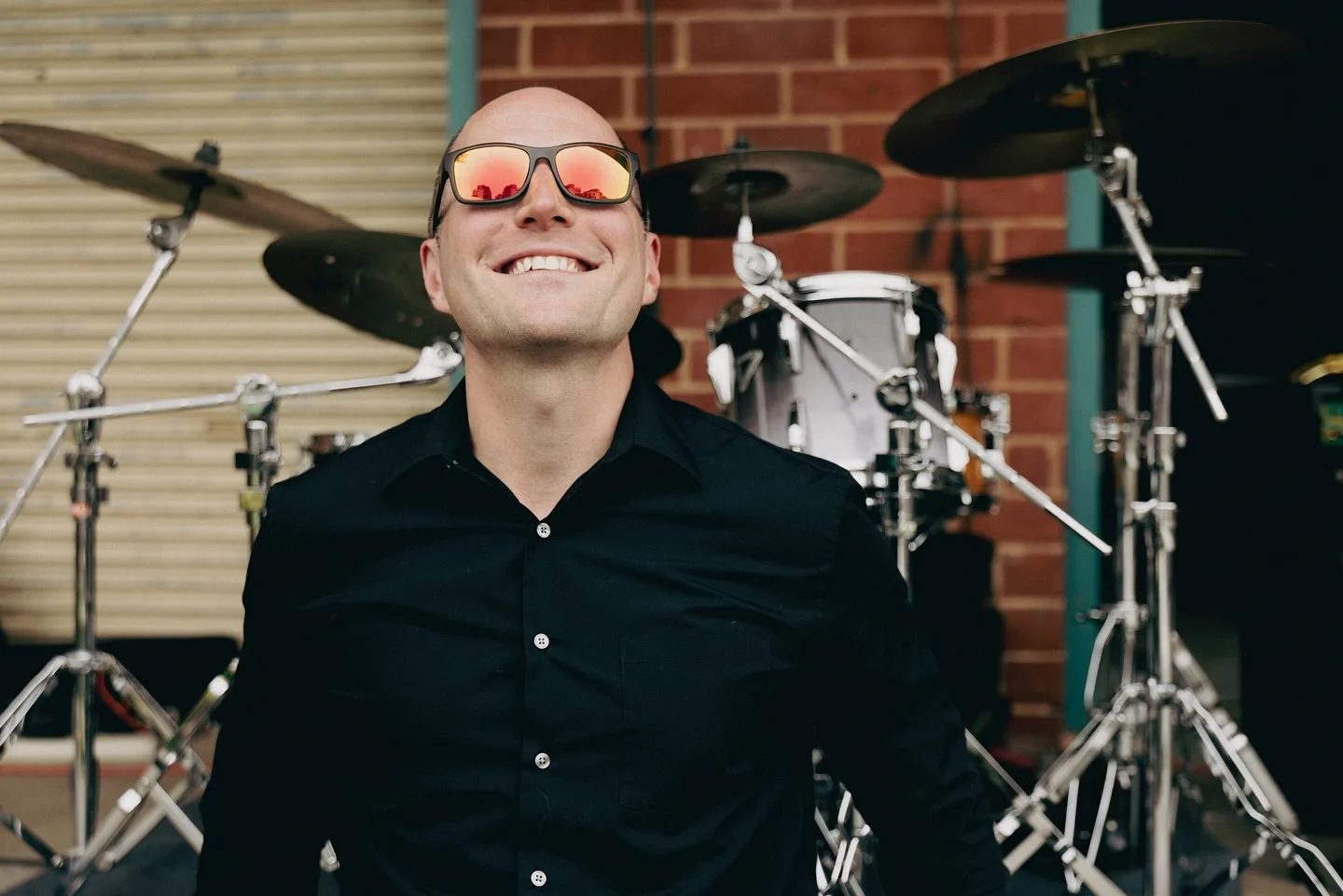
All photo credit: Barry Daley
Having done over a hundred interviews at the time of writing, I’ve learned to expect the unexpected. Even so, I wasn’t prepared for a story like Jeremy E O Anderson’s. Here’s a quick reason why: he spends his working hours writing engineering specifications for nuclear reactors and fills seemingly every other moment switching between a country/Americana band (The Ellis Band) and two different jazz trios (Bull City Trio, Algorhythm Trio). Not to mention a brand-new acoustic duo (Sons of Snow) and a solo project three decades in the making.
Somewhere in there, he also runs Groove Geek Studio out of an insulated bedroom above his garage, tracking drums for artists locally or across the country. And still finds time to be a dad.
With so much on his plate, I was drawn to what drives him to keep up with it all, and the stories between projects. He manages not to lose the thread on any of them, and his experiences are a great example of why you don’t need a full studio, or even a full band, to make something worth hearing.
What’s something you’ve been listening to lately?
Jeremy: I have a seven-year-old kid, and she thinks of car rides as the time to listen to music, so a lot of my listening these days is stuff I’m not normally into at all. One highlight recently has been “The Middle” by Zedd and Maren Morris. The lyrics don’t strike me as genius, but I’m a big fan of the production. I think it’s really impactful. My daughter actually found that one; I didn’t seek it out. It just showed up on the playlist because she requested it, and I was like, “This is actually kind of cool.”
On the flip side, who was the first artist or band you remember discovering on your own and obsessing over?
Jeremy: Dave Matthews Band. A friend of mine in high school brought Crash over, and I had a stereo system my parents had given me for Christmas. I was so struck by Carter Beauford’s drumming. His playing became a huge influence for me over the coming years. Every road trip with my parents, we’d drive up to Lake Superior, about a four-hour trip, and I’d want to listen to their albums the entire time, drumming along in the backseat. My dad would say, “Don’t do that, it makes the car sound like it’s breaking.”
I think Dave Matthews Band is oddly underrated, honestly. People throw so many stereotypes and tropes at them, but it undersells the musicianship on display. They showcased Beauford’s drumming a lot more on the earlier albums. The later stuff got more pop-driven, and the drumming got simplified, but you can still hear the artistry.
You’ve got a lot going on, solo stuff, being a parent, life. With so many different projects, what does a typical week look like for you?
Jeremy: It’s a lot of convincing myself that what I’m doing with music is enough, because I’m a mechanical engineer by day. I was formerly a professional musician, but now I spend most of my day on my work computer doing documentation. I work on nuclear reactors now, which is a highly regulated industry, so I spend a lot of time buried in specifications and manufacturing details.
I’m definitely an early morning person. I usually wake up naturally between five and six, before my wife and daughter are up, and that’s my time. I always try to fit in half an hour of music first thing, whether that’s sitting at the keyboard, singing something into a voice memo, or recording in Logic. Just something to open up those creative taps, because if I don’t, I end up feeling stoppered up. I truly believe I was put on this planet to make music.
I work remotely, so I try to grab half an hour here or an hour there during the day too. Evenings are the whirlwind of dinner and getting our daughter occupied before bed. Sometimes evenings are rehearsals, though not as often as people might think. We never rehearse the jazz trios, especially Algorhythm Trio. We just show up and play, and I rely on the spontaneity of the moment because I find that’s the most fun. Bull City Trio rehearses maybe once a month, same with The Ellis Band.
I’ve been learning new material for so much of my life that the process is really condensed for me now, and I’ve been playing drums for over 30 years, so at this point it’s a language I speak rather than something I consciously think about.
How do you approach being a collaborator? Do you find yourself playing drums the same way across all of them, or do you adapt?
Jeremy: Every genre has its own language, and I need to adapt to that language to be understood and accepted in that space. With The Ellis Band, which is a country/Americana/roots project, I play very differently than I do with Algorhythm Trio. Part of that is the venues. The Ellis Band is a bigger sound, so my touch can be a little heavier.
With Algorhythm Trio, we typically play very small venues; some don’t even have a stage, and we’re just shoved into a corner. So I’m playing basically just snare, kick, and a few cymbals. No toms. The snare is always muffled, and I’m playing as light as I can. Completely different approach just because of the room.
How do you interact with the local music community through these different lenses, country/Americana, instrumental jazz-funk, an acoustic duo? What’s your perspective on those different scenes from behind the kit?
Jeremy: They definitely attract very different clientele. To each their own, but one of the biggest challenges is that I can’t get my friends out to all of my shows because they all have their own tastes. Some will show up to an Ellis Band show and hate it, then go to a Bull City Trio show and love it.
There’s a real challenge in building a following; it’s not just about supporting individual musicians, it’s about connecting with the audiences and sounds they actually prefer. At the same time, I’m making music because I enjoy it. I’m involved in these projects because I enjoy the results. It’s an interesting dichotomy if you think about it that way.

With Sons of Snow, and also the solo project you’re working on, what was the draw to start those on top of everything else you’re doing?
Jeremy: The solo album I’m about to release, Grind Brew Groove Repeat, is really the latest installment in a project I’ve had going for decades. When I started recording, I did it because I wanted to record my own music, and it’s still a playground where I experiment and express myself. That’s the Jeremy E. O. Anderson artist project, something I’ve had my entire life essentially, but it’s only been preserved since I’ve had the ability to record.
Sons of Snow is brand new. I was motivated to make that one after meeting a neighbor of mine. He lives within walking distance, so he’ll walk down with his guitar on his back and come to my place, since I’ve got a studio here that’s acoustically independent. It started when he was having people over for pizza on the last day of school, and I found out he plays guitar and sings. I said, “Let’s get together and jam.” He’s got a great voice, a great sense of time, a songwriting style I really enjoy, and I felt like I could add something to his music. He was into it, and we had a good time together, so we decided to start playing a little more.
Our first actual show is August 30th, a low-key house concert, just to try out that format. We’ve also played a couple of open mics recently and had a lot of fun. I’m looking forward to seeing it grow.
What has the process of building the studio looked like? Is that mainly an outlet for recording your own music, or are you bringing in outside artists too?
Jeremy: At the moment, I typically have one external project going at any given time. I’m about to record some drum tracks for an artist in California; that’ll be a fully remote collaboration. Last year I produced a song for a local singer-songwriter who had just graduated from Duke. I’ll keep taking on whatever I can fit in, whoever’s interested.
Honestly, it’s not a money-making venture at all, since I tend to spend a lot on gear. Gear purchases are driven by my passion and my sense of need, not necessarily actual need. The studio has also changed a lot over the years.
My wife, daughter, and I were RVing full-time about six or seven years ago. We sold our house, sold everything we could, and lived in a 40-foot motorhome for three years. During that time, my studio was a laptop, headphones, and a MIDI keyboard. That’s it. But I kept writing, and some of what I wrote during that period is going to be on this new album, because I go back and listen to old stuff occasionally, and sometimes it strikes a nerve, and I think, “That’s actually really cool; I want to bring that into the present moment.”
For Grind Brew Groove Repeat, that means adding live drum tracks instead of the old programmed parts, but the album has some brand-new stuff too. I have a studio now that gets me a really great live drum sound despite being a single room in a house. It’s just a bedroom over the garage that the previous owners insulated really well. I’m taking drum parts that were originally programmed and recording them with my current acoustic capabilities.
When you’re producing, recording, or engineering for bands you’re actually in, how does that dual perspective change the way you record drums for the project, compared to session work?
Jeremy: I don’t think there’s any way it couldn’t change things. When I’m recording songs I helped write, I have a much deeper emotional investment in that song in that moment. That’s not to say I’m not committed to making someone else’s song sound good too, it just means I have a different connection to it. There’s no avoiding that.
There’s also a time investment piece. If someone’s asking you to lay down tracks as a session drummer, you don’t have as much time with that material, you’re not in the room working on it the way you would be with a project you’ve built with people you’ve known for years.
Who are some of your favorite local or North Carolina-specific artists you’d want to shout out?
Jeremy: One of the realities I struggle with is that between gigging so much and parenting, I don’t have a lot of days on the calendar to get out and see a show. But what’s happening up in Greensboro with Charlie Hunter is great, he’s a really well-known guitarist who worked with D’Angelo back in the day, and he continues to do this really cool funky stuff that only he can do on baritone guitar.
I also really dig the Sam Fribush Organ Trio, a Greensboro-based B3 organist who’s actually played with Charlie Hunter. I really like his playing and I’ve been following him wherever he goes. Those are the two that stick out right now, aside from the friends I play with, some of whom are in other projects, and I go support them as much as I can too.
This interview has been edited for length and clarity.

Leave a Reply