
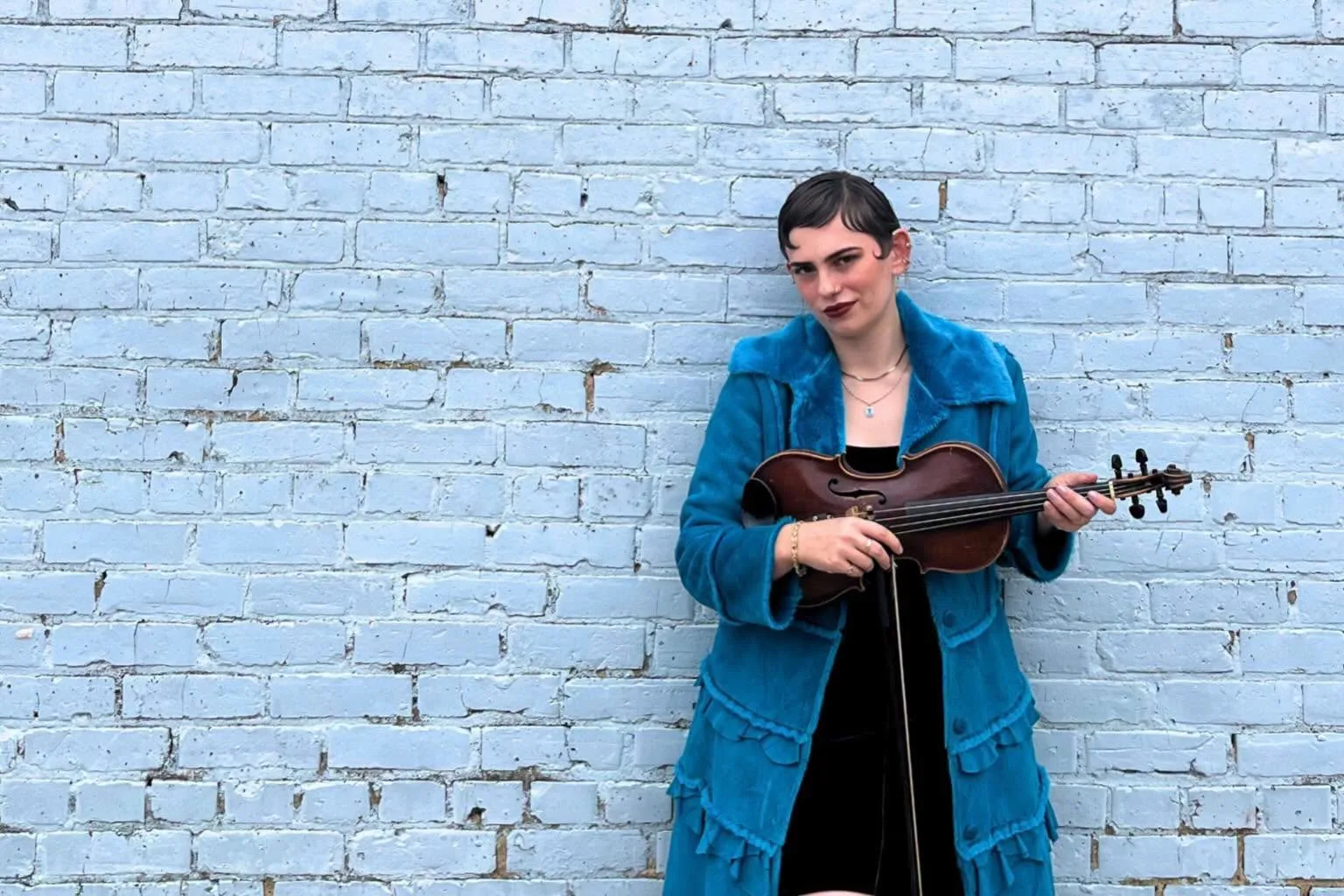
Folksinger Jodi Jones is determined to boldly dream a better tomorrow in the wake of a broken and weary world. Deeply rooted in the musical traditions of her childhood home in the hills of Western Pennsylvania, her work is a poetic and unflinching account of the beauty and hardship of the working-class experience in America. With defiant wit and innate musicality, she beautifies the bitter truths of our modern age into song as an act of love and solidarity.
Art may not save us from our problems, but Jones believes it is crucial to surviving them with our humanity intact.
With the release of her first full-length album imminent after a short springtime tour as well as the completion of three volumes of her ethnomusicology zine The Little Book of Pennsylvania Folk Songs, which focuses on subgenres such as ‘steel songs’ and ‘Susquehanna lumbermen’, Jones has a lot to share with the world and many different avenues to go about it. Her willingness not only to probe the past for answers from a historical, research-based perspective but also to follow those through-lines to the present as a performer herself certainly lends her a unique voice as a modern-day folk artist who first went viral last summer.
You just finished your first tour. How was that?
Jodi: It got cut slightly short, but the shows we did play were so good it didn’t even matter. I was just glad we played as many as we did.
That’s a pivotal moment in any musician’s career.
Jodi: Absolutely. We’d done shows here and there. I once drove 1,000 miles each way to play with Willi Carlisle in Arkansas, but those were isolated, singular events. This was my first time performing night after night, and experiencing the kind of stamina that requires.
How did you get to that point?
Jodi: Three years of kitchen leadership and almost a decade in the culinary arts. It was creative enough to keep me occupied and a low barrier to entry. When I was offered a leadership position, it was my last shot at management paying off, and in some ways it did. I’m a homeowner now, we paid for our wedding. But it got to a point where I was bumping up against the limits of what you can change from within a system when you don’t actually own it. Even leading your own department, you’re still subject to veto power from someone who has the capital but not the know-how.
Boy, does that sound familiar.
Jodi: Yeah, I think it’s everyone’s problem in the workforce right now.
Brendan: You were in a business meeting with your boss when one of your videos started going viral. He’s going through his checklists while your phone won’t stop blowing up.
Jodi: I was in the middle of a serious work crisis last summer. My best friend, who managed the cafe side of things, broke her hip, and I stepped in to cover instead of letting things play out, and about killed myself in the process. In the middle of that week, I went viral for the first time. It got a million views. It was insane.
Was that on Instagram?
Jodi: Yeah.
Brendan: It came out of real frustration everyone was feeling, but you were feeling it in the moment you made it, and that carried across. We were getting those floods at the time.
Jodi: I threw it out mostly as a mutual aid initiative, trying to get people to donate to Triangle Mutual Aid. I don’t know what I stepped on in the algorithm, but it just went crazy.
Right place, right time.
Jodi: I was pretty much completely burned out by fall. I kept telling myself, maybe Christmas break will fix it. It didn’t. I was up for my first performance review in three years, and the raise wasn’t enough. I was sitting at the kitchen table with Brendan and said, “I think I gotta quit.”
Brendan: “This still isn’t worth it.”
Jodi: We’d already booked this tour in April. We both knew we needed to make the leap, we just weren’t sure how it’d play out. I looked at a fully booked April and thought, I don’t know how I’m gonna swing this.
Brendan: I was already gigging on the side while you were tangled up in management.
Jodi: It was just a matter of extricating myself gracefully.
Brendan: While still maintaining the financial support the household needed.
Jodi: I have a mortgage now. But the stability that gave us is actually the foundation we’re working from. I don’t have to worry about a landlord hiking rent, I know what our expenses look like. I’m 27, almost 28. If I don’t do this now, I’ll regret not giving it a shot, even if it crashes and burns.
You mentioned Triangle Mutual Aid, and speaking truth to social injustices tied to geography and place. How does that influence you?
Jodi: I’m first and foremost a folksinger, and I guess I can call myself a folklorist now that I’m self-published. Folk music has always functioned as a people’s record of what’s happening. Not competing with mass media, just a different way culture transmits memory. I think it’s important just to put something down on paper even if nobody hears it. There’s a lot of material to work from right now.
Protest music gets treated as this noble thing. People put you on a pedestal, call you the next Woody Guthrie. It’s touching to hear, but the reality is closer to journaling, just in a form that’s more memorable and easier to pass along.

You both just went to Tennessee to play a big show.
Jodi: Yeah, at the Great Smoky Mountain Heritage Center. They have a museum and a restored village demonstrating folk ways of life in the Smokies, mostly 1800s and early 1900s. We tested out the thesis I’ve been developing on folk music in northern Appalachia in front of a southern-central Appalachian audience for the first time, which is a gap I’m constantly trying to bridge. The focus with Appalachian music is almost always south of the Mason-Dixon line. It went over really well.
Let’s talk about that geography more. The south-versus-north divide, even though the regions are culturally similar.
Jodi: There are a lot of moving parts. In the north, there’s been a bigger generational gap between players. The transmission from father to son has stayed a lot more direct in the south. Where I’m from, there was heavy industrialization much earlier, which is disruptive to music that centers on rural life.
Growing up in the northern mountains, which go all the way up to Chautauqua County, New York, I didn’t consider myself Appalachian. I knew we were in the Allegheny Mountains, and I knew we were a bunch of hillbillies, and I had a lot of complicated feelings about that as a teenager. It wasn’t until I left, hit horrendous culture shock in the Piedmont, then went into the western North Carolina mountains for the first time and felt suddenly at home, that I got curious about why.
Southern mountain music made it onto the world stage partly because of that continued transmission, and partly because of Alan Lomax and other folklorists who were active there. We didn’t have nearly as many people doing that work up north, or it wasn’t as publicized. When people talk about Appalachia, Pennsylvania isn’t the first state that comes to mind.
Is that about the different mountain region name, or the steel and industrialization?
Jodi: A huge part is industrialization. A lot ties back to the Mason-Dixon line as the divide between slave-owning and free states. That’s still a bleeding wound shaping our national identity. There’s a stereotype of Appalachia built around one subset of central-mountain culture — think Kentucky, the toothless-hillbilly-with-a-southern-accent thing — and people are skeptical that anyone from what they consider “the North” shares anything with that culture.
Pennsylvania actually has as many counties under the Appalachian Regional Commission as Tennessee does. There was also this “magical hillbillies” trope in the early 1900s: a simultaneous deification and sidelining, in which being seen as backward and isolated was also romanticized as pure Anglo-Scottish culture.
The ethnic makeup of northern Appalachia, shaped by immigration into coal and mill towns — Polish, Irish, Italian, eastern European — challenges that mythology. Where I grew up, neighborhoods were still ethnically segregated to an extent. That doesn’t fit the story people tell about what Appalachia is.
In your own songwriting, do you think about place?
Jodi: All the time. I learned to write songs by studying old folksongs, writing my own lyrics over existing melodies. My perspective is fundamentally rooted in where I grew up. There aren’t a lot of people my age writing folk songs about Pennsylvania. It’s a tradition bereft of new material, so I try to build on the foundation that’s already there instead of coming in from some revisionary angle.
Someone’s got to carry the torch.
Jodi: I’m frequently working from out-of-print books. The oldest one I’ve used is from 1919, by Samuel Preston Bayard. There are old recordings in the Penn State University archives I want to go see in person. Based on the response to my work, a lot of Pennsylvanians, including my own generation and my parents’, have no idea about the traditional culture they come from. They don’t know the fiddle tunes or the languages their grandparents spoke. We’re at a point where, without concerted effort, it’s going to be a reconstruction of the tradition rather than a revival.
You have a new album coming.
Jodi: Yeah, this year. Full bluegrass arrangements of songs people have heard me play around town with my band, Sugaree String Society. Bluegrass agitprop, maybe. Protest music has to be accessible or it comes off preachy. Bluegrass and country are about the most working-class sound there is, and if you’re trying to reach people who wouldn’t otherwise be receptive, it helps to deliver the message in a familiar package, from someone who looks and talks like an average working-class person, because I am. I didn’t even finish high school. I think that’s a testament to presenting an ordinary perspective, for better or worse.
Brendan: Not lecturing from an elite position.
Jodi: Right. People may come away from my record completely disagreeing with me, but at least they know I’m not full of shit. That’s something people from where I’m from respect more than anything. Authenticity. Even if they think you’re dead wrong, they don’t want you pulling their leg.

Image credit: Todd McPhail
Let’s talk physical media in the digital age. Social media is what made you go viral, but staying true to yourself and that model don’t always mix.
Jodi: I was born in ’98, on the older end of Gen Z. I grew up rural, so tech lagged a bit. I didn’t get an iPhone until 18, which even I find late now. I had more of an analog childhood than a lot of Gen Zers. I also came into music from an outsider’s angle. I didn’t go pro until about five years ago, and I never expected more than maybe playing local farmers markets. So when the video blew up, it didn’t feel like achieving a goal, it felt like something happening to me.
When I introduce “American Dream” onstage now, I half-joke: this is the song that ruined my life. I grew up in a town of 2,000 people, so the concept of a million people seeing anything I made breaks my brain. I’ve been trying to shift away from social media as fast as possible ever since.
Every attempt to use it in a way that served my values just left me feeling like I was pouring my soul into an empty vacuum. Moderating abusive comments because the algorithm rewards engagement, making just enough to cover an electric bill. It was eye-opening about how capital functions on these platforms. You’re facing the consequences of a Zuckerberg’s choices for a payout that barely counts as one.
So how do you make a living without playing that game?
Jodi: That’s most of my mental bandwidth these days. No amount of boundaries I set for myself has been enough to offset what it does to me. A friend, Willi Carlisle, used to put out a newsletter zine as a free PDF, and I always admired the idea but didn’t think I had enough to say.
Now, making the transition to full-time musician, I do. It’s been fun and low-pressure in a way making “content” never was. I did the illustrations in Procreate, laid it out in Canva, then printed, cut, and glued it by hand before scanning it back in. Every step was intentional. I think the zine format works because we’re all dealing with atrophied attention spans. Presenting things in digestible pieces with real design intent is a way to work within that, rather than shaming ourselves for it.
This one says Volume 1. Is there more to come?
Jodi: The newsletter’s going monthly; we’ll see how that goes since that one’s just 10 pages. For The Little Book of Pennsylvania Folk Songs, I’ve already got a second edition ready to design, and at least five more in me. I thought I was making one booklet with everything I knew, then realized I had 20 pages on Pittsburgh alone. And that’s just the easy stuff, the industrial ballads from the early-to-mid 1900s.
The next one covers the lumbermen of the Susquehanna region in the mid-to-late 1800s, the peak of Pennsylvania’s lumber industry — an industry that built the country and caused an ecological disaster at the same time.
If you could go back and give your younger self advice, what would it be?
Jodi: You’re gonna be okay, kid. Don’t let the bastards get you down. “Be yourself” is cliché, but there’s a version of belligerently being yourself in a world that wants you to be anything else that’s empowering and terrifying to do as a young person. Easier to do as an adult if you start practicing young.
What’s next?
Jodi: We just got back from Tennessee, and we’ll be gigging locally for now. Gas prices threw a curveball right as we left for our first tour, so we’re staying regional to keep the mortgage paid. I’m booking a September tour out west with my friend Ross Thorn, another folksinger in the populist tradition. He’s well-versed in the vernacular music of the Great Lakes and Midwest. We’ll hit Minneapolis, Wisconsin, and Illinois.
One thing we haven’t touched on: being a woman in this industry.
Jodi: Oh, that’s a fun one. I make my husband send the booking emails. I’ve got grit but not much tact. Where I really run into it is with sound techs. I’ll give them our needs and they’ll turn around and ask my husband the same thing, who’s in the band with me. We’ve learned to leverage it, and Brendan makes an exceptional buffer, but we’re never not surprised how crummy some people can be.
Brendan: We joke that you get the attention and the followers, and I just get taken seriously at soundcheck.
Jodi: I remember a show where I played “As Long as the Grass Shall Grow,” about the displacement of the Seneca by the Kinzua Dam, poured my heart out, and got offstage to some guy going, “Well wasn’t that sweet!” I could’ve decked him.
Not listening to a word you were singing.
Jodi: Something I think about onstage that Brendan doesn’t have to is whether a positive response means people are actually connecting with what I’m saying, or just like looking at me. I choose to ignore it most of the time. I think a lot of women in this industry do, as a survival tactic. Brendan gets the earful about it as soon as we’re in the car.

Do you ever feel like you’re playing a role up there?
Jodi: Constantly. I’ve taken notes from June Carter. She wasn’t considered the prettiest or the best singer among the Carter sisters, so she went to comedy school and used her boisterous, comedic presence to shift the dynamic. If somebody’s going to treat me like I’m stupid, I’ll play into it — put on the ditz, act like I don’t know anything about the mics — and use it as a roadblock.
Your lyrics aren’t “ha-ha” funny, but they’re witty.
Jodi: I’m sarcastic; it’s a family trait. Where I’m from, people’s sense of humor adapts to compensate for a rough environment. A little humor goes a long way, even on serious subjects. It keeps you from sounding like you’re preaching at people, which matters when your audience doesn’t already agree with you.
A lot of protest singers have to ask themselves: am I making art for a self-congratulating echo chamber, or trying to open something in someone who doesn’t think like me yet? There’s a place for rally-the-troops music, but that’s not exactly my line of work.
Not easy work, but crucial.
Jodi: Some of the most satisfying comments come from people who say, “I didn’t agree with this, but that lady sure can sing.” I think about John Prine a lot here. Nobody thinks of him as an activist folksinger, but “Your Flag Decal Won’t Get You Into Heaven Anymore” is still a standard in Americana protest music. We need people like Pete Seeger, who built a career as an activist singer, and we need ordinary people who step up in the moment to add their perspectives to the public record of dissent.
Not everyone has to get arrested over it.
Jodi: No, diversity of tactics.
You also put out zines and you mail them yourself.
Jodi: Me and my trusty laser printer. We just shipped almost 100 of them this week.
The people want to know.
Jodi: I thought maybe five people would care, the handful I know who are into that lineage of folksong. Instead, there was this surge, people in Pennsylvania and people with billing addresses there but living elsewhere; the diaspora, I guess. It’s been really cool to feel like I’m serving an unmet need.
This whole area is a blind spot in my understanding of folk music.
Jodi: That blind spot was my whole motivation. Why do we have all these compilations for Kentucky, Tennessee, North Carolina, and almost nothing for Pennsylvania? There are really only two records that get close, and one of those is a contemporary composer, so it’s not quite the real material.
And unlike those other states, which lean English, Scottish, Welsh, with a touch of Irish, northern Appalachia is a lot more ethnically eclectic.
Jodi: It is, and that’s what I love about it and what makes it worth preserving. Polka is just as Appalachian to me. There was one radio station that ran a polka show on Sundays, hosted by a DJ called The Big Moose, and that’s what we listened to on the way to and from church — not just Frankie Yankovic, but the deep cuts.
I know a guy our age in a polka band. Polka revival, folk revival!
Jodi: Captain Tom & the Hooligans. He’s out of Buffalo and we’re internet friends through some music Discords. They’re phenomenal, out there doing Dyngus Day shows and the whole nine yards.
Anything else you want on record?
Jodi: I think I’m finally finding some harmony between the protest music I accidentally became known for and the decade of research that’s really my primary motivator: reviving and reclaiming the folk ways of western Pennsylvania. Putting the zine out gave me a foundation that isn’t built entirely on political outrage, which, however justified, is its own kind of pollutant.
There’s a real paradox in trying to release music that’s critical of capital while still needing that system to get the music into people’s hands. But I think the two sides of the work support each other, and I’m excited to see where it goes. It’s like showing the receipts, in a way. This is the lineage that I come from, these are the people who have come before, honoring them, and here’s how we take it into the next century.
This interview has been edited for length and clarity.

Leave a Reply