
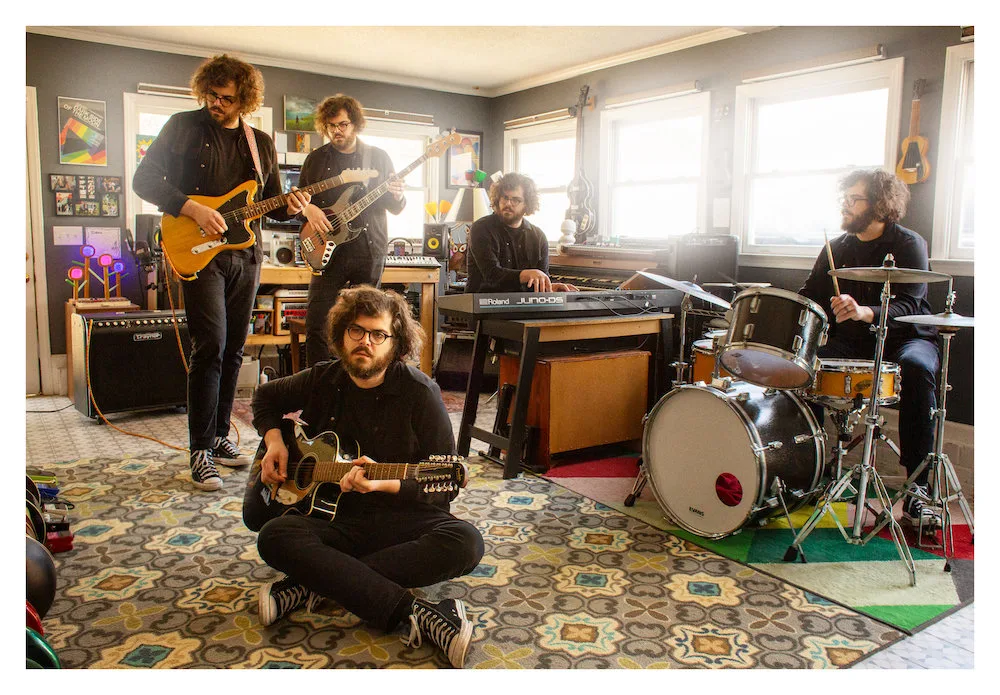
Justin Ellis always seems to be in the middle of something. Since moving to the Triangle as a kid, he’s played in bands too numerous to list, taught music to hundreds of students, booked his own tours across five countries, and quietly accumulated a catalog of solo recordings under the name Ravary.
You might already know him as the bassist for Slow Teeth, whom we named Artist of the Year in our 2025 Rewind. But Ravary predates that band by nearly a decade. The project, inspired by his mother’s maiden name and French-Canadian heritage, has been a recurring outlet for Justin whenever he’s not doing a little bit of everything.
Now he’s got his most substantial release yet: Bargain Bin: Studio Recordings 2015–2025, out now via Suah Sounds. It also coincides with his 35th birthday show, titled Plays Well With Others, on June 14th at the Cat’s Cradle Back Room — an ambitious celebration that aims to bring together nearly every musical chapter of his life so far.
What have you been listening to lately?
Justin: I’ve been really into this band from Seattle and Denver called Packaging. Their self-titled record is just unbelievable, and they’re currently on their first tour of Europe and the UK, so it’s been really fun to follow their adventures vicariously on Instagram.
As a good Quebecer, I’ve got to give a shout-out to Angine de Poitrine. It’s been a real treat to see a band that strange be so caught up in the zeitgeist. And them coming eing from a place like Montreal is a beautiful thing. And I like their music a lot too.
Go Kurosawa, who was the drummer for Kikagaku Moyo, just released his first solo record, and I’ve been listening to that a lot. And then Shearwater, who are like one of my favorite bands in the world, just released two singles from their forthcoming record [The New World]. So there’s been a lot of music for me.
I would be remiss not to mention Getting Killed by Geese. I saw them live twice in the last four months, once at the Cradle and then two months later, headlining a festival I was playing in Idaho. To see that band grow from a 700-person club to a 20,000-person outdoor stage in real time is really inspiring.
You’ve spent different chapters of your life in very different places. How do those experiences show up in your music?
Justin: My family moved to the Triangle when I was seven, so I’ve been in Raleigh, Durham, or Chapel Hill from ages seven to thirty-five. That being said, I was lucky to travel a lot growing up and to spend all my formative summers in Montreal.
It’s not so much about the places themselves as it is about the cultural artifacts that show up just by nature of them being present in my surroundings. A big part of why the Ravary project exists is that it’s just me, and there are a lot of songs that are maybe more earnest than I would want in a more art-rock outlet like Slow Teeth. That earnestness, the big folky acoustic chords, comes from Quebecois folk music.
And then I have other songs that are way more Britpop- or shoegaze-adjacent, because 90s Britpop is probably my favorite chunk of music ever. It’s not really a thing that ever took off here, so being able to tap into that. I would be visiting my grandparents in the mid-90s, and an Oasis video would come on TV as the hot new thing from just down the road instead of across the pond, and that was my relationship with Oasis. I was experiencing their rise in real time, as a quasi-local . That was a really cool experience.
Do you think those summers in Quebec exposed you to music you wouldn’t have encountered otherwise?
Justin: Absolutely. Growing up in North Carolina, I never really watched MTV. But while I was visiting my grandparents in Quebec, I watched VH1 every single day. And what was cool about VH1 and MTV in Quebec was that they would include French-speaking artists I still truly love who just never got played here. The big stuff being played in NC when I was growing up was what used to be called butt rock — as well as early-2000s pop and hip-hop — which is fun in a throwback party sort of way, but wasn’t inspiring me as a writer.
Knowing that there was really great music being made elsewhere, being a visitor to where my relatives are from, and being tapped into the radio and TV networks in those areas is what got me into a lot of music I care about and now try to write.
For those who don’t know, what is the story behind the Ravary name?
Justin: Ravary is my mom’s maiden name. It’s an old French-Canadian name. Neither my mom’s dad nor his siblings had male children, so there aren’t any more male Ravarys.
I started the project because a previous band of mine broke up after about three years. I was sick of being the guy booking all the shows, writing all the songs, and doing all the work to keep the band running, only to be in a band with people who didn’t really care about it to the same extent I did. So I decided to start this and name it Ravary because it’s only me. But it also has separation from me. The music doesn’t need to go anywhere for me to consider it a success.
There’s something really special about it, too. My granddad’s gone. Once I go, the music will stay somewhere. It’s a way to keep it going. It’s also my mom’s, my brother’s, and my sister’s middle name. So it’s a cool way to honor that part of me. And in French, it’s pronounced really similar to rêverie — like a daydream. That’s pretty cool to me.

How would you describe the process of putting together a Ravary record, given everything else you have going on?
Justin: Because Ravary came out of a period of deep burnout and disillusionment, my headspace at the time was, “I don’t want to ever be the band leader and main songwriter in a band. I’ll just play in other people’s bands and write my own songs when I feel like it.” And because it’s just me, no one can argue with me if they don’t like them. I don’t have to change anything. If I think it’s great, or even just OK, that’s good enough.
What’s cool is that, because it only exists to satisfy a creative itch and is always done in tandem with other things, my self-worth as a musician or a creative never got tied to it. So I’d think, “Okay, this band I’m in has a record deal, and we’re going on tour for two years — that’s the priority.” And then when that fell apart, I’d think, “Maybe it’s time to make a Ravary record.”
I recorded my first record, [Hands To Feel because I had all these songs sitting as demos and decided to finally finish all of them. My second EP [Almanac] was all songs I wrote during COVID. I had my gear, my recording equipment, I was teaching music lessons online, and had nowhere to go, so I just wrote a bunch of songs. My favorite four from that period got re-recorded with friends in Washington, D.C. and then ended up as that EP.
This new release [Bargain Bin: Studio Recordings 2015-2025] is kind of a combination of everything, with twelve songs out of probably twenty-four that exist from that whole period. The other twelve, I might record someday or might not. There’s no end goal, insofar as there’s no particular momentum I’m trying to build with it. I’m not releasing this music to book the next big thing. It exists on its own, and that’s it. If people resonate with it and cool events, gigs, or opportunities come out of it, that’s just an awesome bonus.
I think of it like a video game; I just pick up when I have the time. Or a journal that I’m not particularly religious with. It’s just there for me whenever I want to revisit it.
How has your approach to touring evolved over the years?
Justin: Before I discovered music and playing in bands, I wasn’t good at anything. I didn’t really have any friends. I was kind of a loser. And then when I got into playing music and playing in bands, I found my people. And once I found my people, I knew exactly what kind of people I’d want to surround myself with.
I’ve always viewed touring as an all-expenses-paid vacation where I’m only paying for food, if that. In recent years, I’ve made the same amount of money on tour as I would staying home doing my day job, which is an incredible privilege. I’ve never lost money on a tour; I’ve only ever broken even or made money. Part of that is because I’ve always organized every tour I’ve been on.
But I think the most important change is that as the years go by, the bandmates I have now are more on the same page with me about what a tour is or ought to be. I’ve had former bands implode because not enough money was being made, or the band wasn’t becoming famous fast enough for more impatient members. And then when I joined Easter Island in 2018, it was a complete game-changer. All four of my bandmates in that project are older than me and are to this day, like four older brothers I never had. They knew going in that the tour is about the hang. It’s about making connections. It’s about playing well. And if you make money, great. But a tour not making money is not a reason to be a band anymore.
For me personally, the only thing that’s changed is that I’m better at figuring out who I want to share these experiences with. It’s still my favorite thing in the world to do. And I just like sharing it with people who agree.
When I was sixteen, I thought, “I just want to play music every day for money, and that’s it.” And that’s my life. All I do for money is play gigs and teach others how to play and make their own music. So in my definition, I’ve already “made” it. Any level beyond that is just a bonus. That’s the secret, really. I would say almost everyone I play music with feels the same way. Whereas people I used to play with had a very arbitrary metric for what would constitute success, and if they didn’t meet it, nothing counted.

Tell me about this awesome 35th birthday show you’ve got coming up. How did that come together?
Justin: For my 30th birthday, I thought it’d be cool to do a show where all the bands I was in would get together. At the time, my bands like Happy Abandon and Easter Island were super active, Ravary was doing well. I thought it’d be really fun to get everybody together. I almost had it booked, and then COVID happened.
I wasn’t going to do anything for my 35th, but earlier this year, I remembered that original idea and realized I have a bunch of bands right now. This birthday also happens to line up with my one-year anniversary of being fully freelance as a player and teacher. So I just started asking people. All my current bands said yes, and then some of my older bands did too. I kept going further and further back. This show is called “Plays Well With Others” and it’s happening at the Cat’s Cradle Back Room on Sunday, June 14th. I’ve been playing the Cradle since I was 15 years old, so it couldn’t really happen anywhere else.
There are two or three bands I really wish could be part of this who aren’t. A lot of the people live far away, and some of it just couldn’t happen. Most of the bands reuniting are doing so without certain members and/or substitutes. But it was really just asking and seeing what happens, which has been my MO for a long time.
Another fun aspect of this is that a bunch of my former students are sitting in. Many of them are high school seniors who will be graduating the day before the show. I thought it’d be a fun way for them to play with the big dogs, so to speak.
Being the bass player or drummer in all these bands means I get to revisit all these foundational parts of myself. Every single person I’ve ever played with has had an effect on me. I never got into Jeff Buckley until my bandmate Jeff introduced me to him. I didn’t know any of Radiohead‘s incredible B-sides until I started playing with my friend Lauren. Everything I am is from this. I’m just amazed that everyone was down to do it.
You mentioned before we started recording that you had some thoughts on physical versus digital music. Can you elaborate on that?
Justin: So my friend Mike is the owner of a label called Suah Sounds. They have put out a bunch of music, including music from Amelia Riggs, with whom I used to play drums, Skylar Gudasz’s record, and, most notably, the final Reece McHenry record. Mike is a very caring guy. I feel like his mindset is a mix of a perfectly healthy amount of jadedness about the music industry and a deep care for it, so he kind of doesn’t care about anything that doesn’t bring him joy.
I asked Mike a while back if he would put out my record. He said yes, and then I was too depressed at that particular point in my life to see it through. Because he’s that kind of guy, I asked him two years later, “Hey, I completely dropped the ball last time, but this time I’m ready. Are you still down?” And he said yes.
So I will finally get a Ravary CD for the first time in my life. It’s not in the nature of the project to have a physical release, because that involves a level of care and overhead I just didn’t have the capacity for. I’m excited to finally have my music available at the merch table.
As a fan, I love physical media. I buy so much vinyl, more than I should. I still love buying CDs for my car, especially if it’s the only thing a band has to sell at a show. I still do the cassette thing. I used to religiously buy LPs, download codes, and put them all on my Zune because, in my head, we are still in 2008.
But with streaming, spending money on digital music, even if you love the band, has kind of become a hard sell. Especially since I’m a Qobuz user now, so I get lossless and FLAC on streaming all the time. I can’t even make the argument anymore that buying digital music gives you higher resolution.
Providing someone with something they can take home from the show gives you a certain level of buy-in. And there’s something I still love about CDs specifically. You buy it, it’s in your CD drive, and it’s there until you turn it off or swap it out. You don’t have time to change it. You have to soak it in. So much of my favorite music has been absorbed exactly like that. And I hope people absorb me that way, too, so to speak.

What are some of your favorite local or regional bands right now? Who do the people need to know about?
Justin: I’ve been on a huge ambient kick lately, specifically live ambient. I love Setting so goddamn much. I love Ben Hackett from Athens, Georgia. I love Delver. All the Sleepy Cat homies are great. I love Verity Den.
I’ve also been obsessed lately with Rod Smoth. He just moved here from Alabama, and his music is unbelievable. It’s not like anything else I’ve heard, and it’s very, very good. His record Living in Nowhere has been a favorite lately.
Verity Den has a side project called Oiled that I’m really excited to check out, and I love Mellow Swells. Honestly, especially now that Stancyzks is open, there’s a band I want to see live nearly every single night somewhere in the Triangle.
Especially now that I’m in my freelance era, I’m listening to so much more music for me, instead of the same handful of classic rock songs I’m teaching kids, though that’s still part of it too.. It’s been really cool to see what’s out there and what’s around.
Anything else you want to add before we wrap?
Justin: In the way that it makes sense to mention it — eight of the songs I recorded myself at a buddy’s studio in Carrboro, back when my previous band imploded. This was before I joined the Amelia Riggs band, before I joined Easter Island, before I even started teaching music for a living. My first record was made when I was waiting tables, wasn’t in a band that was seriously doing anything, and was kind of rudderless. I guess you could call it a quarter-life crisis.
My second record, I recorded with friends in DC that I met on tour. At that point in my life, I was very secure — married, had bought a house, and had a job with benefits I loved.
This new compilation combines two very different eras of my life to my present reality, and it’s a really cool full-circle moment for me. Thinking about all the people who helped me record these songs, all the people who helped me play them live, all the people I’ve ever played with who made me who I am. And it’s all culminating in this birthday show. I’m just experiencing a lot of gratitude right now. It’s a really nice feeling to have in my mid-30s, as opposed to getting too bogged down by the state of the music industry, AI, or our government.
I feel hopeful and energized in a way I haven’t felt in a really long time. And as an immigrant, shit is bleak right now. But I think if you let it bog you down too much, the oppressor wins. Being the antidote to fascism in your community is crucial. So my birthday show will also be a fundraiser for Siembra NC or another organization that helps our undocumented brothers and sisters stay here, because they’re still part of our community. I’m not going to let people tell them they’re not valid members of our society.
I’m navigating my road to citizenship as we speak, but my complexion, upbringing, and community status are all massive privileges. Others aren’t so fortunate, and I hope to make a difference there.
This interview has been edited for length and clarity.

Leave a Reply