
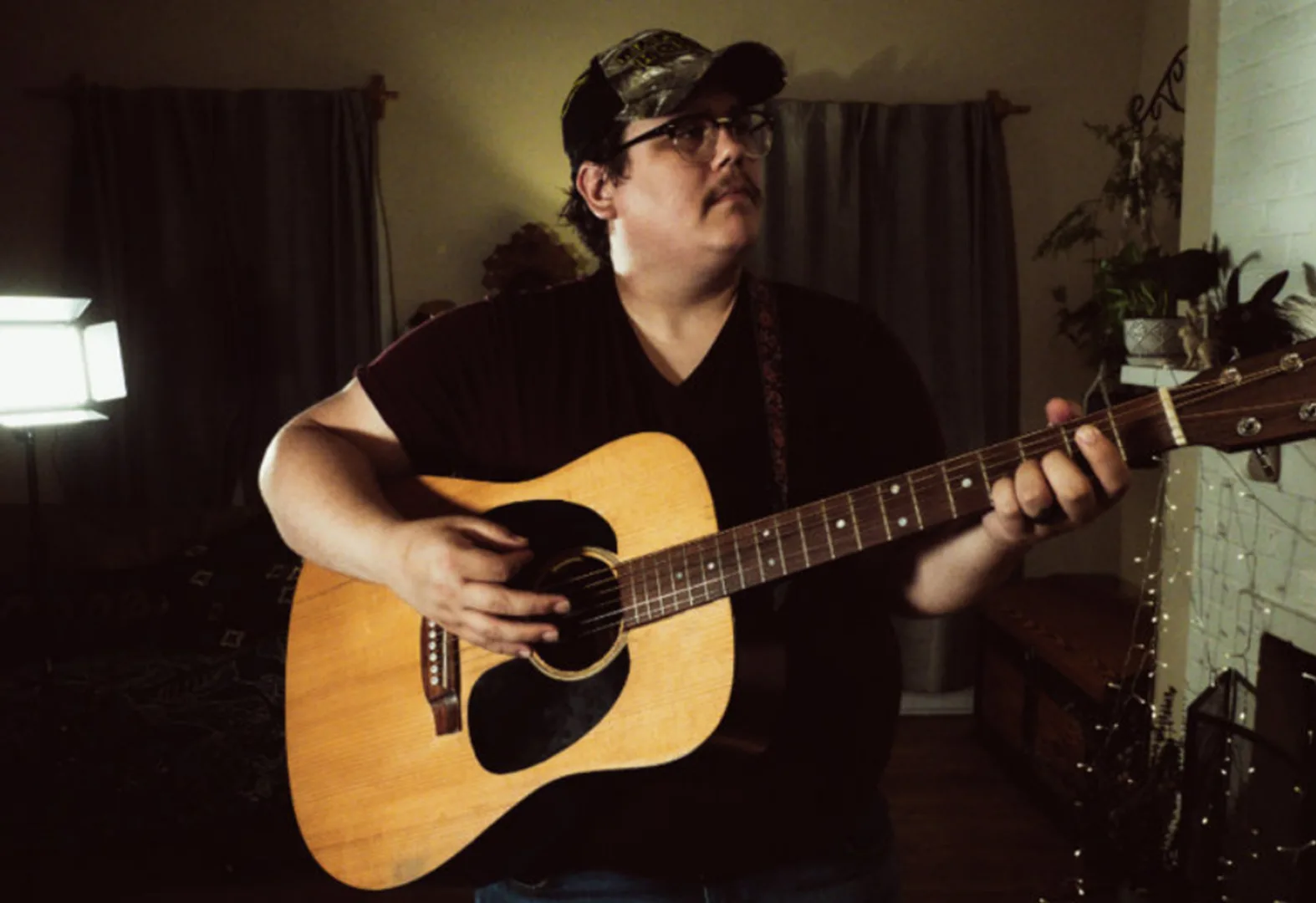
It didn’t take long talking to Max Lane to see that he’s never been one for doing things halfway. At 19, he left Louisiana for Kansas City to join an evangelical cult, not out of desperation, but out of conviction. Music was the only place he’d ever felt truly safe, and the International House of Prayer offered him the most extreme version of it he could find: midnight-to-6am worship shifts, bloodletting rock and roll, and a community built around singing until Jesus came back.
That same refuge would eventually cast him out. What followed — five years without music, heavy drinking, hospitalization, sobriety — would have broken most people’s relationship with their art entirely. Instead, it broke him open. When he finally picked up a guitar again, what came out was country.
Now based in Hillsborough, Max Lane is quietly becoming one of the most compelling voices in a local alt-country scene rife with heavy-hitters. His latest solo EP, Backsliding, works through the wreckage of faith, trauma, and belonging with the kind of hard-won plainspokenness that recalls John Moreland or early Jason Molina. And as a fellow born-and-raised Christian, it was easy to get philosophical about a world where empathy is now considered by some to be a sin.
You came here from Louisiana originally?
Max: The trajectory was Louisiana, Missouri, here. I grew up a Navy kid, so I claim Louisiana as my lineage. Most of my mom and dad’s family is from there, near Ruston in north Louisiana. They both grew up in the same town and got married super young.
I grew up on the road because I was a Navy brat, bouncing between bases. My dad retired from the Navy in 2000 — literally right before 9/11, honestly, the luckiest timing — he had put in 20 years, and he retired in Baton Rouge. That’s where we lived for most of my growing up, from about age 9 until I moved out at 19. Then Missouri for about five years.
So what took you from Louisiana to Missouri?
Max: Around 2009, I moved to Kansas City, Missouri, to join an evangelical doomsday cult called the International House of Prayer. And that’s not an exaggeration. It’s not a normal church. They have a crazy operation: 24/7 music, non-stop, to “sing until Jesus comes back.” They’d been doing it for over 10 years at that point.
I was growing up Christian, neurodivergent, and sheltered, and that felt like the most hardcore thing I could possibly do. So I joined one of the teams that would do two-hour slots. And when I talk about worship music in this context, I mean bloodletting rock and roll. My musical church background is not what many people picture. I grew up at a rock-and-roll church. As weird and fucked up as it was, there was some genuinely good music that came through there. That’s how I cut my teeth.
My whole goal was to go be a full-time music minister, because music was the only place I ever felt safe. I first joined a worship team in Baton Rouge, where I grew up, then brought that musical interest to the Kansas City cult after I moved out — and grew a lot musically because I just did it all the way. I was part of a group called the Night Watch. I’d go from midnight to 6, worshipping Jesus, then sleep a few hours, wake up, and go work at Target, then come back and do it all over again. That was life.
But in that, I actually met my partner, since she was there too. We’re still together. We would never have met each other if not for this crazy cult, so there’s that. We started dating in 2015. We dated for six months, then I asked her to marry me, and we were married just about a year later. We’ve been together 13 years now and have two kids.
That is a wild story. How did y’all land in North Carolina?
Max: After I got kicked out of a church, I didn’t really know what I was doing with my life. Church and music were really all I had done. She’s from Hillsborough, and she said, “Let’s just go live with my parents until we figure out what the fuck we’re doing.” So I was working at Sam Ash Music in Raleigh, 45 miles from here, every day.
Having that church community was my way to bloodlet. No matter what was going on, at the end of the day, if I could go on stage and play loud music, just scream for a while, and I’d feel okay afterwards. When that was taken away, I just stopped music altogether for five years. I drank really heavily, to the point where I was hospitalized.
I’ve been sober for four years now. I feel like [being in a bar] doesn’t bother me as much anymore. It used to be on my mind all the time. Not like that anymore, thankfully. Once I stopped drinking, I used writing as a kind of therapy. Mostly writing songs in my journal. I didn’t pick up a guitar for five years. When I did finally pick it back up, I had to approach it in a completely different way. And what came out was pretty country. It actually felt good.

Where does the country sensibility come from? Who were the early influences?
Max: My earliest singing influence was Elvis. My mamaw says I sang Elvis before I even talked, because my Papaw was really into him. That was basically one of the only non-Christian things my parents would let me listen to in the early, early years. Then I got into rock and roll, and my Papaw got a little more concerned as I started bending the strings more. He was worried I was going to hurt the guitar because he was very much more of a precision country player; he was surgical with it, but I liked fighting with it more. I can’t help but bend strings when I play.
Growing up as a military kid, it was all very sheltered. VHS tapes with the commercials cut out; that’s how we had TV. When we got to Baton Rouge, we got cable, which was sort of a semi-normal early-2000s existence. But I was not bringing home an Eminem CD or anything. The stuff I snuck in was like, “Hey mom, we like rocking for Jesus.” She’d be like, sure, sounds good. I’d get a little suspicious when the first Christian metal CD showed up.
But whenever I’d go back to visit my grandparents in Ruston, my Papaw would pull me back into his office and pull out his old ’62 Strat — a ’90s reissue, but still a great guitar, three-selector — and jam country blues licks. It’s the best guitar playing I’ve ever heard in my life. My Papaw is the best guitar player I know; very Chet Atkins, articulate fingerstyle, thumb picking, playing everything at once. I don’t do that exactly, but it’s there in how heavily I pick with my thumb.
And my mom would write worship and gospel songs that had a southern rock-infused sound. It was cool and introduced me to songwriting. Those two things are really at the core of who I am musically.
Your latest EP feels like it’s still working through all the knots of that complicated relationship with faith, community, and music. Was that intentional?
Max: I’m glad you got that from it. It’s especially real now, in the post-Trump era, watching how Christian nationalism has co-opted the entire religion. I grew up Christian, so it’s strange to see that and have conversations with my church community and think: This is the opposite of what you raised me with. A lot of people have their own version of that reckoning.
The thing is, what we’re seeing now with Christian nationalism — how overt it is — is what I grew up in, but under the surface. It’s been brewing for a long fucking time. I didn’t leave ministry in earnest until I was about 25. It was around 2015, right when Trump first started talking about running, and I started noticing things in the church. At that point, I was already a bleeding-heart liberal within the church, which made me a target.
What has it been like reckoning with all of that baggage while still holding onto faith?
Max: It’s been: what do I do with all of this? All the musical history, the useless theological knowledge. The reckoning is figuring out what that looks like in a way that doesn’t trigger my religious trauma.
Then just earlier tonight was the first time I’ve been to anything resembling a service. We went to a place called Emmaus Way in Durham. It was really, really cool. There were other people from the scene there I didn’t even know were going: Chessa Rich, Lonnie Rott. The music was a Towne Van Zandt song, a Johnny Cash song, a Hiss Golden Messenger song.
It wasn’t a sermon; it was an idea presented, and everyone could ask questions or share their impressions. I was sitting there sober as a judge just thinking, “This is cool, but this is so…” I had to step out for a cigarette. Too many things were coming up at once. That was my first time in a church in over 10 years.
My wife was just like, “I know, I need to let you go do your thing.” I was having an existential crisis: “Am I going back to church? What the fuck?”
I still have my own beliefs. I’m still deep into theology; friend me on Facebook and you’ll get the theological side of Max. I feel a compulsion to push back on the Christian nationalist narrative among the people I grew up with. I should probably let it go, but part of me can’t. And that’s really what “Gospel” is about, this thing that burned me out so much. Like, am I ever going to experience it again in a real, healthy way?
Tell me about the recording process for the EP.
Max: The tracks that are out are all one take, start to finish. Just me and my buddy Josh Hawley, who works at the Speakeasy in Carrboro. He’s a multi-instrumentalist, recording genius, very ADHD like I am, so we’d go in, and I’d do one take on a click track. The church taught me how to play with a click track. So even the faster ones, like “Burnt Offering,” are on a click the whole time.
Those are the scratch tracks. Everything is being redone with the full band. But before I put out the full band versions, I wanted to release these raw takes because of how emotional and raw they were. The one-take solo versions feel naked, vulnerable. If I’m putting something out like this into the world, I feel like that’s what needs to come first.
You mentioned John Moreland as a big influence. Can you talk about that?
Max: In 2016, when I first heard “You Don’t Care for Me Enough to Cry” — growing up listening to country, that was the first time in a while I heard something that spiritually made me want to cry, and it wasn’t a church song. I was like, “Whatever that is, I want to do that. I want to be able to reckon with my own shit like that.”
John’s a church kid too. He grew up in the south, in Tulsa, Oklahoma, big into the hardcore scene. He told me they used to do shows in churches with circle pits.
Now you’ve just had your first full-band rehearsal. How has that been?
Max: It’s been really fun. All the stuff recorded right now is still at the demo stage, just me and Josh. But I had my first band rehearsal last week, and it’s the first time since the church days I’ve played with a group. I’m genuinely excited.
I went into this with no interest in being controlling. I just picked really good players, people I trust, and said play what you feel. I have a skeleton and a couple of ideas, but beyond that, just go.
Drew Howard on bass is a good friend who I worked with at Redeye. I was so excited that he wanted to play with me; he is one of my favorite people.
Jones Bell on keys is a killer player with a great voice; I know him from the Cave and the Chapel Hill scene. J. Candeed on drums; I’d only seen two clips of this guy playing and he just messaged me like, “I’ll play drums for you.” Dude, he’s so good. I have a kick-ass pedal steel player named Clay Connor, who I met here at one of my earlier gigs. What he’s going to do on “Gospel” and some of the other songs is going to rip your heart out.
Kyle Case on guitar, who has a country project called Craig Miller and the Killer Lites out of Greensboro. He’s like a dictionary of classic country, but he was also a church kid, so he knows how to blend some emotional rock stuff with country, which is exactly what I like. He plays this riff on “Burnt Offering” that gives very Dire Straits, and I was just like, “I love that. I never would have come up with that.”
They’re making me step up, and that feels good. It’s easy to get musically stagnant when it’s just you and a guitar. This is breathing new life into the songs. It’s getting funky, swampy, and Southern. We might cover a Roky Erickson song and put “Two Headed Dog” on the album. It’s getting exciting.

Let’s talk about the local scene. Who are some artists you’d want to shout out?
Max: Oh man. First, my buddy John Rodney, who does queer outlaw country. It’s country punk, almost, and it’s so much fun. My first gig was with Jesse Fox. Jesse and I are both on All Y’all, which is kind of a collective of local roots and country artists. He helped me get my first show outside of open mics after I sobered up. A lot of really cool bands on there — go check it out. Rebecca Porter‘s on there, she’s on the come-up, and her voice is insane.
Lonnie Rott, I love his music. Very contemplative, incredible voice, beautiful fingerstyle stuff. He was actually at that service I was telling you about.
Nicole Tester is so great. I did a gig with her at Neptune’s in Raleigh, and it was one of the first times in a long time that another solo artist made me stop and actually listen. I was just like, “Damn, this is really fucking good.” And she’s such a sweet person.
I caught her at the Pinhook with Bedroom Division, blankstate., and Grace Lucia not too long ago. That was a great bill.
Max: Oh man, I saw Grace Lucia perform for the first time at an open mic at Yonder, maybe three years ago, before she was really doing many shows. She went up, and I was just like, “What the fuck is this?” She wasn’t even 21 yet. So good, such a killer voice.
And Kit McKay. That whole band is great. The stuff they’re putting out right now is real alt-country in the best way.
Also Glamour World. That’s my best friend Ernest Smith’s hardcore band. Brutal as fuck, so good. That sound is kind of my other side of the personality. Actually, some of the songs coming out might go in that direction, at least rock and roll heavy.
Where do you see your music going from here?
Max: When I first started writing, it was all very traditional country. Now it’s more… I’m okay with saying it’s not strictly country anymore. There’s a little bit of 90s alt-country in there — Uncle Tupelo, Jason Molina, MJ Lenderman. Some Drive-By Truckers. Some punk. Even a little indie. It’s kind of all over the place, but I’m excited about it.
For the next level of the evolution, I think it’s going to be a good one. I’ve learned a lot. And the community here in the Triangle, we’re all really supportive of each other. There are obviously some artists from the scene who are too big for their britches, but for the most part, the ones playing local spots, we’re all buddies. As it should be.
There’s a lot of good country music happening in this area that the country music world just isn’t really aware of. I hope we get some more eyes on us. And honestly? Go to your fucking local country shows.
This interview has been edited for length and clarity.

Leave a Reply