
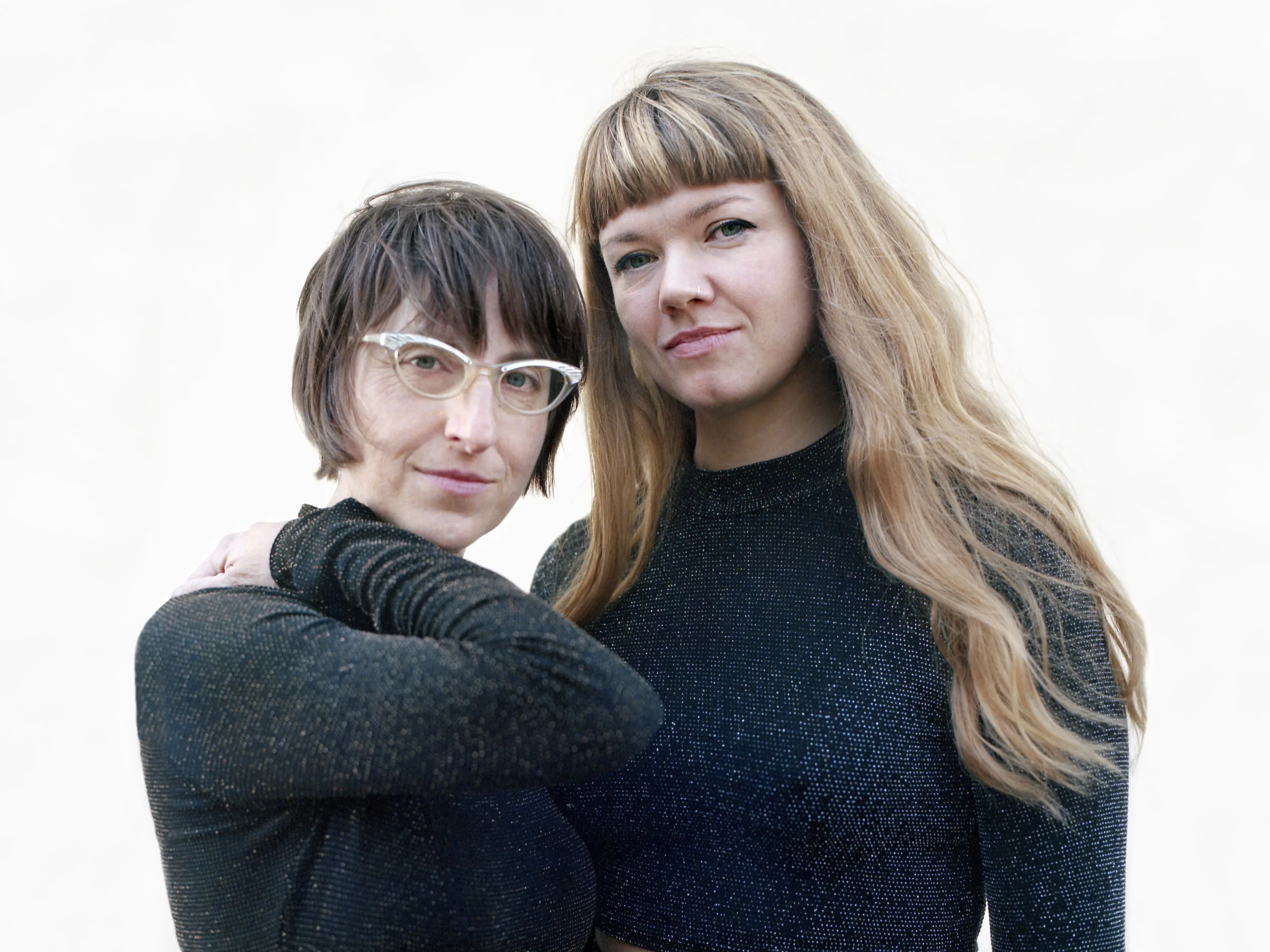
Private Cathedral is one of those acts that shouldn’t work on paper. What started as a graduate school thesis project between Scottish singer-pianist Genevieve Dawson and North Carolina multi-instrumentalist Wendy Spitzer became an exercise in persistence. One that weathered a continental divide and global pandemic to create a self-titled debut. Holding a vinyl copy is surreal, knowing that it took nine years of collaboration to get into my hands.
Despite their geographic differences, Genevieve and Wendy had strangely parallel journeys into music. Both had fled the same academic music world that nearly killed their love for creating. And yet, they found each other and their artistic freedom in a London graduate program designed for musical creatives.
Wendy had sent over their in-studio performance of “The Ghost and the Coat”, a complex art-pop song that wormed its way into my head and stayed there. When we met at Epilogue Books in Chapel Hill to discuss their journey, I was struck by how thoughtfully they reflected on their shared history. The next night at The Pinhook, watching Genevieve and Wendy perform for a packed, devoted crowd, it was clear that their nine-year journey had led exactly where it needed to.
What was the catalyst moment that got you into music growing up?
Genevieve: I was quite lucky that my mum taught herself the piano and she always sang with us. Me, my brother, and our younger sibling would sing together. I started writing songs when I was maybe 12 or 13 and grew up with a lot of music in the family. I’m from Scotland, and everyone in the family played or was involved with music. At family parties and stuff, we would all play together. It’s a part of the culture. I think I was really lucky in that sense.
I chose to study music at university because I didn’t really understand how you would become a musician. I was like, “I know I want to go into the world and make music, so I should go to school,” but I don’t think you need to do that at all. Just making music is enough. But I went down that path, ended up going to Oxford and studied a very academic, institutionalized version of what it means to be a musician. And then I had to kind of recover from that for about four years.
At that time, I still wrote songs, but I wasn’t performing. I was working in gender equality campaigning. And then I had a mega breakup with someone I’d been with for years. I was so fucking miserable. So I went to Goldsmiths[, University of London] and everything started to make a bit more sense. I was meeting people I wanted to make music and be in bands with. I made my first album out of that program. And it’s also where Wendy and I met.
Wendy: I also started music young with piano lessons because that’s what you do. And then I played flute in the school band for a couple of years and it was the worst. I was born in Canada and moved down to North Carolina. I didn’t have a flute to play in the band, but they needed an oboe player and the school had an oboe. That was the only reason I picked up the oboe.
Within a couple of years, I was just completely oboe obsessed. I was playing in the youth orchestra all through middle school and high school. I auditioned for the all-district band, all-state band, and all-state orchestras. And then I came to UNC.
I studied oboe performance all through undergrad, but by the end of it, I was feeling quite burned out. I sort of knew that I wasn’t going to become an orchestral oboist, even though that was what a lot of the professors figured was going to be my next step. But I was out of it. I knew I wanted to do something creative, but I didn’t know what.
A couple of years later, my boyfriend (at the time) and his band needed a bass player. And they’re like, “you’re pretty good at music.” [laughs] But within six months, we were recording and touring. It was right into the deep end. I got very lucky because that band, Eyes to Space, had really top notch players. You always get good by playing with people who are a little bit better than you.
Then other people started asking me to play bass in their bands. Those became my heavy touring years. I started my own band, Felix Obelix, and put out a couple of records. They’re completely bananas. But from that, I knew I wasn’t going to be fronting a band. That’s not really my style. But I burned out a little bit on that. I lived abroad for a little bit. I was a bit older and I knew that I was missing pieces of my musical and creative knowledge. I needed to go back and reassess the kind of music I was interested in.
I wound up looking at graduate programs in music, similar to Genevieve. I was trying to find something that would just allow me to do whatever I wanted. At the time, UNC’s music department was quite traditional and I wanted something different. There’s a Master’s of Music in Creative Practice course we were on, which covered pop music, classical music, sonic arts and production. And you can just pick whatever from all of them.

How did you decide to start making music together?
Wendy: This project came about as part of my Master’s thesis. I wrote about creative collaboration and how interpersonal relationships, trust, and vulnerability play out when two people are making something together. It was very heady and culminated in a performance, which we wrote a couple songs for. But we both were like, “This has some legs, we should keep doing this.”
It’s worth noting that when I came to graduate school, I was older in the program. Almost everyone was about 10 years younger. They were just starting the journey, but I thought Genevieve could pretty much do anything as a singer and as a pianist.
Genevieve: When I met Wendy, I didn’t really think far ahead enough to know we’d make an album. I just thought “This feels great to make music with you, so let’s keep writing songs.” I’d come from an environment where I felt criticized most of the time. Finding a collaborator like Wendy is important because she lifts me up a lot. She’s great at creating and thinks I can do the thing I do really well.
Wendy’s a really unusual musician in that she’s such a gnarly bass player that she could be in a heavy noise rock band. But then she plays the piano as if she’s from the 18th century, prog meets early romantic era. Just this incredible kind of compositional mind in a very different way from me. It was fun to play together because she would do things that I would never do, but I could then kind of do whatever I would do as a singer or as a player when she’s playing the bass.
What artistic freedoms did that afford you that you couldn’t explore before?
Genevieve: I do a lot of collaboration with different people. Often, you end up in one mode, where they play the piano and you sing, I play guitar and they play the bass. You have your thing, right. But we realized we had these different triangulations that we can try. Each one produces something a little bit different. When I play the piano, I’m thinking about chords and harmony, but Wendy is thinking in a more linear way about melody.
Wendy: And we both share the academic musical upbringing, so we can pull tricks out without having them be the focus.
Genevieve: When you’ve been institutionalized, you have to come to a place where you learn it to forget it. That’s the best case scenario because you can be free to make things, right? It’s the opposite of the institution, which is about critique.
We’ve both gone through that recovery process and understand there’s a lot that comes up in writing together with someone. It’s a vulnerable thing to do. It can be hard to let go of that voice in your mind saying, “That’s not good enough” or “That’s rubbish.” Especially when we’ve been in environments where there’s not that many women doing what we’re doing. We’re both quite good at being like, “That was sick, let’s do it again!”
At what point did Wendy move back to the US and y’all had to shift to remote collaboration?
Wendy: The move back was very soon after finishing the program. I left and sort of had this idea that I might never see any of these people again. That was incorrect. It wasn’t nearly as hard as I thought it was. But we did have to figure out, sometime in the course of the next year or so, how we could make this work if it was going to work.
Genevieve: There was a luck of the draw moment where my younger sibling moved to the U.S. and they were living in Connecticut. I had to come over to see them and decided to come to North Carolina. I came here first, we spent like a week writing some more songs, and then we put on a show at the Nightlight
Wendy: That show was really great. People loved it. We were stoked. So we said, “Let’s do this.” We got a grant from the Orange County Arts Commission and were planning on Genevieve coming back to record again. And then the pandemic happened. There was a point in the middle of COVID where I was like, “I don’t know if I’m ever going to be in the same country as this person. One of us might die before the end of it.” It was a dark time.
Eventually, we were able to have these intense weeks where I would come for a week or vice versa. We were sending long emails to each other. From that, we were taking some common themes and exploring them more.
Genevieve: I remember one story where I had this crazy job tutoring for a very rich family in the south of France. And I sent Wendy a small novella about this experience because it was very strange. It was just a stream of consciousness about the whole thing. The next time we saw each other, Wendy printed out the email and was like “This whole line about you being basically a servant in the 21st century. We’ve got to write a song about that.” That was how we ended up writing a lot of these songs, which I’ve never done before.

Did y’all do most of the work on the album in-person, or was it more of an even split between in-person and remote?
Wendy: Mostly in-person. We had the basics of the songs: I’m either playing bass or piano; Genevieve is playing piano and singing. When it was time to make the record, we wound up making it in December 2021 at Fidelitorium Recordings, which is owned by Mitch Easter, who produced the early R.E.M. records and is an NC music legend. We had Missy Thangs engineering it.
We had six days, which wasn’t enough. [laughs] We first tracked the things that we knew, and then it came to the last two days. We just went crazy. He has all these like vintage synths, a massive Leslie organ, so we’re cranking it up. The marimba and grand piano got on there. It’s incredible.
Genevieve: I’ve never been in a studio like it. I felt like I was in a James Bond film. Studios in London are all tiny, unless you’re working at expensive larger spaces. It was just such a luxury. I think that’s kind of how the album came to its true form.
Wendy: We wound up recording loads of stuff, but then had to do a lot of arranging and producing. All of that sort of editing was remote, but we mixed it together in London.
Genevieve: We worked with Callum McGuinness, who I work with often, at this studio called ZigZag. It has a rooftop that looks out over the whole city, so the hours were broken up with us going out and looking at a pretty cool view.
Wendy: By this point it’s 2023. We had more back and forths. It felt interminable, but I feel like that’s how good records get made. Eventually it was mastered by Jeff Carroll of Bluefield Mastering here in Raleigh.
When did the album feel completed and ready to shop around with record labels?
Wendy: It was finished at the end of 2023 and then in 2024, we sent it to everyone we could think of.
Genevieve: We really didn’t expect anything. But you have to go through that process, I think, because you never know who’s going to pick up the phone.
Wendy: Just when we thought about releasing it ourselves, we connected with someone completely out of nowhere. There was a Facebook poll from Glenn Boothe, who is a local promoter [andmoreagain presents] and used to own Local 506 years ago. He asks his music friends and music industry contacts for their top 10 albums of their year, then makes a massive list from every response.
I decided to put my top 10 down, with the added note of “We’re putting this album out next year, here’s a link to our single.” And a complete stranger saw it, a man named Chris who runs a small label in Florida called Barchan Dune Recordings. He liked the single, we sent him the album, and got into conversation. Barchan Dune ended up pressing the record to vinyl, which we didn’t expect.
Genevieve: It’s amazing the difference it has made to our sense of the project, just being able to hold it in your hand and know we made this real thing.
Wendy: Of course, we got put into the vinyl production pipeline, which takes more time. But here we are, almost nine years after we met, and the album is out. It’s a testament to us: that at all of these very dark periods where it seemed impossible, we put one foot in front of the other and made it happen.
Genevieve: So if anybody out there also is sitting on a record that’s taken years, just put it out. You’ll be dead one day. You can’t take it with you. It’s easy to dismiss this stuff when life is really busy, like “What’s the point?” The point is just to do the thing. Make something that wasn’t there before.
Can you tell me more about getting local arts funding? What is the process like for bands that might not be familiar with it?
Wendy: The big funders around the Triangle are United Arts of Wake County, Orange County Arts Commission, the Durham Arts Council, and the Chatham Arts Council And there are a couple of ongoing grants, like the Emerging Artists Grant from the Durham Arts Council. Those are just open calls for any artists in any art form.
Even though the local music scene in the Triangle is really robust and has been for decades, there aren’t as many applicants from people playing in bands, I think. There are lots of composers and jazz people who apply for these grants. You need to have work samples, maybe a resume, and a project proposal. The requirements are all a little bit different, but they are all online to look up and apply.
When we applied through the Orange County Arts Commission, we were going to do a couple of performances and in-person workshops. Genevieve has a background in creative choral workshops. Because the pandemic happened, we did an online virtual workshop instead, if anybody remembers what that was like. [laughs]
United Arts Wake County also gave me an artist support grant this past go-round. My project proposal was that I needed a new MacBook to do all this work on, because my old one was 10 years old and shutting itself off constantly. We made music videos for this release. All the artwork and flyers are done in Photoshop. It was on this new laptop that wound up doing much of that work.
It’s one of those things that I’m very grateful for, to have a little bit of extra. The Triangle has those resources. I feel like the local music scene, bands in particular, don’t know that they’re even eligible for these funds. But you are, if you can craft a proposal that makes sense. . So don’t discount it or count it out. I play and write pretty weird music and I’ve been funded a few times. I’m also a resource for any Triangle-based musician reading this; let me know if you have questions.

The album has been out for a few weeks. How are you feeling about this culmination of all this work? And what has the reception been like?
Genevieve: I feel that sense of “the work now belongs to everyone.” I’m excited for it to go on its journey. And for people to receive it however they experience it. People get such different things out of what you make, depending on their own experience. That’s the bit that’s so mysterious.
There’s this guy, Chris, who lives in Manchester and runs a pub. He heard about me through another band I play in. I posted about Private Cathedral through my own social media and I noticed that he’d started following us on Instagram. Then he sent me a message saying, “I’ve booked my ticket to London, got a hotel, and bought the record!”
London is quite far away from Manchester and I don’t really know this guy. But it was magical to see him so excited about our music. I don’t think it matters the scale of that; it just feels really good. Especially the way the world is at the moment. When things feel so divided and so disconnected.
I’m really excited for the shows. We’ve been working our asses off to play these songs. Let me tell you, we’ve not given ourselves an easy job. Re-learning playing this album has been intense.
Wendy: We have not actually played these songs live together since December 2021. The last 4 days have been focused on rehearsal. It’s been a very intense week. Lalitree Darnielle is opening for us. She put out an album [Forest Fires] last year that didn’t really get the attention it deserved, so it’s like a double album release.
We have this show on Friday [May 16th]. We’re also doing an in-store record show at All Day Records on Sunday at 5pm. On Monday we leave for England and literally a week later we play the big London release show.
Genevieve: In a very different kind of venue, but an equally beautiful place. It’s more like a jazz bar. It’s in a basement and it has a really beautiful piano in it. That concludes the world tour. [laughs]
But we have been getting some nice reception. People we know and people we don’t know. It’s an unusual record in many different ways. There’s a really great magazine called The Line of Best Fit, they put us on their Songs of the Week playlist.
Who are some of your favorite “local” bands, either here in NC or back in the UK?
Genevieve: Southeast London is a very special place. There’s so many amazing bands and artists that have come out there. There’s a band called Hejira who are not together anymore but I work with someone from that band. They released two albums, which are two of the best albums I’ve ever heard in my life. They did well but they didn’t go crazy. I always thought that they should have. There’s a song they wrote called “I Don’t Belong To Anyone” and that is one of my favorite songs.
Kae Tempest has risen to lofty heights. Their lyrics and the way they write is extraordinary. And seeing them perform, they have this clarity of intent. They know exactly where they want to take you and who they’re speaking to. I find that really inspiring.
There’s this singer in London called Momoko Gill. She’s also a drummer and has loads of projects. But she’s just about to put out an album with Matthew Herbert. He’s also a Southeast London composer, artist, and electronic musician. Everything I’ve heard from the album is super exciting.
Wendy: I already mentioned Lalitree Darnielle, but she deserves more love. Forest Fires flew under the radar and shouldn’t have.
My other pick is a live band I just saw a few weeks ago, Magic Tuber Stringband. It is very high-level string playing, where it’s folk music, but they’ve combined it with experimental music. I saw them live, and they were mind-blowing in their execution. I’m a recent convert.
This interview has been edited for length and clarity.

Leave a Reply