
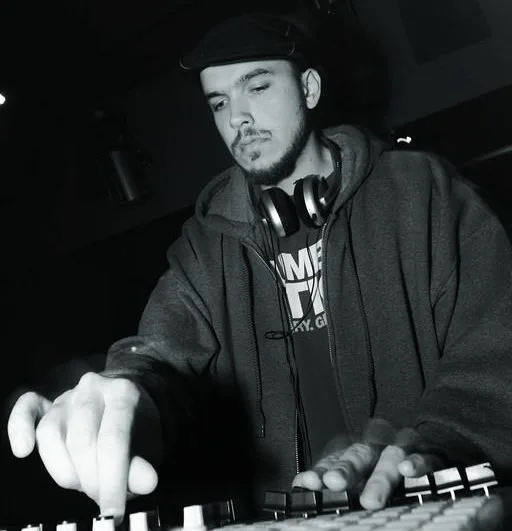
Ronesh has been rapping for 25 years, yet he says he’s only getting started in North Carolina. From Chicago to Oakland, he absorbed local greats and brought energy back to the scene that matched theirs. Since moving to Durham a few years ago, he’s taken a measured approach to getting back involved in local music.
Yet this past summer, he’s been preparing two shows at once: an Open Mike Eagle and Kenny Segal tour stop at Cat’s Cradle Back Room, which he landed through a decade and a half of loose industry rapport and a cold email, and an all-local eight-artist local rap showcase at The Pinhook.
These shows sit on opposite ends of what promoting actually requires. One takes matching a touring act’s routing and trusting an agent juggling fifty emails a day. The other demands building a lineup from artists he barely knows and betting that their audiences overlap enough to fill a room for eight sets. Both carry the same risk: if the numbers don’t work, he eats it, not the artists.
I sat down with Ronesh to dig into his Chicago roots, what brought him to Durham (and back to booking shows), and how he thinks through a scene that isn’t bound to any one city.
Anything you’ve been listening to lately that stands out, either new or something you keep coming back to?
Ronesh: I’ve got a few. I played the new Hieroglyphics record, All Set and Done, yesterday and today. I’ve been a fan of theirs for almost 30 years, and it’s cool to hear a group with that longevity sound age-appropriate. Not bitter old guys, but not trying to sound young either. The production is modern, but it doesn’t sound gimmicky or like it’s chasing 2026 rap trends.
The other one I’ve played a lot this year is Black Milk, a producer out of Detroit. I always thought he was a protégé of J Dilla, though don’t quote me on that.
Who was the first artist you discovered and got completely obsessed with?
Ronesh: Two albums came out the same month: The Fugees‘ The Score and Tupac‘s All Eyez on Me. I was in sixth grade. I heard them on the radio or on the school bus, and I had birthday or Christmas money, so I went to Best Buy and got the tapes, since they were a few bucks cheaper than the CDs.
That was the start of an obsessive dive into the hip-hop world. I’d go to the grocery store with my mom and read The Source while she shopped. I got the Columbia House catalog, thirteen CDs for almost nothing. At that point I didn’t know underground music existed. I mostly knew artists who got mentioned in The Source or played on the radio.
My introduction to underground rap came about five years later, in the early 2000s. I’m from the Chicago area, and there was a guy named MC Juice. Right after Eminem got famous, someone at school told me MC Juice was a Chicago rapper who’d beaten Eminem in a battle, and you could find the audio on Napster. Some friends and I tracked down his tape at a record store on the north side, Gramaphone. It sounded completely different from anything I knew. Rough sound quality, just a guy rapping over what might’ve been a four-track, punchline after punchline, super witty.
Around the same time, Atmosphere and Rhymesayers Entertainment were coming through Chicago constantly. I went to a bunch of those shows and got immersed in that whole independent rap world, artists touring and pressing their own albums with no major distributor, no video, no radio play. That’s when the idea planted itself that maybe I could do something like that with my own life. That was 25 years ago, and I’m still here.
Was Chicago your first real local scene?
Ronesh: Yeah, definitely. A lot of my strongest musical connections are still from there, just from the way those bonds form in your late teens and early twenties. You go through all kinds of stuff with people and come out closely bonded. We’d ride around to college radio stations, hit every all-ages show we could since we couldn’t get into the 21-and-up spots. Chicago in the early 2000s had a rich underground hip-hop scene. People from that era deserved more acclaim than they got, but they were superheroes to us regardless.
What brought you to North Carolina?
Ronesh: After Illinois, I spent a good chunk of time in the Bay Area, Oakland and Sacramento. I’ve only been in North Carolina for four years now. It was mostly family. My kid’s mom moved here for grad school, and I already had a brother in the area, along with other family nearby. My kid was one year old then, and being close to family felt more valuable than ever. I didn’t have anyone else from my side of the family on the West Coast. Now I can see my siblings and parents within a few hours, which is huge.
How did you first get plugged into the local underground scene once you got here?
Ronesh: Initially, I didn’t. I wouldn’t call it a hiatus exactly, but I was wrapped up in new fatherhood. The first couple of years out here, I didn’t have much opportunity to get out at all. I stayed aware of scenes through people I was already connected with online, back in the Bay or Chicago.
About two years ago, a friend back in Chicago told me he had a buddy in Durham, also from Chicago, named Otis Ghost. We connected on Facebook and realized we knew all the same people back home. He’d been here a few years longer than me. He asked if I wanted to do a show at Rubies [on Five Points in Durham], and that ended up being my first show in North Carolina. Me and Otis clicked right away; it’s likely we’d been in the same room in Chicago before and just never met. He’s been super supportive, introducing me to people and continuing to book me for shows. That’s how I got back outside.
That was strictly as a performer, though. The shows I’m doing now are actually the first ones I’ve thrown here, even though I’ve thrown shows in other cities before. I wanted to spend time feeling out the scene from the performing side first, learning what venues made sense.
I also started going to Genius Party in Cary, a monthly event focused on hip-hop and experimental producers, along with rappers and singers. I performed there, but mostly I studied what they were doing and met a lot of talented people. This year, I’ve had more time and energy to pursue my own projects. I’m still a very active father, but the intensity of how much I’m needed day to day has eased up a bit, which opened up space.

How did the Open Mike Eagle show come together?
Ronesh: I saw Mike was dropping a new album [Doomed!] and just emailed him, asked if he was touring it and whether we could make North Carolina happen. I’ve known Mike for about a decade and a half. I wouldn’t call us close friends, but we’ve been friendly for a long time and have crossed paths a bunch on the West Coast.
It took a while to get everything lined up with the right date and venue. I’ve booked shows before, but never one where I had to match an artist’s existing tour routing. Their agent has to figure out whether the show even makes sense given the other cities on the route, whether Carolina fits the path or gets left out entirely.
That’s a whole job I have massive respect for. They’ve probably got fifty other emails to juggle, dates that don’t line up, cities that don’t work. But his team has been great to work with.
Why does this particular pairing make sense for this region?
Ronesh: I’ve been a fan of Mike’s music for a long time, but I also think this region embraces left-field, unconventional pairings in general. The greater Durham area leans toward things a little outside the norm. I wouldn’t say Open Mike Eagle‘s music falls that far outside traditionalist hip-hop, but the presentation and the content are often very unique. That’s part of what I love about it; he’s doing something nobody else is doing.
Kenny Segal produced the latest record. I wouldn’t call it experimental exactly; when I think experimental, I think more toward noise, but it’s boundary-pushing in both content and style. It pushes against your expectations for where a song is going.
I expected it to be dark and sad, and to some degree it is, but it doesn’t leave me feeling heavy when I listen to it. I find myself chuckling more often than not. There’s a line about switching doctors after his marriage ended because he got kicked off his ex-wife’s insurance. It’s not happy content, but it’s real, anyone who’s dealt with a weird insurance situation is going to relate, even presented with a laugh.
What have you learned from being on both sides, performing and booking, that you had to figure out by doing it?
Ronesh: You have to be comfortable with the risk you’re taking on as a promoter. I have to be okay with the possibility of a show flopping completely. I can promote it as hard as I can, do everything right, and if not enough people show up to cover costs, I need to be prepared to handle that financial obligation myself.
I’ve been on the other side of that as a performer who didn’t get paid, and it sucks. I’m not going to do that to anyone I book. If I can’t honor my agreements, I shouldn’t be throwing the show. That’s the real business side of it.
The other big one is building a lineup that actually makes sense. For the Open Mike Eagle show, his team worked with me collaboratively on that. I’m performing on the bill too, and as the promoter I put myself last, opening the show instead. I trust my own crowd will show up regardless of where I land. We’ve also got Katie Blvd, a talented producer, singer, and rapper I did a show with last year, another left-of-center artist. With her, you’ll see and hear something you haven’t before. That fits what Mike’s doing and what I try to do myself. I kept that bill pretty small on purpose.
The Pinhook show in November is a different animal: eight of us, all local, pulling from a few different worlds instead of one touring headliner. That can go sideways if it doesn’t cohere. Ideally, if someone comes out for one specific opener, whoever plays next should be compelling enough to keep them there. You can’t guarantee everyone stays for all eight sets, so there’s a balance between enough variety in the sound and enough cohesion to hold an audience. some of us are on the older side and have been doing this a long time, while a couple of the performers are 22 with young, energetic fan bases who might stay out later than my crowd will. A lot of that lineup instinct comes from years of experience on all kinds of bills, seeing what’s worked and what hasn’t.
Digital marketing is the newer challenge for me. The last show I threw before this run was in 2018 in Chicago, and it succeeded almost entirely on word of mouth with the artists involved. Now I’m learning Meta ads. I might try to get one of the younger artists on the bill to run TikTok for me. I genuinely don’t know how effective that is for promoting shows; I don’t even have an account myself. Instagram is enough for me to manage.
And venue matters. Cat’s Cradle Back Room is the right size for the Open Mike Eagle show, well-established, and I trust them to help get the word out through their own channels, local papers, online listings, and their mailing list. The Pinhook has been just as thorough for the Durham show. They sent me a detailed media sheet, which is actually how I found you.

How did you land on the lineup for the Pinhook show?
Ronesh: It started at a party back in June, thrown by Super Empty, part of their Summer Nights series. Super Empty had teamed up with Genius Party for something at Shadowbox that I couldn’t make it to, but I saw three of the artists who played there afterward: SACREDD919, ROHTWIQ, and their producer PROFESSOR PAYNE. They really impressed me – just the dedication, the energy, the connection with the people who showed up to support them.
It’s clear the three of them work closely together, and they’re at the start of what’s probably going to be a real journey musically. I think Ryan from Super Empty. saw the same thing I did and made a point to book them. I didn’t know these guys at all going in, and I wasn’t sure how it would land reaching out cold, but they were all fully on board to get on the bill. They’ve got a lot of music dropping this fall too, so the timing works out well.
Once I had those three, I started building the rest of the bill. I knew Otis and I would draw a different crowd. Then there’s MILLYDOTCOM, who I did a show with earlier this year. She’s not going to sound like anyone else on this lineup, partly because she’s the only singer, and partly because she’s just a phenomenal live performer with a great voice.
I haven’t met RIZZY in person yet, I’ve only seen clips of her at open mics, but I wanted her out here performing in Durham. And PROTON, I connected with online; he booked me for a festival he threw out of Pittsburgh earlier this year, so I wanted to bring him out to something of mine in return. There’s some overlap between these different worlds on the bill, but it’s not a perfect circle, more like a Venn diagram with real edges to it. I’m hoping for a strong night. This one’s going to run more on word of mouth and a push close to the date than advance ticket sales.
How does promoting an all-local bill like this compare to promoting a touring show?
Ronesh: It’s harder to move advance tickets when everybody on the bill is local. There’s no built-in urgency like with a touring act, where people feel like they need to lock in a ticket before it sells out.
Any other Triangle or North Carolina artists you want to shout out?
Ronesh: Big shout-out to Jooselord. I had the privilege of recording him at my home studio earlier this year for a project of Otis Ghost‘s, and everything he’s done and continues to do for this city deserves recognition. We’ve got big love for him. Also, the homie SkyBlew is making incredible music, and he’s putting together the Carrboro Hip Hop and Grooves Showcase (as part of Carrboro Music Festival), which I’ll also be performing at.
I also want to shout out G Yamazawa, even though I don’t know him personally. If he ever reads this, I’d love to talk about doing a show. He seems to have stepped back from posting online. I’m actually wearing a jersey he put out years ago. Long before I ever visited Durham, I was listening to his album Shouts to Durham, and it made this place sound cool to me. I’m a huge fan of everything he’s done, and it’d be great to see him do a comeback show.
This interview has been edited for length and clarity.

Leave a Reply