
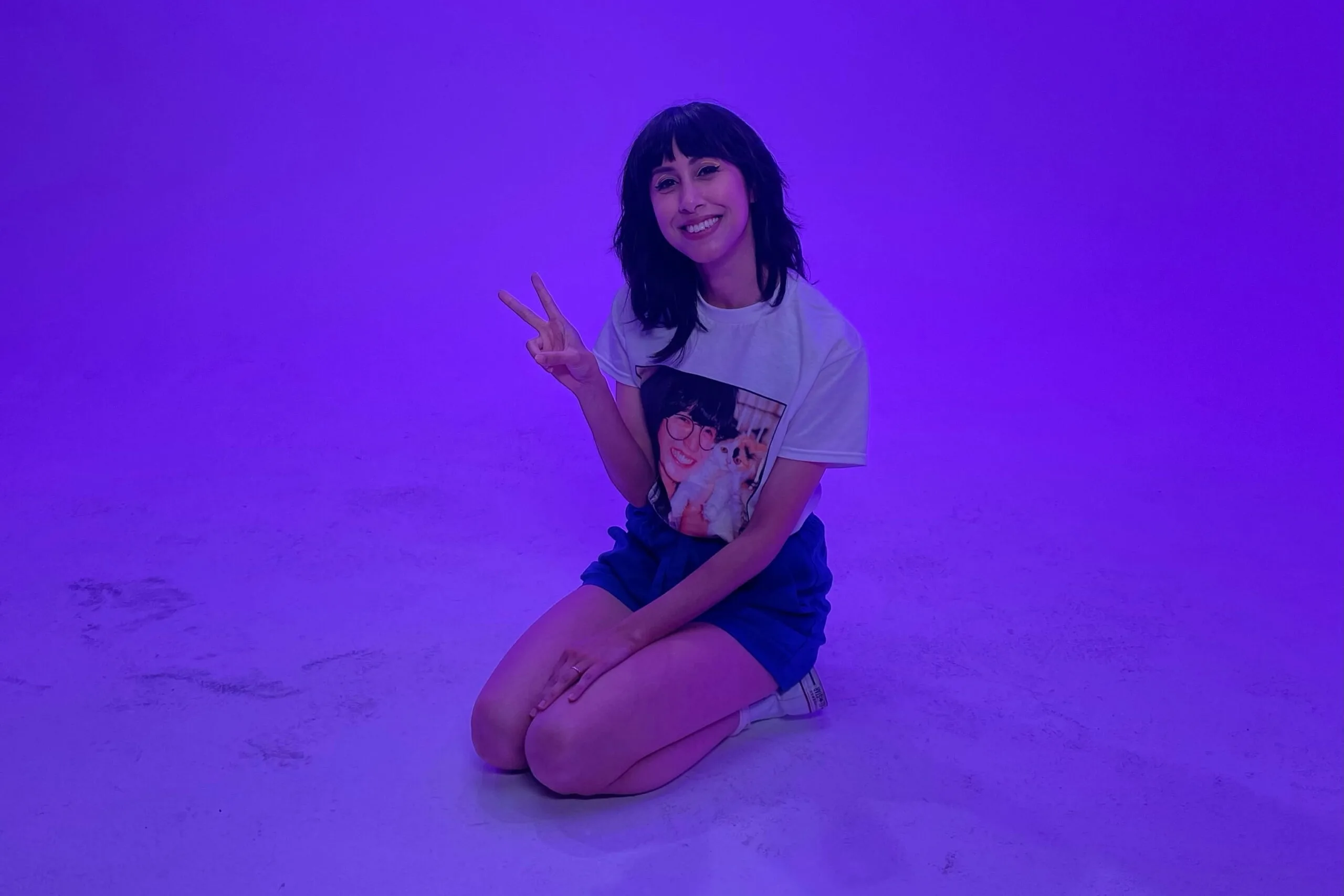
Header photo credit: Melanie Chin
There’s a version of the Teens in Trouble story that sounds like a lot of other indie rock stories: a project born out of a layoff, stalled by the grind of adult life, resurrected with a handful of songs written during the pandemic.
What makes Lizzie Killian’s version different is what she did once she had the songs. Rather than sitting on them, she leaned on the Bay Area indie network (specifically, Asian Man Records founder Mike Park) and built a recording lineup out of old friends and new collaborators she’d mostly never met in person. The result was What’s Mine, her 2024 debut LP that channels a lifelong Weezer obsession across a suite of infectiously catchy indie-punk songs.
Outside of that, Lizzie can’t help but get drawn into new projects. She’s put out two split EPs, one with Desert Mambas and another with Bat Boy, plus a live EP recorded at Phoenix’s Crescent Ballroom when opening for RX Bandits. She co-founded Sneak Dog Records, which features artists like Dog Party and Sweet Gloom. And in January, she took Teens in Trouble to Japan for the first time, playing four packed Tokyo shows just weeks after being asked to do it. All while holding down a full-time job in games PR, doing music PR on the side, and helping out with a booking agency.
What have you been listening to lately?
Lizzie: That’s a great question. It’s hard for me to listen to new music in general, but I actually have a weird, non-normal situation where I work in music PR and I’ve also been helping out part-time with a booking agency, so I’ve been listening to a lot of newer stuff I wouldn’t have otherwise.
All that to say, I’ve been listening to a lot of local bands lately. Beeper is a new one; they’re Chapel Hill area, more of a garage-y rock sound.
And then I’ve been going down the rabbit hole of older playlists. I have one with a lot of Osees on it, and they’re a band I love listening to over and over. And I can’t not listen to old Weezer. I think that’s just a through line in my life. I did recently listen to Pinkerton again, but more specifically, I’ve been listening to the B-sides from that era. Just needed that hit of nostalgia.
That’s interesting because you’re described as a “child of Pinkerton-era Weezer.” I also feel like they’re a classic example of whether happy people can make music as good as when they weren’t happy. What’s your stance?
Lizzie: For me, I’ve been in bands since high school, and a lot of what fueled the songwriting was angst and depression.
But now that I’m older and still writing songs, I feel like, all things considered, I’m a pretty happy person. I had to move through the angst. And I still write music that maybe isn’t happy, it’s just that I’ve had to make it more of a practice than something I wait for inspiration to strike on.
We just finished recording our second album, and I spent a lot of time last year writing for that record, establishing a daily practice. A lot of it was gibberish and things that will stay in my voice memos forever, never to see the light of day. But within that daily practice, every now and then there’s something you can follow through on or flesh out. I give myself prompts sometimes like, “I want to write a song about my dog, what do I feel about my dog?”
One song on the new record came from a mutual friend asking, “How are you and so-and-so?” and suddenly I’m thinking about a friendship that had fallen apart. You have to put yourself back in that place. It doesn’t mean you have to be sad or mad about it now, but it helps with the process.
Are there specific routines or places where you find inspiration striking?
Lizzie: A lot of shower singing. [laughs] Some songs we have out literally started or were finished in the shower. “Decomposing”, off our first EP, I wrote about composting. It was peak pandemic, I’d gotten into gardening like a lot of people, and I got a compost tumbler and was thinking about how you put all this dead stuff in, and it feeds things that will be alive.
I was having this really existential moment in the backyard, recorded a voice memo of the chorus, sat on it for a while, and then the bridge came to me in the shower. Same with “Brave”; I think I figured out the chorus melody in the shower. Songs can come up anywhere: while walking, doing chores, or on a bike ride. You just have to not be afraid of where they come from.
Can you walk us through the origin of this project?
Lizzie: When I started Teens in Trouble, it was 2015, and that was the first year I’d gotten laid off from a job. Looking back, it was definitely a blessing in disguise. I had been working nonstop since I got out of high school. I was living in San Francisco, where I’m from, and I was like, “Okay, I don’t want to jump into another job right away. I want to figure out what I want to do.”
Before this, I was in a chiptune band called The Glowing Stars that had broken up. It was a duo; our drummer was having a baby, I was moving to LA, and we were like, “I guess we can’t do a long-distance band.” “Santa Monica” was written about the time I was living in LA for a year.
With Teens in Trouble, I wanted to figure out my own sound and voice. I’d been in punk bands and other projects where I was kind of doing the same thing each time, and singing was still relatively new to me — there wasn’t much singing in my punk bands; you mostly had to yell “hey.” So this was me exploring that more.
During that layoff period in 2015, I released that first single with a B-side on a 7-inch. I had friends who played the other instruments, but I didn’t have a band per se. A few people offered me shows, and I was like, “I don’t have a band and I don’t even have more than one song.”
Then, a year later, I started working again, and music fell by the wayside. Every time I tried to get back into it, I was so deep in work that I had no inspiration. By 2017, I was thinking maybe I wasn’t playing music anymore. I can’t even write a song. I have to just work for the rest of my life. The American dream.
Fast forward to 2019, and I moved to North Carolina for my husband’s job. I work from home, so I could go anywhere, and I immediately fell in love with the music scene here. By August 2019, I’d joined a band called Blab School. We all met on Craigslist. The drummer Dave Cantwell put out an ad that mentioned bands I liked, like Talking Heads and Mitski. I had to tell my husband, “Okay, this guy on Craigslist, I think he’s not a freak, I looked at his Facebook.” [laughs]
We got along immediately. Ryan was the main songwriter, so there wasn’t a ton of pressure on me. I just had to show up and play guitar, which was awesome. We played our first show in December 2019. And then everything shut down.

Image credit: sasss world
It feels like a classic turning point for so many artists now. How did that affect you and your relationship with music?
Lizzie: During the pandemic, I started doing music PR. My main day job has been games PR since 2012, and out of boredom, I was like, “All my friends are canceling tours and still putting out music, so let me try to help them with their releases.”
While doing that, I was inspired to start writing again. A friend whose tour had been canceled was doing songwriting workshops on Zoom. Every week she’d give us a prompt, and we’d spend the following week working on a song based on it. It was a six-week workshop, and theoretically you’d have six songs at the end; I had four. Those four ended up being the songs on the first Teens in Trouble EP.
I also started doing The Artist’s Way [by Julia Cameron] around that time from a Zoom concert Rivers Cuomo was doing. While he was waiting for people to join the chat, he was answering questions. Someone asked what he was reading, and he said that. I looked it up and was like, why not?
So I was doing all of these workshops, morning pages, getting back into creativity. At some point, I decided I wanted to take a week by myself. My husband and I had been stuck in the same house for almost a year. I rented a place in Asheville for a week, went out there, and that’s where a lot of the bones for the first EP came together.
Looking back on What’s Mine, which has now been out for a little over two years — you’ve described it as exploring your relationship with art and your own voice. Does it still feel like yours?
Lizzie: That’s a great question, because now that we’ve finished the second record, I’ve had some perspective on it. After recording the first one, I was like, “I feel like I understand my voice a little more.” And one thing I took from that experience was to approach the record differently.
Teens in Trouble has always been my project, and when I’ve recorded, it’s always been friends playing bass or drums or things I don’t know how to play. But over time, especially after the first EP, I’ve been using the same people, so they do feel like the band now, and two of them have been touring with me too. With the EP, though, it was the first time I’d ever met half of these people in person.
Randy Moore, who produced the last few records and plays bass and lead guitar on a lot of the songs. I met him through the pandemic, doing PR for his other band’s release. When I was working on the EP, Mike Park at Asian Man Records, who I was doing PR for, listened to the demos and was like, “Oh, you should record with Randy.” I only ever met Randy on Zoom before we went into the studio. I was like, “Hey, Mike Park says we have to do this, so I guess we have to do this.”
Randy brought in Henry Chadwick on drums, who’s been on every record since and has been touring with us. There’s Mike Huguenor, who plays lead guitar on a lot of songs. I’ve known him since high school; our bands played together back then. I’d have to say he’s probably my favorite guitarist. Every time Rolling Stone puts out their 100 Best Guitarists list, I’m like, “This is an incomplete list.” And then my friend Sim Castro started touring with us; he’s now more prominent on the upcoming record.
With the EP, we tracked everything separately, which in hindsight felt like a safe approach. What you lose from that is the dynamics of everyone being in a room together. On What’s Mine, we recorded everything live in the room, still did overdubs, but when Henry was playing drums, we were all playing along and feeding off each other’s energy. While we were playing, I felt like it really made me want to move.
I’m still proud of the record, and it does still feel like me, but it feels like me from 2024. Since then, I’ve been working with a vocal coach who’s made me realize I can sing much higher than I thought. When we play those songs live now, some of them are a half step or whole step up, and it feels more energetic. And now this new record feels like me from 2026. These things are always a bookmark of a certain place in my life.
But yes, it does still feel like mine.

Image credit: kuylen.media
You’ve also done two splits now. What’s the appeal of that format, and how does the process work for folks who might not know?
Lizzie: A lot of these just come from getting excited about an idea with friends. With the Desert Mambas split, I had just finished recording What’s Mine, and I was amped about how fun it was being in the studio. I was talking to my friend Bailey, who is Desert Mambas, and it started with, “We should co-write a song,” and then bouncing ideas, and then, “What if we do a split?” and then, “Is a split one song each? Let’s do two songs each.” There was this whole text thread where we one-upped each other’s ideas.
At the time, Asian Man Records was putting out What’s Mine and Kill Rock Stars was putting out Desert Mambas, and we were like, “Do you think they’d be willing to work together and put this out jointly?” We had to get them on a call, and it felt like we were on a call with both of our dads, trying to show a PowerPoint. But they went for it.
For the songs, we looked at what we had in progress. I had “Sharon”, which is about my therapist who ghosted me, and “Winter in the Trap,” which I wrote about Traphill, North Carolina. Bailey had a song about Chicago and “Weird Mirror.” We had songs about places and mental spaces, and wanted to do something thematically tied to that. I think we’re the only ones who care about it, but we had fun.
With the Bat Boy split, we’d toured together and just fell in love immediately. Loved each other’s music, had so much fun hanging out. When we got home it was like, “What else can we do together? We’re on the same label, so let’s put out some songs!” For that one we decided to both write songs about the tour that started everything. That’s where “August” comes from, and their song “Oh Wee!”, and both literally just about hanging out. Then we decided to cover each other’s songs. We recorded it in January 2025, it came out in May, and then we did a tour around it. Now we’re touring together again and it’s the one-year anniversary of the EP.
The cool thing about splits is that you’re less precious about them. They come together fast, you put them out fast. There’s still a little bit of flaws in there, but it makes it feel more real. And then the natural follow-up is always, “Hey, we should do a tour around this.”
What was the story behind the Live in Phoenix EP?
Lizzie: That one came out of opportunity. We got asked to open for RX Bandits when they were doing their 20th anniversary tour for one of their albums. They were looking for support slots in Chicago and Phoenix, so we jumped on Phoenix because they had two shows. If we’re going to fly anywhere, it might as well be for more than one show. We played at the Crescent Ballroom, they had a really nice setup and recorded our set and just gave us the tracks. I listened back and it was actually pretty good. Why not put out the best songs on tape?
Around that same time, later in 2024, I started a record label with some friends called Sneak Dog Records, after the nickname I give my dog because he is a little sneak. The first release we put out was Dog Party, these two sisters out of Sacramento, a guitar-and-drum duo kind of like the White Stripes, also Asian Man Records alumni. They wanted to self-release something, remembered I’d mentioned wanting to start a label, and came back to me about it.
My co-founders have been really good with social media and graphic design. Which is great because I don’t have a graphic design bone in my body, but I can help market things. We put out their seventh album. And for the Live in Phoenix tape, we just did a limited run of 50 translucent teal cassettes and they sold out really fast. I want to do more stuff like that.
How has your approach to touring evolved over the last couple of years?
Lizzie: It’s actually evolved a lot, from being a solo project to being a band, which is complicated because most of the people I record with are on the West Coast. They’ve more or less become my touring band too. I kind of feel like this is the band, but we haven’t even officially talked about it. I’ve tried many different lineups over the years, and for a while it was unclear, even for me, how to make it work live.
Right now the touring lineup is Sim on lead guitar, who filled in one tour in 2023 and never stopped. That happened because we were doing a tour for Pouzza Fest in Montreal and I put out an Instagram post looking for a lead guitarist. Sim, who I’ve known since 2011, responded like it was a joke because he figured it was out of the question since he’s on the West Coast. And I said, “What if I fly you out?” He was like, “Oh, now this is real.” Then Henry on drums, who’s been consistent on the records. The tricky part has always been bass. Randy plays on the records, but he’s in a ton of other bands, so it’s a rotating cast there.
Because we’re all spread out, it’s easier to focus on tours rather than one-off shows. I do all the planning, and I try to anchor tours around festivals when I can. This upcoming run starts with Jorts Fest in Nashville — I may or may not have to wear jorts, they didn’t specify if it was mandatory — and ends with Midwest Friends Fest near Cincinnati and a show in Chicago. If we didn’t have festivals anchoring it, we probably wouldn’t have done this run at all.
I work full time, so our tours tend to be a week or two tops. Would I go on a two-month tour if it were the right opportunity? Absolutely. But we’re not there yet. For now, the goal is to lose as little money as possible, which is a whole equation. It’s a lot with van rental, hotels when we need them, flying people in, shipping merch. We’ve figured out a setup where I have equipment on the East Coast, and they have equipment on the West Coast, so we’re not flying gear everywhere.

We’ve gotta talk about your tour in Japan early this year. How did that come together, and what was the experience like?
Lizzie: We got the opportunity because of our friends Dog Party, who also run Sneak Dog Records with me. They got an offer to play Japan and decided to turn it into a short run. They’d played there before with a different band, Peach Kelli Pop, so they weren’t going in completely blind. At some point, I must have mentioned I wanted to tour Japan, and they remembered and asked if I wanted to do it. Before I even knew if I could make it work, I said yes. Then I quickly checked with my band, and it came together really fast. They asked me in December and we went at the end of January.
I didn’t know what to expect. I knew we’d do three or four shows, and I’d accepted upfront that it would probably be a money-losing opportunity. Flights, Airbnb, transportation to and from venues; none of that is cheap. But I had to weigh it. Like, we’re not making money, but what is it actually worth? It was a chance to break into a new market and hopefully start building a fan base there. And I think we did since we got asked to come back, so I’m hoping we can return for the LP2 release.
All the shows were in Tokyo, which made it easier logistically. We only stayed in one place instead of traveling across the entire country. I mean, obviously it would have been cool to also play Kyoto and Osaka, but honestly all four Tokyo shows were packed, and it was just this incredible energy from people who’d never seen us before. I’d never played outside of North America before, so that was a first for me.
We had this person there named Jin, who’s in a band called Teenage Slang Session, kind of a jazz-punk thing, really awesome. They played one of the shows with us, but also helped with the other shows, showed us around, and had dinner with us. It was so valuable to have someone who knew the city with us the whole time, because it’s genuinely a hard place to get lost in if you don’t speak the language.
This wasn’t my first time in Japan; I was there in 2018 for my husband’s work trip. Because it was his work trip, I was often alone. I thought it’d be fun to explore on my own, but my GPS wasn’t working, so I kept getting lost. And getting lost in Tokyo isn’t like getting lost in the US, where you can just look for street signs. It’s all in Japanese, and you can’t even extrapolate like you could in Montreal, where at least there are Latin roots. I was just like, “I feel like I need to go north. I don’t know why.” So having Jin with us this time, plus a working GPS phone, made a huge difference. And since it was half the band’s first time there, they were able to navigate just fine, too.
All the bands we played with were amazing, some of the best we’ve ever seen. Sometimes you play a show, and you’re like, “This lineup makes no sense.” But every lineup in Japan was solid. I definitely want to play there again, and next time I hope we can expand to places like Kyoto and Osaka.
What does the timeline look like for the second record?
Lizzie: I’m not sure, but I don’t like waiting too long once we’ve recorded it. I don’t want it to come out two years from now and feel like I’ve moved on. We’re in the mixing process right now, about half mixed, and we have a good sense of what the singles are going to be. I’m really excited about the new songs because they feel more fun to play live than anything we’ve done before. Not that What’s Mine isn’t fun to play, but this is just more energy. It’s funny because now the older songs feel so easy by comparison. I remember when we first started touring What’s Mine, I was like, “How am I going to sing ‘You Don’t Want to Mess with Me’?” It’s so hard. And now I can do it with my eyes closed. It’s weird to have to relearn your own songs.
So we’re figuring out the singles, figuring out which ones get music videos, and that’ll probably take most of this year. But we’re actually going to play some of the new songs live on this upcoming tour, which is exciting. Some people will get to hear what they sound like before anything is officially out.
Who are some of your favorite local musicians in Raleigh, the Triangle, and North Carolina broadly?
Lizzie: Beeper, definitely. They’re my new favorite right now. My friend Taylor Hollenbeck has a project called heartscape landbreak, kind of somewhere between Americana and indie rock, really awesome. I really love Charlie Paso; they’ve been a longtime favorite ever since I moved to Raleigh. I saw them for the first time at a Hopscotch day party in 2019 and I just love that guitar tone.
Fake Jr. is a great local band we’re playing with at Kings at the end of this month; they’re really good live. My friend Pat [Stovall, aka Kit McKay] plays bass for them, and this guy Kevin leads it. They’re part of this collective called the Honeyguide Collective that does a bunch of stuff around Hopscotch and the local scene, and they invited me to do their Live From the Nest acoustic series.
This interview has been edited for length and clarity.

Leave a Reply