
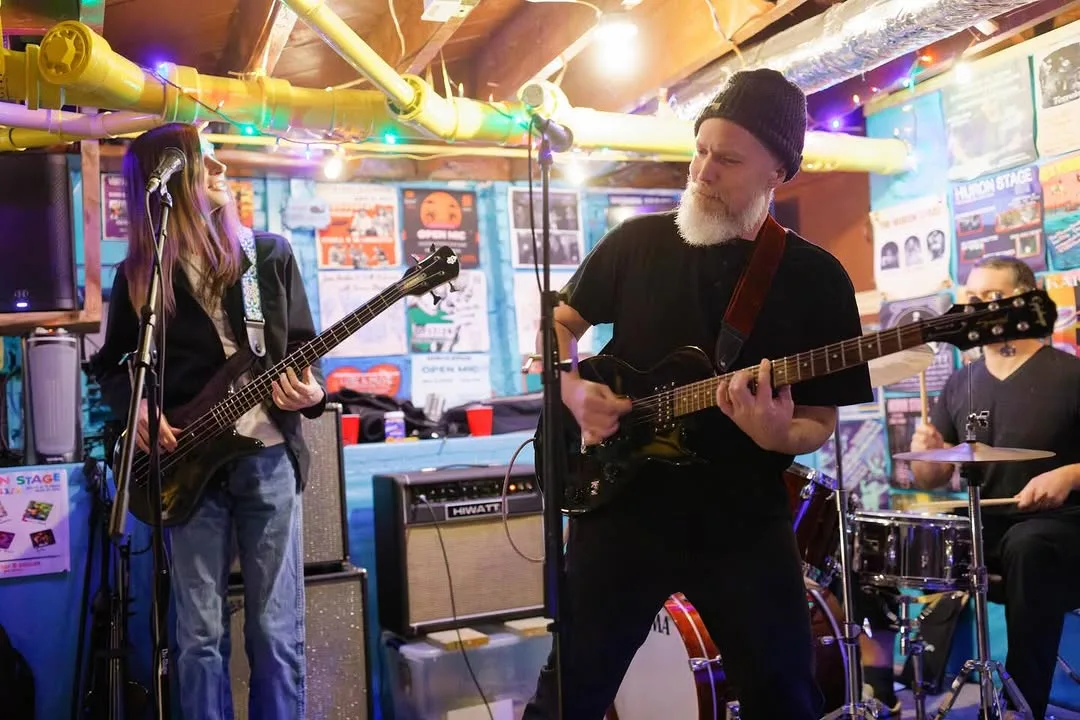
All photos credit: Kevin P. Neal
The Matildas will be the first to tell you they’re not trying to be cool. They describe themselves as “Durham’s okay-est band,” rehearse in a metal-walled storage unit off Highway 70, and record their music in GarageBand. Their drummer coaches Little League soccer. Their bassist joined the band because he answered a Craigslist ad and figured he’d at least get a good story out of it.
And yet there’s something genuinely compelling happening in that practice space. The trio — guitarist and vocalist Dan WB, bassist (and occasional violinist) Karl Nilssen, and drummer Aisander Duda — has quietly built a catalog of garage rock songs that punch above their self-deprecating billing. They’re tight, well-produced, and shaped by an everything-but-the-kitchen-sink range of influences. Their latest EP, Magic Mirror, sounds like the most confident work yet, the product of a collaborative process they’ve refined since the band’s unlikely beginnings.
What’s something you’ve been listening to lately?
Karl (bass/violin/vocals): I’ve been getting really into Knower. I’ve been exploring them a bit more than I used to. I went through Life, which is a bit more of an electronic album. It’s pretty neat but shouldn’t be played around children.
Dan (vocals/guitar): This week I’ve been listening to a lot of older stuff. There’s a great album by this band called Wilderness called Vessel States, put out on the Jagjaguwar label way back before Bon Iver and all that. It sounds like very little else; just thundering, majestic guitar sounds. I highly recommend everyone check it out. It’s very anti-algorithm. If you search for it, YouTube Music doesn’t like you.
Aisander (drums): This is going to be really lame but early 70s Genesis, when they were the Peter Gabriel prog rock Genesis. Mostly for Phil Collins‘s drumming. Phil Collins the pop star: super lame. Phil Collins the prog drummer: just amazing. So from a drummer’s perspective, that’s what I’ve been listening to. Another one recently is Esperanza Spalding; she’s an amazing bass player and has an incredible voice too.
Who’s the first musician you remember discovering on your own and obsessing over?
Dan: MC Hammer. 100%. I was seven years old and my babysitter was like, “This album will be absolutely perfect for you.” I memorized all the lyrics. It was just lyrically dense for a seven-year-old and really fun.
Karl: The first artist I got really into was Edvard Grieg, the Norwegian composer. I was like four or five, and I was just really into “In the Hall of the Mountain King.” And then beyond that, the Grateful Dead, because my dad was really into jam bands. I thought “Shakedown Street” was a really cool song, which is a funny one to latch onto because it’s like their one so-called sellout song that doesn’t sound like any of their other stuff.
And then there’s this little underground band called The Beatles. I got into them quite a bit. Those were the big three of my younger years.
Aisander: Weezer. Those first two albums are really great. It was the mid-90s, right in the crush of the mainstream grunge era, and I just listened to The Blue Album to death.
What inspired you to start playing music?
Dan: My parents were really musical. We had a piano in the house, and I just remember going up to it and hitting the lowest key over and over again, thinking, “God, that sounds so cool.”
Then in fifth grade my band director was recruiting people and said, “Your arms are long enough to play trombone.” So I started on trombone, discovered I had a knack for it, and went to Indiana University to study it for a few years.
At that point I decided I loved music as a hobby but didn’t want it to become a chore. Then a friend left an acoustic guitar in my apartment with four strings on it, tuned to DADA, and I started playing around with that. After a while I’d learned how to play the four-string guitar and had about ten songs, so I started playing guitar from there.
I grew up in the DC area, which had a really established punk/hardcore community. I went to and played in a lot of local shows. I built a lot of personal meaning at that time around being in a band, and I still think it’s one of the best ways to be in community with others: to continually share your art in person, in small local groups, with people who are really excited about the whole scene.
Karl: My best friend in elementary school joined the after-school violin class, and I was like, “I want to hang out with him.” He actually quit before I even joined, but by then my parents were like, “You’re involved in something productive, you have to stick with it.” [laughs] I actually really enjoyed it, so going on past that it was for the love of the game.
Eventually I found out I dug teaching too. I did some volunteer work in high school, then got a music ed degree. Unlike Dan, I wanted it to become a chore. Then during COVID I had an existential crisis: I used to practice violin constantly, and I was like, “Do I really want to keep grinding at that?” So I decided to transition and started picking up bass.
Aisander: In early middle school I saw Chick Corea and his live band play. They did this incredible, highly percussive version of “Spain” and parts of My Spanish Heart. It just completely blew me away. I’ve always loved jazz and 70s jazz fusion — Mahavishnu Orchestra, all the Miles Davis stuff from that period. Seeing that live, I was just overwhelmed by the musicianship and thought, “I’ve got to do some version of that.”
I started in concert band like everybody does, then moved to drum kit through high school and college, and played in jazz combos, rock bands, prog bands. That’s where it all started. I’ll throw some jazzy flair into things live — a little syncopated stuff here and there — though you’d probably hear less of that on the recordings since I’m just trying to get a clean take.

How did the band come together?
Dan: I’d been sitting on 20 or 30 bedroom guitar songs and wanted to start playing them for people. I met Aisander because our kids went to the same school. He mentioned he was playing drums in a band that wasn’t doing many shows, and I was like, “I’m going to snag this guy.”
He and I started playing in this shed I have in my backyard. Eventually we figured we needed another instrument, so Karl put an ad on Craigslist — something like “hey, I play bass, anybody want to jam?” At the time we were moving into a storage space rehearsal facility in this industrial zone off of Highway 70 going into Durham, so I told him, “Meet me at this totally not sketchy storage facility at night.”
Karl: I figured no matter what happened, I was going to get a story out of it, so it was worth it. To be fair, he did send me demo tracks first, so if it was a robbery, it would have been quite an elaborate one. I figured I’d earned it. And here we are.
Were the demo recordings on your Bandcamp recorded with all three of you?
Dan: Yes, once Karl joined we were like, “We need to start recording so that we’re a real band, and to make booking shows easier.” We’ve kind of fallen into this routine of recording EPs instead of albums, which feels like a lot less pressure and is more fluid. It’s also easier to conceptually group an EP together. We record everything in the storage shed, metal walls and all, and then go back and add some special sauce in GarageBand.
As you’ve gone through the recording process a few times now, what has changed or improved?
Dan: At first it was kind of like, “I have this song and we are going to play it.” Now it’s much more collaborative. I’ll write songs on acoustic guitar, but we’re a garage rock band, and by the time we get to the rehearsal space it’s like “This may not actually sound very good at full volume. So how do we make it more beautiful in a loud way?” It’s much more of a back-and-forth now than just handing off a completed work.
Karl: Song structure was more of a “here’s a song, let’s go for it” approach at first. Now it’s rare for a song to not go through at least four or five phases. “I’m Not Dead,” which is on the latest EP, has been with us since the beginning. I don’t even remember how many versions has that song had.
Dan: We just kept tweaking it. That’s a good example of the process: we’ll start a song, get to a point where we all look at each other like, “it’s okay,” and then whatever we do to tweak it inevitably changes the song altogether. “I’m Not Dead” used to be much more aggressive, especially the chorus. We quieted the chorus down to get that dynamic contrast.
Karl: “Riding in Cars” is another dramatic one that used to basically be a punk song and now it’s not quite that anymore.
Aisander: It was really fun to work through as a group. You develop this repertoire of styles and start to understand everyone’s taste and references. That one had this whole wacky middle section for a while — slowed to half-time tempo, did this ethereal thing — and then we were like, “Actually that doesn’t work at all. Let’s remove it.”
When you’re settling on lyrics to accompany a track, how does the idea marry with the instrumental? Does it come after you’ve figured out where everything is going, or is it percolating in the background?
Dan: My favorite part of all this is figuring out the melody line — where the stops are, the jumps, all of that. Once I’ve got that, a phrase will just come to me while I’m driving or wandering in the woods, and it’s usually slightly ridiculous. The phrase just has to lay over the melody well.
In the case of “I’m Not Dead,” I was like, “Yeah, Monty Python did it first, but I feel like I can make a song about it.” That one’s a deeply unserious song about someone whose friends all think they’re dead, but they’re not. A magical realism type of situation.
Aisander: That’s super interesting to hear, because I just assumed it was a midlife crisis song and it spoke to me directly. I was like, “I 100% feel that Dan, thank you for saying it out loud.”

When you’re playing live, how does the sound translate? Especially Karl, with the violin?
Karl: Still working on it, honestly. I don’t think I’ve ever done it completely cleanly. I did get a switch pedal though, so that should help. Generally the venues we’ve played have had pretty solid sound. I can’t think of one where I’d complain.
Dan: The shows are super fun, but on the technical side they feel like a constant moment of crisis from beginning to end. Just trying to make things work, pouring everything into the energy. When things go wrong it feels like an eternity onstage, but people don’t even notice in the crowd.
Aisander: We do a slight post-mortem after every show where we’re like, “Have we ever ended that song that way before?” No, not once. But we made it and nobody noticed the difference.
Who are some of your favorite local or North Carolina acts that are active right now?
Dan: I saw someone pretty recently who I was very impressed by: Celestogramme. Unbelievably odd but really beautiful songs. She’s a one-person show, she opened for Mdou Moctar when he came through. I would definitely see her again if she came to Durham.
Aisander: I’ll give a shout out to some guys we just played with at Slim’s in Raleigh. Run Hill from Elizabeth City. Incredible sound live, incredible musicians. Another local favorite of mine, because I’ve known them forever, is Hammer No More The Fingers. They’re buddies from way back in high school. When they play, they’re just awesome live, I really love them.
Dan: Oh, and we can’t forget to shout out the other The Matildas from Carrboro, North Carolina. Our sister band. [laughs] They’re more emo/shoegaze. We reached out to them, so hopefully we can do a show together.
And to any other bands out there considering what to name yourselves, please consider The Matildas.
This interview has been edited for length and clarity.

Leave a Reply