
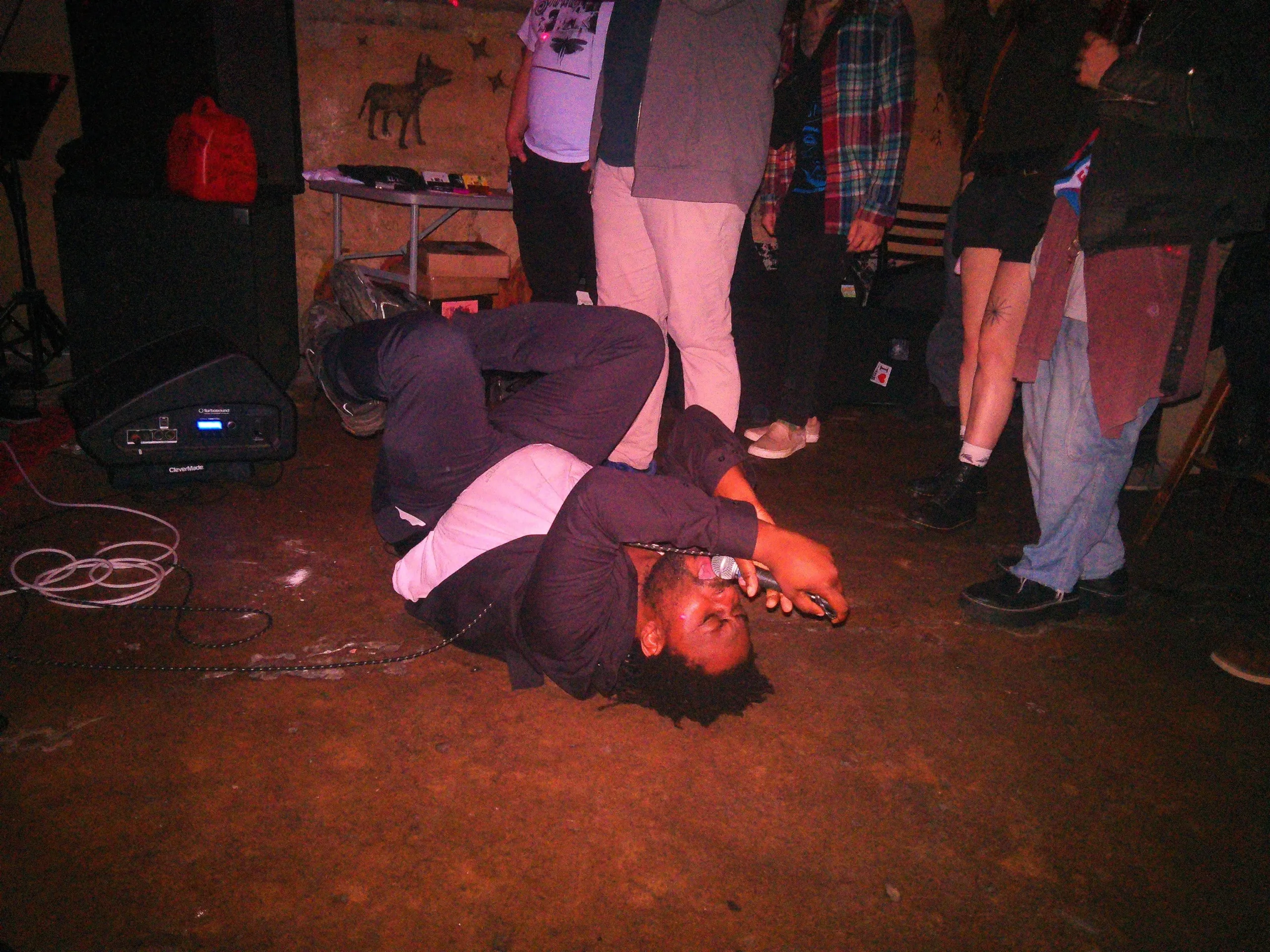
All photo credit: Brady McDaniel
Yuno is one of those bands that doesn’t fit neatly into any single music scene, both by circumstance and design. Spread across Raleigh and Charlotte, they’ve built connections in both cities’ DIY circuits without fully belonging to either, which might explain why they’ve landed in the hardcore punk-meets-skramz blend of genres.
To hear it from their (preferably anonymous) vocalist and primary songwriter, their 2023 LP Indie Show at Moralton has always felt like a time capsule. Each song was written across four schools and countless slow shifts at work, stockpiled in notebooks for years before a band existed to play them. When the lineup finally came together, those songs got the full-band treatment they’d been waiting for.
The album title alone tells you something about where the band is coming from: it’s a reference to Adult Swim’s Moral Orel, and the whole record operates in that intersection of being earnest, a little weird, and more deliberate than it lets on. With a split on the way and an expanding presence across both cities, Yuno is still figuring out what they are (but seems pretty comfortable with that).
What’s something you’ve been listening to lately?
Yuno (vocals): Kyle M’s The Real Me. 110% complete banger of an album. I feel like every album has a period of time it belongs to, and that one just feels like where I am right now. I’ve always been a huge fan of the guy, but this was the album that made me a FAN, if you feel me.
Going back to when you were first getting into music, who was the first artist or band you remember discovering on your own?
Yuno: There was one specific period of my life between sixth and ninth grade, where I went to four different schools. I remember listening to the whole discographies of Nirvana, System of a Down, Bullet for My Valentine, and Avenged Sevenfold. But I cannot remember which one was first for the life of me, so it was one of those in sixth grade.
That set off the whole rabbit hole of being obsessed with that kind of music in particular. It definitely got me down the path where I ended up going. I wanted a band, so those were the ones that kick-started the idea of “I want to play music, I want to sound like this.”
What was the next step toward actually starting a band? Did you have different bands in high school?
Yuno: Interestingly enough, Yuno‘s drummer is a friend I met in tenth grade, Mindi. I had moved to the high school I ended up graduating from, and we were both in the anime club. By that point in my life, I had gotten used to just walking up to anyone and saying, “Hey, be in my band.” He was one of the first people to say yeah. So that’s how he ended up where he is now. I tell everyone we’re married.
How has the journey gone since you two started playing together?
Yuno: We were going to school in Laurel, Maryland, so we were both in Maryland at the time. Tyler moved to another part of Maryland, and I didn’t have a car, so as far as I was concerned, he was out of state. I jammed with a few people around that time; he had done that too. Then I ended up moving to North Carolina, specifically the Raleigh area, and around the same time he started going to school at UNC Charlotte.
This time, one of us had a car, so it was much easier to set everything up. We had done a few projects online together, including one with a friend of mine in another band in Maryland called Kilbarron, who I think are great. We had this thing called Soil Oilers for a little while. We never played anywhere, just recorded it and dropped it on Spotify. We had 2 albums, the first was collaborative, but the second was mainly him.
You’re in Raleigh now, right? And the rest of the band is in Charlotte?
Yuno: I’m still in Raleigh. The rest of the band is in Charlotte. One of our guitarists was actually in the Rock Hill area of South Carolina. He just moved in with Mindi, and then our other guitarist is probably in Chapel Hill right now because I think he goes to UNC Chapel Hill, or his girlfriend does but he’s around here all the time. So we’re more or less Raleigh, Charlotte, all the way around.
What is it like making music across that distance? How does that impact practicing and putting shows together?
Yuno: As far as songwriting goes, I do all of it. Even before we had the full band together, we had already put the album out because we just decided we wanted to release something. Basically, I would write it and record it on some PC software, then send it to Mindi, who then records it and it sounds the way it’s supposed to when someone who knows how to mix things gets involved. Then I come down and record vocals with him.
For practice, we do about once a month at this one spot in Charlotte. For shows, most of the time we get asked to play via email. We have a private Discord server where we talk everything through, make sure everyone’s available, and figure out a plan if someone can’t make it.
The worst part is honestly just the travel time and gas money. But if there were no monetary issue, I would drive three hours right now just to say hello to them. That’s a sign of a good group to be part of.

As the primary songwriter, what was your perspective on putting together Indie show at moralton? And what’s been going on since then?
Yuno: That album is kind of a collection of songs I wrote throughout my life. I started songwriting around fourth or fifth grade. If you write a hundred songs, at least a few of them are going to be good. Something has to be good.
I would spend countless hours writing in class, at work during slow, four-hour shifts, and on weekends when I was supposed to have my books open. So when I wrote a lot of those songs, I didn’t really have an outlet for them until this project.
With Soil Oilers it was more like one of us would send a riff and the other would add something. But with this album, it was more like: here’s the notebook, the best of what you saw me working on for half a decade. That’s what became Indie show at moralton.
We have a split coming out in the fall with Kilbarron, that same band in Maryland. With that one, it’s been a lot more collaborative. I’ll send them stuff, and now I finally have guitarists who can actually write guitar solos. They add so much to just this little piece of rock I bring. They give it the googly eyes, they draw on the mustache, and that’s what makes it art.
How has your sound evolved now that you have more collaborators adding their own layers?
Yuno: It’s more that I can give them a reciept and they can turn it into a recipe. When it came to the original album, I didn’t want to write anything too complex because there was no guarantee I’d get someone who could play it. I was even struggling with some of the drum parts and I thought those were easy. I have never understood drums, I’m still learning. I was writing guitar parts on a really ancient guitar my grandmother’s boyfriend gave me for a birthday. The output didn’t even work; I had to literally go in and pull it just so I could plug in. And I was recording on a sixty-dollar bass I found somewhere, barely knowing how to play bass — which, I realized during that process, is a completely different instrument.
So I didn’t know if the parts I was writing would even be too complex. But the band I have now? They got it. They got it down. When we play songs live, sometimes they’ll add parts and I’ll go, “Oh, I didn’t even think of it that way.” It makes writing easier because now I don’t have to limit myself. It’s always easier when you have people who are better than you recording your stuff.
What has it been like navigating both the Raleigh and Charlotte music communities?
Yuno: It’s been really interesting, honestly. One of the biggest things is that because mindi went to UNC Charlotte, when we play in Charlotte, we’re playing to college kids a lot of the time. And most of our Raleigh shows are in bars. So one night we’re playing to thirty-five-year-old guys, some of whom have been in bands before, some of whom are going to be in bands next week, all of whom can drink.
And then another time we’re playing at a big festival in the heart of UNC Charlotte where the only drinking is soda or something hidden because people don’t want to get caught. In both situations you find really interesting musicians and bands, and you can tell they’re both just doing what they do. That’s always something you need.
Is there a show that stands out as particularly memorable?
Yuno: We don’t have the recording anymore, but bar none: our first ever open mic, the very first show we played. At that point we had a bassist, and we’d just gotten Eric, one of our guitarists. And the bassist flaked out of nowhere. So it was just me, Mindi our drummer, and Eric. They said, “You’ve got to play bass and sing.” I don’t remember the parts I wrote to most of my songs, I will admit that fairly. I remember the lyrics, thank God.
So we played through the set. It was glaringly obvious we were missing stuff, but in typical fashion, when things get chaotic, we start being chaotic. We were jumping around, extra loud for no reason. I think I tore my voice. We only played like two songs, and everyone was into it. We get off the stage and this guy comes up to us and goes, “Wow, I thought you guys were going to be like soul or something.”
Every time I tell that story, I think about why I didn’t ask him why. Is it because there’s three black guys in the band? Did we give off soul energy? I’ll never know. We’ve played plenty of better shows. We have more members now. But yeah, something going wrong and us just doing whatever we can, and then someone coming up to say something that kind of makes me want to hit them but I know they’re being nice. That’s pretty textbook for us.

You and Mindy met in anime club. How much does anime influence how you create music?
Yuno: I mean, the name of the band is an anime character’s name. It’s my favorite yandere. That’s why I named the band Yuno. When it comes to songwriting, pop culture in general influences a lot — there are so many references in that first album. The title, Indie show at moralton, is a reference to Moral Orel.
Anime influences it the most because anime was a good majority of what I was watching when I wrote a lot of those songs, and I still watch a ton of it. We all do. We finally showed our guitarists what the band name is a reference to, and I’m pretty sure they loved it. Anime is a huge part of the writing because when I’m creating, I’m usually watching something, and it’s usually a connection I’m making with that art that leads me to songwriting.
Do you see a trajectory in your songwriting based on what you’ve been watching at different points in your life?
Yuno: Yeah, definitely. Part of it is just that I watch a lot more stuff now. There are some things I wouldn’t have watched when I was a younger, lesser me. I can admit that. I hated Twilight purely out of spite. I have watched Twilight in the last five years and I was wrong. I was right about Fifty Shades of Grey, but I was wrong about why I was right.
The vast inclusion of all the new things I’ve seen, combined with the way media has evolved, it feels like media itself has divided to the point where there isn’t really good or bad anymore. There’s just “amazing” and “technically proficient at best.” And I love that some of the amazing can be amazingly bad.
I’ve been watching a lot of this director called David Decoteau. I’m in love with his work. And it’s stuff like that that compels me to write, because when I’m watching something and I can feel what a character’s feeling so deeply that I hear a guitar riff in the back of my head — I have to explore that.
Who are some of your favorite local or North Carolina musicians you’ve gotten to play with or enjoy?
Yuno: Starting with bands I want to play with: there’s this band called Ajena that’s really local. There’s a local house venue here called Merwin House, and they’re one of the bands there all the time. I love hearing them play. I know they’re working on a new batch of recorded songs and I’m excited for it.
In Charlotte, there’s this band called Syndicate99. I’ve adored screamo since I was a teenager. That’s actually how I discovered emo; I was a contrarian, so when everyone else was listening to Fall Out Boy, I was like, “No, it’s Sunny Day Real Estate.” [laughs] But screamo had my heart, and Syndicate 99 is one of those bands I would have had on repeat when I was seventeen or eighteen.
Red October is another. The first time I listened to them, I didn’t get it. But the second time, I totally did. They’re probably some of the best shoegaze I’ve ever heard. And DIT, who we just played with, is just a fun combination of music. They’re pop punky but not quite, and I always love pop punky but not. It’s why I still listen to some ska.
I also can’t forget Underthecatacombsofparis. I love them and Boygirl Rising, who knows everyone, including you (that is also a reference). I recently saw Donnybrook which, thank god, because I’ve been needing some heavier music in my life.
Beyond that there’s CarCrashPoolParty, Amateur Surgeon, Louder Transition Collective, Clout Funeral, Blue Tag, Ellie K, Vermillion Green, and so much more that it would require me to have an address book just to name even half of them.
This interview has been edited for length and clarity.

Leave a Reply