
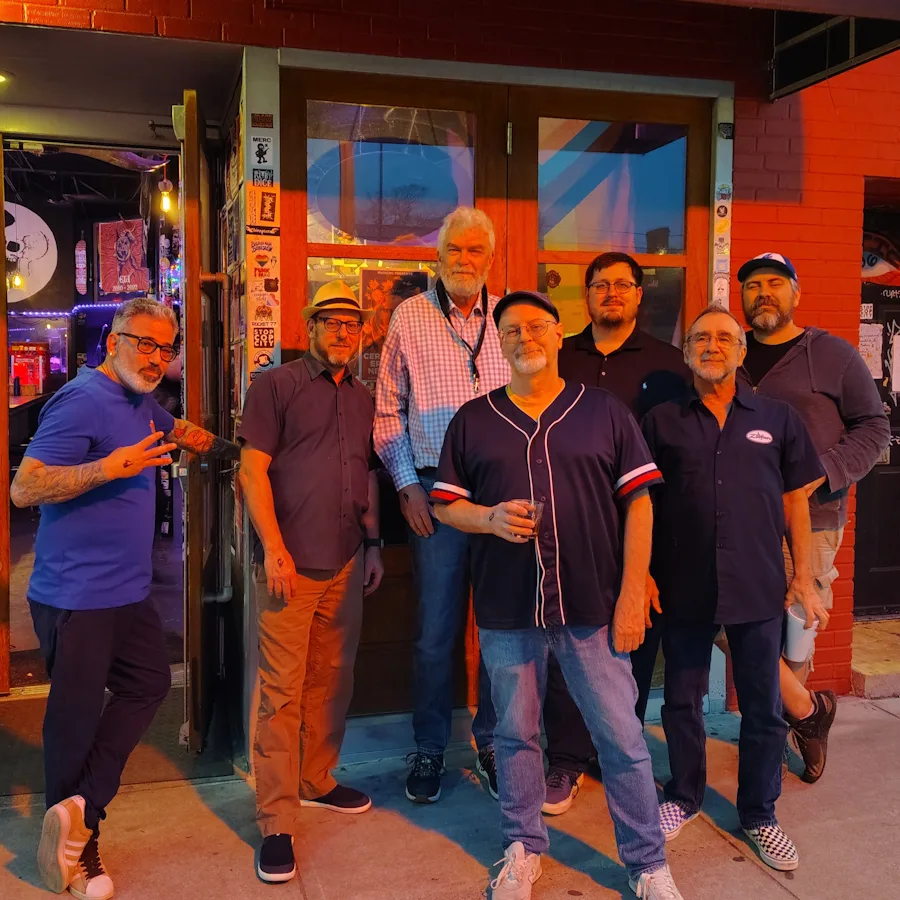
Thomas Szypulski (aka “Ski”) has been playing music in the Triangle longer than most. He moved from Pine Knoll Shores to Raleigh in 1984 for college and never left. Somewhere along the way, a trip to Jamaica in 1997 redirected everything. He started a reggae outfit and eventually found himself leading Sound System Seven, the fourth-wave ska band out of the Raleigh area that has become one of the region’s most enduring live acts.
Ska music, as Ski will tell you, is more than just punk rock with horns. It’s the mother of reggae, with roots drawing from Jamaican, British, and American cultures. Sound System Seven lives at that intersection: balancing the uptempo punch of third-wave ska with reggae’s minor-key soul, the jazz vocabulary Ski grew up absorbing, and a deep commitment to keeping it original.
Beyond the band, Ski has taken on an unlikely second role: archivist of North Carolina’s largely undocumented ska scene, tracing its roots back to the 1970s and preserving the stories of bands and musicians who might otherwise be forgotten.
What’s something you’ve been listening to lately?
Thomas: I’d tell you that I’ve been listening to a whole lot of a certain band, but if I did, it would be really easy to guess who we’re playing at The Great Cover Up [April 3 at Kings in Raleigh], so I’d better not say. Typically, my listening habits are lots of jazz and reggae. I will, every once in a while, get into some yacht rock that gets put into my playlist somehow.
I’ve been listening to a lot of Miles Davis recently, some Herbie Hancock, and a lot of The Skatalites. A bit of The Toasters, too; they’re probably my favorite band that I’m not in, and I’m so happy that we get to play with them on April 16th at The Pour House in Raleigh. I’ve been listening to the new Ruler! EP [Growing Pains] that just came out a couple of weeks ago, too.
Who was the first artist you remember discovering or having someone introduce to you that you claimed as your own and obsessed over?
Thomas: It was Christmas, right after I turned five. My older brother, who is 15 years older than me, got me a little compact record player and an Allman Brothers 7-inch record of “Ramblin’ Man.” I had never heard guitars like that. I had no idea there were like 11 guys in that band, that just blew my mind. How can you put 11 people on stage and have something that sounds so great?!
Well, I did eventually join a ska band, so I understand how you can get 11 people on stage and have it sound great.
What led you to first connect with ska as a genre?
Thomas: Way back in 1997, I visited Jamaica. That island has a vibe. You hear a lot of people talk about it, but it’s one of those things you don’t really understand until you’ve experienced it yourself.
I stepped off the airplane at the old airport in Montego Bay, Jamaica, where you actually walk across part of the runway to get to the concourse. As soon as my foot hit the pavement, it was like, “Oh, I can feel it.” I had been in a power pop kind of punk band up to that point. I came back two weeks later and said, “Fellas, I’ve got to quit the band. I’m going to go play reggae.”
So I put together a big old reggae band, and that was my focus for a while. For me, the lines between ska and reggae started to blur very early on. Basically, I figured out the only way I can really wrap my head around the difference is that ska tends to be more in a major key, and reggae tends to be more in a minor key. Beyond that, I think I can make an argument for ska being reggae and reggae being ska, no matter the song.
When did you start playing bass and playing in bands?
Thomas: I’ve been doing that since high school, so about 44 years ago. Just like every other kid, you want to be a rock star. I’d turn on all my favorite music as loud as my parents could take it and play bass guitar or electric guitar.
That same brother who got me the record player when I was five gave me a bass and an electric guitar. He was also a musician and very much wanted me to follow in his footsteps. My mother was very unhappy about that idea, but it ended up happening anyway.
What was the story of Sound System Seven coming together? Has the lineup always been the same?
Thomas: No. We started out from a band called Archbishops of Blunt Streets. We were starting to make a name for ourselves locally — getting good gigs, opening for lots of touring reggae and ska bands, and starting to make a name with the local venue owners. We just kind of had a split down the middle. The horn section went one way, and the rhythm section went another. Those of us in the rhythm section collected some new horn players and just kept on keeping on.
When y’all started playing out, was it mostly the Triangle at first, or did you branch out?
Thomas: When we started, we were doing more at the beach. It’s kind of a strange thing because we do primarily original material. We’ll throw in about 25 percent covers, just to snap the audience’s heads back around when they start to lose focus. We’d go down to the beach for a couple of weeks, stay at some places, and play two, three, or four nights in a row at different spots.
That started to get a little more expensive as we added more guys. We were doing it as a five-piece, and that wasn’t too bad, but as soon as you get six, seven, eight guys in the band, it gets more expensive than playing gigs where we can all sleep in our own beds at night.

How do you approach arranging for a band that size? It sounds like it can be complex.
Thomas: Arrangement for seven or eight guys is not a walk in the park. You have to remember the range of each instrument and make sure everyone stays in their lane. You remind the keyboard player that the bottom octave already has a bass player, and the top octave already has an alto sax. Be careful where you meander during your improvisational parts.
You can have eight guys on stage, no problem, unless they’re all playing the same thing at the same time. If you have polyrhythms and polyphony, you can be just as loud, but the audience won’t mind. But if everybody plays a power chord in the same range, the audience starts taking steps back from the stage.
We’re very cognizant of our scores and making sure we have a nice, clean, crisp sound so you can hear everybody. If everybody’s playing the same thing, it all becomes one big mush. Then somebody turns their amp up because they can’t hear themselves, and everybody else does the same, and all of a sudden nobody can hear themselves. A good arrangement and everyone staying in their lane makes it a lot easier to play music that the audience likes to hear.
As long as you have good onstage communication, even with that many people, it’s manageable?
Thomas: Right. As long as everybody’s not staring down at their toes while they play and everyone’s got a certain amount of situational awareness, you can communicate on stage. It takes some practice. Sometimes one guy gets lost in his solo with his head tilted back, eyes closed. You just respect his zone, eventually he’ll come out of it, jump up, look around like, “Oh no, did I…?” and you just say, “It’s okay dude, we were just following you.” You learn to communicate on stage, no matter how many people you’ve got up there.
Y’all just put out a new single/cover of “You’re Wondering Now” (featuring John Roy). What was the experience of recording that one, and what are your plans for music this year?
Thomas: Recording that one was a roller coaster. We had just about finished the process when we were given an opportunity to appear on a national ska compilation with a whole bunch of real heavy hitters. I didn’t want to include anything we were working on in the compilation because it’s a cohesive statement, and I didn’t want to disrupt that by throwing one tune onto a completely different album.
So we went back and remixed one of our older tunes from a couple of years ago, turning it into a dub-style instrumental. That took about five weeks, and then we got back into finishing the tune we just released. It was actually a lot of fun. It’s a cover of a really old song called “You’re Wondering Now,” originally done by Andy and Joey backed by The Skatalites. You’re probably more familiar with The Specials‘ version, but theirs was a cover, too, so we didn’t feel bad about covering a cover.
I got a whole bunch of local, regional, and national friends to appear on it with us, mostly singing. I sent them the basic tracks and said, “Do a harmony with what I’ve already got, do a melody, whatever. Just get on this and express yourself.” Twelve people sent me stuff, and then deciding who was going to do what was an amazing process because I got a bunch of friends who can really sing, and most of them sing much better than I do.
One of the people singing all the way through with me is John Roy from Smoke & Mirrors Sound System; they’re a very big West Coast band right now. I was so flattered that he said yes. I’ve also got my son on there, several folks from the area who are in other bands. It all came together very nicely. It was an intensive decision-making process more than anything else, but I’m really happy with how it turned out.
What’s your release strategy going forward?
Thomas: We like to do singles and release them about six to eight weeks apart. The thing about doing singles instead of an album is that when you drop an album, you’re in the studio for six or seven months, and you can start to miss the forest for the trees. If we concentrate on singles, we can get in and out with relatively quick recording sessions and then spend time on the mixing process.
Releasing an album, you get a whole bunch of attention for about three or four weeks, then you fade into the background again until you release another one two years later. Releasing on a fairly quick cadence — like a single every two months or so — helps the algorithm on streaming services put us in places we might not otherwise be, and it helps keep local attention, too. At the end of the process, if we’ve just released eight singles, well, that’s the next album. That’s typically how we do it.

One thing I really appreciated about y’all’s website was the way it chronicles local ska history. When did that come about, and what has the process of keeping that history been like?
Thomas: A lot of it for me was lived. I’ve been here since 1984. As soon as I got here for college, on my first night, I was at the old Crabtree Valley Mall in Circuit City, playing around on some digital keyboards, and the manager came up and offered me a job demoing them. So I’ve been living and playing music here for a long time. A lot of it I’ve seen myself; others I had to ask the right people.
Sometimes it’s a web search. Sometimes it’s saying to John Willse of The Jumpstarts, “Hey John, who do you remember when you guys started out?” That sparks conversations. And then, “Hey, Don Dixon, I know you from a while back. Tell me about The Pressure Boys.” I felt like it needed to be more than an oral history.
Several years back, online radio was really starting to get big. I had a North Carolina ska and reggae station on a platform that’s no longer with us. Way before digital rights management got as stringent as it is now. I had records going back to the 1970s. I’d put them out there, and others found them. Someone would reach out and say, “Hey, I was in this band; can you play us?” And I’m like, “Yeah, sure, share it.”
A lot of those guys I talked to about the early days aren’t around here anymore, and there weren’t a lot of people writing about ska in North Carolina back then. When you say “North Carolina music,” you’re going to think of mountain music, beach music. And if you really start digging, you might find some really cool punk stuff from the mid to late ’80s through the mid ’90s that you don’t know about unless you go looking. I wanted there to be at least a digital footprint of this stuff so that, if you have to use the Wayback Machine in 30 years to find out what happened to North Carolina ska, there’ll be some people on there who get to achieve a little bit of immortality.
I’m glad that resource exists and that y’all have kept it live and up to date. How do you try to make it as comprehensive as possible?
Thomas: At the end of each section, I say, “Hey, did I miss something? Should your band have been mentioned here? Let me know.” I want to make it as interactive as possible because the more of us who participate in something like that, the stronger the history will be and the wider its reach.
Who are some local or North Carolina-specific bands that y’all love and would want to shout out?
Thomas: This Wednesday evening, we’re playing at Local 506 in Chapel Hill with The Unsustainables and a band from Atlanta called The Bad Leavers. We tend to run in the same circles quite often with The Unsustainables. There’s always Plastic Flamingos, they’re great guys and a lot of fun to play shows with. I mentioned Ruler! before, but they’re fantastic.
Also, you can’t go to a Carrboro Music Festival without seeing The Spectacles and us. We’re all around here, all doing stuff, each with our own little niche in the local ska sound. What I love about it is that we’re not terribly competitive; everybody has a sound that goes well with everybody else’s. When we play together, which is pretty often, we complement each other.
Anything else you’d like to add before we wrap?
Thomas: Nobody joins a ska band to get rich. I think that’s something I love about the local music scene and statewide musical communities. The majority of people aren’t in it for fame and fortune because they recognize that it just isn’t there. Community is there.
The audience really makes it for us. The first time somebody was singing my own lyrics back to me from the front row, that was earth-shaking. But yeah, it’s all about the love of the music. If you’re on stage playing music you don’t like, the audience picks up on that immediately. And if you’re up there playing something you love — even if you’re not playing it perfectly — if you’re having a good time, that good time translates off the stage and into the mosh pit, the seats, the dance floor. It all translates.
So don’t get up on stage and let your day continue to suck. Get up there, have fun, be with your bandmates, make some music, get some people dancing. They’ll trade the energy right back to you.
This interview has been edited for length and clarity.

Leave a Reply