
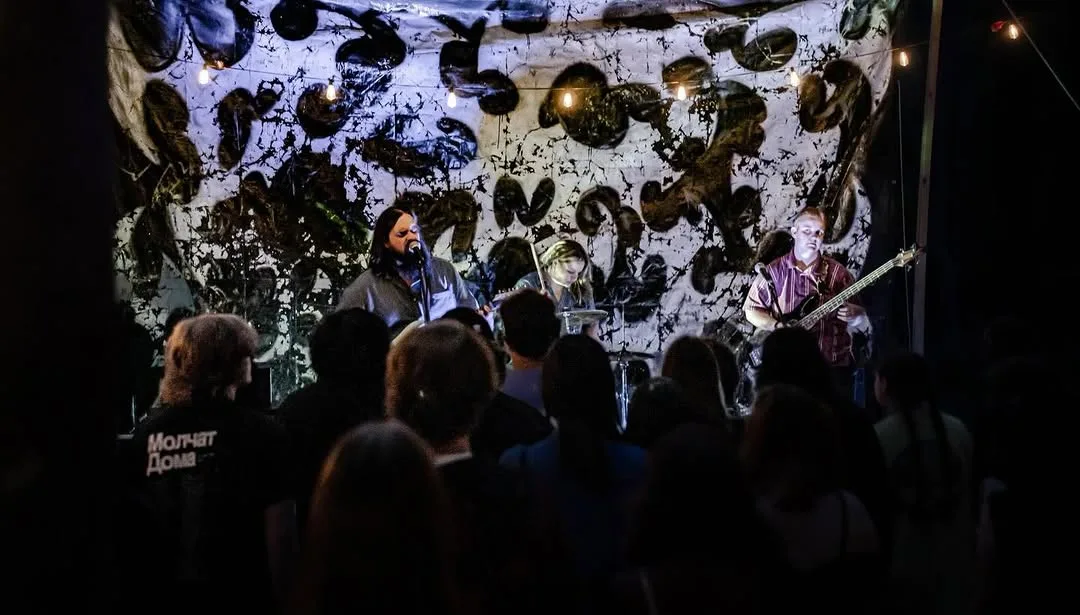
All photo credit: @jctech2112
Tyler Suggs has wanted to be in a band since he was nine years old. Not as some dream, but with the kind of conviction that survives awkward elementary school pitches to friends who didn’t own instruments, years of bouncing between bands, and the slow grind of writing songs for other artists who eventually walked away from them. By the time he threw a bass guitar at his best friend, Hannah Garand, and said, “Let’s just do this,” he had already learned most of what he needed to know the hard way.
That effort became Blissful Thoughts, a punk trio with progressive rock instincts, now with three full-length records under their belt. The latest, Freeing Yourself from Whatever It Is, dropped in early 2025 and has since coincided with what the band sees as a new chapter. The other two members are now based in Asheville, while Tyler still makes the drive from South Carolina every week, pumping his day-job money back into the band.
It didn’t take long on my call with Tyler to dig into (among other things) the community older brothers who handed him blink-182, unexpectedly opening for Danny Worsnop eight months into the band’s existence, and what Asheville gave them that years of bar gigs in South Carolina simply couldn’t.
What’s something you’ve been listening to lately?
Tyler (guitar/vocals): I just finished listening to The Stylistics’ self-titled record. They’re a soul and R&B group from the ’60s and ’70s. That record was their debut, and it’s really good.
Who’s the first artist or band you remember discovering that you just completely obsessed over?
Tyler: blink-182 is the first bug that bit me, and then it was like no return from there. I had a neighbor across the street who was a little bit older than me, and he had a brother who was quite a few years older. They just kind of exposed me to that whole Hot Topic culture, and I soaked up whatever music they were listening to. Like community older brothers, basically.
Did you go deeper into pop punk from there?
Tyler: Yeah, the journey was pretty much from blink-182 into more traditional punk rock. So I went from that to Descendants, Ramones, NOFX, and Bad Religion. They were my gateway drug into what most people consider the organic, real punk rock.
When did you join or start your first band?
Tyler: I’ve been trying to be in a band since I was nine years old. I would try to convince my friends in elementary school — “Hey, you look cool, we could start a band” — even though they didn’t know how to play an instrument.
The first band where it was actually starting to work, where we were writing songs, I was twelve and in seventh grade. Totally pop-punk ripoff stuff. This was in the late 2000s, early 2010s, when recording software was becoming more accessible. A friend had some cheap recording equipment, and we were just figuring things out in his room, trying to put songs together.
Did you keep that going consistently as you got older, or did you step away from music at any point?
Tyler: I’ve been doing it consistently, but it’s very difficult to find people who are as committed as you are. I played in a few bands here and there. I’m from South Carolina, and in my early teens we’d go play in Myrtle Beach, do odd gigs around town, jam band-type stuff. I kind of bounced around.
It wasn’t until college, when I moved to Raleigh, that things started to click. I was making some money as a songwriter and producer, working with artists, helping them write and record. When I graduated and moved back to South Carolina, I was like, “Okay, now I know how to write music. I need to invest that in myself and put a band together.” The band I have now came together almost as soon as I graduated.
Are you still in South Carolina, or are you based in Asheville now?
Tyler: So we’re a three-piece. Two of us live in Asheville permanently. I’m still in South Carolina, but I travel every week. My day job is still down here, but I’m always taking the money I make in South Carolina and pumping it back into the North Carolina economy. We’ve been in a slow process of all of us getting to North Carolina, which is still kind of in transition.

How do you make that distance work with practicing, playing shows, and recording?
Tyler: With recording, that’s the easy one. We’ve put out three full-lengths already. The first record had a drummer from South Carolina, when we all lived there at the same time. On the second and third records, I just played drums myself to make things easier. I’d go in, record drums, my bass player Hannah would play her parts, then I’d overdub guitar and we’d cut vocals together. We made those two records just the two of us.
We got a new drummer about six months ago, his name is Chris Semsey, and he’s really stepped up. He’s a much better drummer than I am and can play a lot more complex stuff, so he’s going to play on the next record. As far as practice goes, we play shows pretty much every week now. We rehearsed a few times with Chris when he joined, got to know one another, and now we just run the same set, maybe swapping one song in and out.
What was the original catalyst for this project?
Tyler: Not to sound cliché, but it really was just the dream I’ve had ever since I heard blink-182. I got burned producing and writing for other artists. We’d make really good records, momentum would build, and then that artist would quit, want to get married, have other priorities.
The last project I worked on, we were even having conversations with a small label that had a little distribution agreement. When that artist didn’t take it to the next level, I was like, “I just have to go back to my roots and write for myself in the context of a band.” My bass player Hannah has been my best friend since high school. She had moved back to our hometown, and I knew she could play guitar a little bit, so I literally just threw a bass at her and said, “I wrote some songs, let’s do this.” And we just hit the ground running with no stops since we started.
How did the sound of the band come together? Was that something you led, or was it a collision of influences?
Tyler: I write the majority of the music. Hannah contributes a couple of songs per record, too, and she’s really grown. When we started playing together, she wasn’t really a musician yet. She’s become one as we’ve been in a band together.
For me, I just wanted to start a band where I could take all of my influences, even if they seem contradictory or incompatible, and just express that. Blissful Thoughts is my vehicle to do whatever I want musically, without worrying about fitting a label. I understand that genre labels are a necessary thing — for putting together show bills and marketing — but I’ve always just seen myself as a singer-songwriter in the context of a band. This record may be one way, but maybe the next one will be a different way.
When you’re writing songs, is it primarily riff-led, or does your process vary?
Tyler: Most songs are just a compilation of riffs and chords that I put together. I’ll sit in my room and demo the parts out, and once everything sounds cohesive to me, I’ll demo the drums, the bass, any keyboards, or whatever. So I’ll have a full-fledged demo, and then I send it to Hannah and just say, “Do you think this is cool? What should I change?” She’s essentially the final person who approves whether we use a song.
Then I’ll come back to it — sometimes a year later — because the music always comes easy. It’s the lyrics and vocal melodies that I really zero in on. I want to make sure we’re not singing about cliché things. I want to give people something to think about, not in a preachy way, but just to offer a perspective. I spend more time on lyrics than I do putting the actual music together, because writing the music feels therapeutic and easy. The lyric writing is the real job.

How has playing in and around Asheville shaped the band over time?
Tyler: Absolutely, because when we were playing shows in South Carolina for the first couple of years, we were playing in bars to general audiences. You know, people who were there to watch a football game and didn’t care about our music. That gave us a level of grit. Then, kind of by a strange anomaly, we were only a band for about eight or nine months when Danny Worsnop from Asking Alexandria came through my hometown, and we happened to open for him. Hannah had been playing bass for less than a year. That gave us some confidence. Like, if we keep doing this, bigger things will come.
When COVID shut the world down, we heard Asheville had a great scene, so we went out there and started playing. Hannah moved there almost immediately. What Asheville gave us that South Carolina hadn’t was an automatic audience. It was like pulling teeth just to get one or two people to appreciate us before, but Asheville brought an audience right away. The culture there is much more open, and even the audience is very artistic themselves — that changes how you evaluate your own music.
I also started putting mosh parts in songs on the third record. That was a very deliberate decision. These kids like to dance, so let’s give them a reason to. But really, Asheville just gave us the reassurance and confidence to lean into whatever we do.
You mentioned working on a new record. Where does that stand?
Tyler: We’re in the demoing stages right now. When you’re making your first couple of records, you just pick the best songs you have and go record them. But now that we have people listening to us, there’s something to compare it to, so I get more cerebral about it. I have to one-up myself.
I’ve already gone to the studio and cut two songs that I decided we’re not putting on the record. We’ll use them as B-sides. So I’ve been in a kind of testing phase, throwing things at the wall and seeing what sticks. I’ve got maybe seven or eight loose demos, and I’m sending them to Chris so he can come up with his ideas. Then we’ll get together and jam on them. We’re actually taking April off just to work on music.
Is the goal to get the new record out this year?
Tyler: No, we’re going to spend the next year and some change promoting the most recent record, which came out in early 2025. We want to give it as much life as we can; we still have music videos to shoot and conversations to have. This month is actually the one-year anniversary of that record.
How has the response to that record compared to the first two?
Tyler: We were looking at the analytics at the end of the year, and they tripled over the course of that record. We held an album release party by renting out a conference room in a county-owned building, and we sold out. The new material has made our live set much stronger. People message us more about songs they connect with. It’s definitely given us a boost.
Who are some of your favorite local bands in Asheville or North Carolina?
Tyler: My favorite band right now is Once Below Joy; they’re from Charlotte, and they’re really good friends of ours. There’s also The White Horse from Shelby. And we’re really close with a progressive rock band called Raised by Sheep, who are from Virginia.
This interview has been edited for length and clarity.

Leave a Reply