
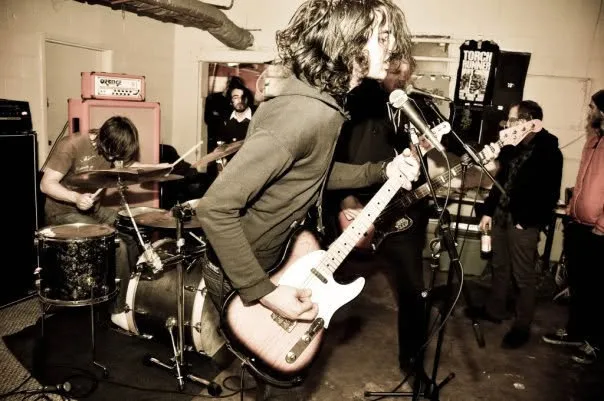
Life moves in cycles. To be reborn, you must die. Simple as. Systems’ Ghost Medicine delves into the final moment, the discomfort and purge that frees space for new life. The catharsis is violent and unpredictable, but a small price to pay for the result.
Ghost Medicine’s musical catharsis is an imposing first listen, a cacophony of black metal and screamo breakdowns divided by drawn-out sludge designed to disorient. The band operates as one rhythmic unit, delivering each note with maximum force. The riffs constantly twist and skitter, defying any attempt to find repetition. It’s not for everyone.
For me, nineteen and fresh off the high of As the Roots Undo, it was captivating. There is something new happening all the time. Partly because it’s so unpredictable and partly because it’s only available on Bandcamp, it’s still new to me fifteen years later. Some cycle of my own brings me back every six months to spend 41 (or 82, or 123) minutes awash in the flow, navigating incrementally better each time. Then I put it down and rest my brain.
There is vanishingly little written about Systems, their predecessor Chiaroscuro, or Ghost Medicine. The contents of their Facebook page are brief and full of show announcements. Coming into this piece, I expected to write about the Gatsby-esque longing incurred from loving a foreign local band (and how hard Ghost Medicine rocks). Instead, guitarist-vocalist Cameron Zarrabzadeh promptly answered my email and rallied bassist-vocalist Spencer Lee. If you, like me, have spent fifteen years wondering about this beast of a record, read on.
[Note: Cameron dug up these videos during the interview and later uploaded “The Desert” for the first time. Please enjoy responsibly.]
What have you been listening to lately?
Spencer (bass/vocals): I’ve been listening to a lot of Harvey Milk.
Where should someone start with Harvey Milk?
Spencer: It depends on where you’re coming from. If you want a more rocking record, I’d start with Life… The Best Game in Town or maybe The Pleaser. My personal two favorites are A Small Turn of Human Kindness and Special Wishes. Those two in particular are absolutely incredible. I think because of some label dispute, you can only find Special Wishes on YouTube. Fantastic record, big recommend.
Cameron (guitar/vocals): I’ve been listening to a lot of Iranian music; it’s been heavy on my mind recently. More on the Western track, I’ve been listening to this band Dark Chisme, a darkwave, goth-y project out of Seattle. I saw them play not too long ago.
How did Systems start? What was the intent, how did it originate?
Cameron: Peter (Gwynne, drums) and I were really good friends from 8th grade; he showed me how to play guitar. In high school in Charlotte, we were in a screamo/skramz band called Devar-Toi in which I played bass and sang.
When I moved to Carrboro for college, I somehow convinced Peter to move up there to play music. We got a house and started playing in bands with one of our friends, Taylor, who was also in our high school band. Eventually, we wrote enough material to come up with a band name: Chiaroscuro.
I met Spencer in my first year of college, around the time Taylor was moving. I remember we went for a walk in the woods near my dorm, had a good talk, and from there decided to start playing music together. Later, Chiaroscuro was setting up a winter tour, and I had met Daniel through some friends, so he joined the band and learned all the material in about two and a half weeks. I think about a year later we changed the name, figuring that Chiaroscuro was hard to say. We changed the name for practical reasons.
Spencer: We had a habit of picking up members right before tour; I started a week before that three-day thing down to Atlanta.
Cameron: Didn’t we play a house show in Raleigh too?
Spencer: I think so, Raleigh, Atlanta, and Columbia, South Carolina. That was the show where I realized I needed to get into Sunn amps. We were the first band at this house show; the second band was called Defeat. I never heard anything else about them but I remember they were really good. I was sitting outside at the merch table and Daniel walked out and I said “Hey, their bass tone is really good.” He started laughing and told me they don’t have a bass player. I walked in and saw that wall of Sunn amps. I think Cough played that show.
Cameron: I would guess that was 2009.
How was the name change received?
Spencer: I think people liked it. I remember we made the final decision in the van on the way to Greensboro.
Cameron: We did an interview that night and the interviewer told us they liked Chiaroscuro.
When you were Chiaroscuro, were you playing songs that would become Systems songs?
Cameron: We were working on this one really long song called “The Desert” that was really four “movements.” It came to about twenty minutes in length. That’s all we worked on for a while. After that, we started writing what would become the LP.
Spencer: That first year, even after I joined, was playing “The Desert” mostly.
Is there a recording of that?
Cameron: I found a copy I can send to you. Didn’t we play an early show in Durham with members of Thou?
Spencer: That was right before I joined the band. I went to the show because I had seen you guys play before. I don’t think we’d had our hang yet, but we knew each other, and I loved y’all’s band. I really wanted to play bass in it, and I was going to every show. It was Thou at Bull City Headquarters touring for Tyrant. There was some other band; I remember them being really good, but I don’t remember the name off the top of my head.

Whose idea was it to write a 20-minute song, and did anybody require convincing?
Cameron: I don’t think it was a conscious decision; at the time we were listening to a lot of post-rock: Envy, Mono, Godspeed You! Black Emperor, I think we were open to the long-form epic. When we were first writing, we had these riffs that were thematically linked, so the long song emerged. I don’t think anyone was opposed to it, and I think Peter was into it. I grappled with that at some points. What was cool was having continuous motifs and dynamics, but it’s hard to send to people. Do you remember having any thoughts about it, Spencer?
Spencer: I remember thinking it was really cool. It was a huge challenge figuring it out quickly. I remember being into it, but I have this vague recollection of starting on Ghost Medicine and thinking, “This should get broken up, at least into tracks.”
Was that kind of scope something that you had explored in previous projects?
Spencer: I had never done anything like that; I came from punk bands. It was new, but I was very excited about it.
Cameron: Our high school band wrote some long, 7-minute songs, so we had that propensity, but nothing that long. I haven’t done it since, either.
How’d you get into playing heavy music?
Spencer: From a very early age, I liked making noise, and also from an early age developed a lot of cynicism and skepticism about what I was told and how society operates, and that made a natural fit with punk rock when I first heard it.
I started a band in high school with a brother and a friend of ours, then started playing in a pop-punk band, which was a ton of fun. They were great folks, but by the time I was going to college, my interest in punk rock was branching into doom, sludge, grindcore, and powerviolence. I got into a lot more metal; I was itching for something heavier and more avant-garde.
Seeing Chiaroscuro was like “Oh, this is what I want to do.” I was really into Circle Takes the Square (CTTS) and Converge and a lot of the European emo at the time – La Quiete, Daitro – and Orchid and Ampere. Seeing Chiaroscuro was like “There are other people in this town doing what I want to do.”
Cameron: Similar to Spencer, I was always making a lot of noise as a kid. Music was a natural outlet for that energy. I know in about 10th grade CTTS first hit me. That led into screamo, punk, and hardcore.
I went to a show called For the Kids Fest. CTTS played, but it was this other band, The Kodan Armada, that was really cool. They played on the floor, and they have this song “Say Something” that ends with the chant “say something.” By the end, everyone was screaming it. I was screaming it too, but I had the lyrics wrong; I thought it was “taste the pain.” But it was that moment when you lost yourself in this catharsis, screaming on the ground with everyone. I remember the way that felt; that was it.
As for making it, I was in a band that played basic punk songs, and we were messing around after practice. I grabbed the microphone and just started screaming. Realizing that that was in me opened things up. I branched out a lot again after moving to Chapel Hill; Spencer showed me a lot of music.

How do you remember these long, ever-changing songs?
Spencer: It became muscle memory.
Cameron: Totally. It’s not a conscious thing when you learn a song that is that technical and has that many parts. Peter is a very technically accomplished musician; he grew up on piano. He had a lot to do with why our songs got so long. We would typically come up with a vibe for a riff, and then Peter would always fuck it up; he’d say, “let’s do a weird count here or there.” I remember it being frustrating, but in retrospect it was really cool to have that dynamic. Having to count beats didn’t come naturally to me, so we just rehearsed a ton, and it became rote.
Spencer: What you just said is verbatim what I was telling a coworker recently, we’d come in and you or Daniel would bring in this total headbanger of a riff, I’d be into it, and Pete would be “we’re going to drop a beat here, add three here, go halfway then come back around to the beginning and then go all the way.” At first I was like, “God dammit, dude, I want to headbang for thirty seconds in this set.” But when I would get it, it was so satisfying. I think it was for the better in hindsight.
It’s interesting that those changes came from the drummer.
Spencer: Peter is immensely talented.
Cameron: He’s a virtuoso; he played guitar and bass, he could hear a classical song and play it, he knew more about theory than any of us at the time. He had a really clear way of explaining things.
Let’s talk songwriting. I understand Ghost Medicine as one long song. Is that right?
Cameron: I sent Spencer this review from a blog called “Can This Even Be Called Music” that makes the same point, but I’m not sure where it came from. We did see it all as being connected, but I think they are individual songs. It’s similar to “The Desert” in that there’s a motif, but the individuals are different.
Spencer: They’re songs, but it’s a record that flows in such a way that I could see how you’d reach that conclusion. There are a lot of repeating motifs, but not a lot of songs with conventional structures that tie up in their own thing. I think each of those songs stands well enough on its own. I do think there’s something about listening to the record start to finish, but I don’t think we talked about it as we were writing that.
Cameron: It’s not like we had a song as a “single”. It was written to be listened to as a long play.
What I notice is that it flows well; nothing is structured such that you can tell when there’s a new hook. Was there any discussion about sequencing, or did that come as you were writing the songs?
Spencer: I feel like we talked a lot about sequencing during the writing process. That’s something I’ve never done before or since. When we were writing the music, we were consciously focused on where the song would be placed on the record and how it would segue from the previous one into the next.
Cameron: It was set by the time we recorded. We did revive an older song that ended up being “IV. Burial”, we did mine for older material. Except for that one, the record is chronological, in the order we wrote the songs.
What was the typical songwriting process?
Spencer: It was a lot of starting from a riff and deciding whether it locked into something we already had or whether it was its own thing, and then figuring out how it locked into a thing. We wrote a lot of transition riffs, quick little runs that serve as a way to enter or exit a motif. I remember a lot of “we’ve got ‘A, ‘ and we’ve got ‘G,” what are “BCDEF,”” which is a fun process.
Cameron: It was very revision-heavy. We’d write something and sit with it, maybe record it, then go back and complicate it and add more parts. We had some of the reverse, too, where there was too much going on, and we dialed it back. When we recorded, we had struck a good balance between the technical craft Peter brought and the intuition- or vibe-oriented thing the rest of us did. We demoed everything on the album at least two or three times. It took a couple years to evolve.
Spencer: Lots of revision work. This was a record that took its time.
Cameron: There wasn’t a set way we wrote, it kind of snowballed into this thing over time. Spencer, were we ever writing more than one song at once?
Spencer: I feel like we were one song at a time. We would come up with things on the spot and set them aside for later, but we really worked on one song at a time. Then, when it was done, we would take the record from the top and see how it all fit together.
Where was it recorded and with whom?
Cameron: It was recorded at Die In a Fire Studios, which is what Peter named his in-home studio. He built a studio above his parents’ garage outside of Charlotte. I remember driving there every week for a couple of months to record my parts and to be there with Daniel. Peter taught himself how to mix and master and did those parts himself.
Spencer: He did a great job with it.
Cameron: I think it’s aged pretty well for what was a DIY recording. I wish we’d sent it somewhere to get mastered, just to get another set of ears on it. But I like the way it sits.
What was it like, recording over interrupted sessions?
Cameron: Peter went and recorded all the drums first, with a scratch track.
Spencer: Didn’t he map it in MIDI, too?
Cameron: Yeah, he had a map of every single beat. He played drums first, then I did guitar.
Spencer: There are some funny moments from that. That “clank” at the end of the intro for “VII. Visionary” is Cameron dropping the chimes on the floor. If that clip played longer, you could hear him go “nur nur nur nur.” I wanted to keep that in the song.
Who did the album art?
Cameron: I did the drawing. When I was in Chapel Hill, I was an Art major; I did drawing and printmaking. All the packaging was printed on like eight times; we did a couple rounds of screenprinting and then a couple passes of letterpress.
So it’s a physical piece. Do you still have it?
Cameron: I have one of the plates right here (pictured below). It’s the mirror of the cover image.

What inspired it, and when did it happen relative to writing and recording?
Cameron: It was the last part. The way I made visuals was never super logical or linear. I think I was trying to channel the themes and motifs in the lyrics, and I had just found the butterfly wings and the silkworm moth. There was a lot of this idea of death and decay as part of the necessary cycle of growth and rebirth, so that was the vague thing. But as I was drawing it was partly “This could go here, and I just found this butterfly wing.”
Who wrote the lyrics?
Cameron: Mostly me, and there were times when Spencer would add or tweak things.
There are some themes running through the record. Can you talk first about the plants?
Cameron: When I went to Flagstaff for the first time, I was illustrating plants for an ethnobotanist (ethnobotany is the study of how people use plants for food, medicine, clothing, etc.). Ghost Medicine and Datura were two of the plants I ended up illustrating for her herbarium, so I spent a lot of time with them. I had a really impactful summer.
Right before I went there, I was a junior; I was 21, and I wasn’t treating my body well. I was taking Adderall and staying up all night doing art and playing music and drinking coffee instead of eating food. I had a full-on panic attack in a class and didn’t know I was having one. I couldn’t even talk, so they called an ambulance. I got a huge medical bill just for them to say “Nothing’s wrong, you just need to eat and sleep.”
That was a moment where I felt myself break down physically, and working with an ethnobotanist opened me up to another way of thinking about energetics and healing. That stuff can get kind of new-agey, but I think I had a grounded teacher who was in it for the right reasons and had 30 years of experience. Ghost Medicine was one of the plants. As it was introduced to me, it’s used by the Navajo people to treat hauntings: lingering spirits, dead folks showing up in dreams. It’s an emetic (makes you vomit), and that physical catharsis hit me; it felt like what I’d been going through that summer, and it felt like what we were collectively processing with our music, using shows as an emotional catharsis.
There’s callouts to time, specifically in cycles. What’s up with that?
Spencer: That was a motif in the band before I even joined. When I joined, there was “The Desert”, but before that there were three seasonal movements, where “The Desert” was the summer movement. Those tied into the death and rebirth cycle as a means of growth. Something about understanding the cycles that you exist in and how they impact you and how you can impact them… I don’t think I could have articulated this at the time, but one thing that felt inspiring was that we were writing music about these cycles to liberate ourselves from them through that catharsis.
Cameron: I like that. Partly, it was trying to access other ways of accounting for time, resisting linear clock time, wage labor, and quantification. I think we were pushing against that to get to a deeper, older sense of time.
How about the blood-water tie?
Spencer: I do remember there being a tie between blood and water during the writing, I can’t remember what it was exactly. I remember there was something about liquids generally in that they’re hard to capture – if you slam your fist into a glob of water, it just sprays everywhere – something about that was interesting to me, the idea that you can exist without a cohesive, corporeal form.
Cameron: I think it mirrors our song structures, or lack thereof.
Are there any musical motifs that stand out to you?
Cameron: Definitely “I. Procession” and “II. Healing Tides” feel like one song to me. I was listening to the record in preparation for this, and I think the guitar at the start of “VIII. Unveiled by the Fall” sounds a lot like the start of “The Desert”.
Spencer: There were a few of those. I don’t remember motifs within the record itself, but if you listen through our early works, you’ll hear a lot of riffs get reworked in Ghost Medicine.
Cameron: I feel like the first and last tracks have these long, slow builds that bookend the record for me. The rest of the songs get kind of shreddy.
Ghost Medicine is only on Bandcamp. Was it intentional to leave it off streaming?
Cameron: We were always more concerned with putting out something physical. We burned CDs, but we screenprinted and packaged them ourselves like the vinyl.
Spencer: We had a lot of fun sessions hanging out in Cameron’s garage with his screenprinting setup and listening to Biggie Smalls.
Is anyone still hanging onto the vinyl?
Spencer: Mine are all out in the world.
Cameron: I still have a couple. Do you not have a physical copy, Justin?
I don’t, I sold my vinyl a ways back. I’ve been considering CDs. Really, I miss my iPod Classic. Ghost Medicine came out on Halloween; was that intentional?
Cameron: We technically released it on October 26th at a show with CTTS. I guess we finally got it on Bandcamp by Halloween, but it was probably intentional.
Spencer: I remember driving down and trying to figure out a costume. I just put a burlap sack over my head, but I forgot to put earplugs in, so I had to take it off after the first song. But I tried. I put a bunch of Taco Bell hot sauce around the mouth.

Have you listened to Ghost Medicine much since release?
Cameron: I just put it on a couple of months ago; I realized it had been over a decade. It was funny that you reached out right after that.
Spencer: I rarely go back and listen to the music that I’ve made, but I have gone back and listened to Ghost Medicine a couple of times. It’s been a couple of years now, but I always enjoy it when I do. The memories of making that record and hanging out with those guys, coupled with a record that I’m still really proud to have been a part of, it’s a good feeling. I was telling Cameron, sometimes when I’m practicing, I’ll see how far I can get through “VII. Visionary” and it’s a good couple of minutes before I have to stop and think.
Do you have a favorite show from the Systems run?
Cameron: The one that comes to the top of my head is the night we hustled to release the album. We played with Circle Takes the Square and Pygmy Lush in Greensboro. Circle Takes the Square was my high school obsession so that was a big moment.
Spencer: That was a standout show, as were all the shows we did on that little run with them towards the end of the band. The show we played with Converge and Gaza at [Cat’s] Cradle was really awesome. A lot of really good house and basement shows. There were a handful of shows at the Hanna street house where you guys lived. I think the one where MAKE got informally established was the one where you threw your guitar into your amp stack and broke the headstock.
Cameron: Yeah, Corbie Hill wrote that up in the review he did for Indy Week, that was a good one.
Spencer: There was a particular sort of ecstasy to that kind of show, having a ton of people crammed into a really sweaty living room. We played some good houses out in Asheville, too.
Cameron: I wish I had a complete list of our shows.
Spencer: The Gay Street house was always fun.
Cameron: That Columbia show was really fun, I remember hanging out in the pool afterwards.
That was a good time for houses. Have you guys been to a house show as an adult? Talk about a way to feel old.
Spencer: Yes, but it’s been a while.
Cameron: I think that’s something that’s cool about them, that they’re all ages. I liked that younger kids could come. It’s the quintessential vibe of a punk-rock, community-based scene. It made for really good shows.
From what I can tell, Systems was active for 5 years. What happened?
Cameron: We played our last shows in 2014, but by then I had already moved to Flagstaff. I had lived in Flagstaff once before for a school-related reason. That’s how I first fell in love with the Southwest. I was restless for a while; I moved from Carrboro to Asheville, then to Flagstaff, and back to Asheville before moving to Albuquerque, where I live now.
Do people ever remember you or recognize you as part of Systems as opposed to your other projects?
Spencer: Every now and then. I work at a guitar shop, and sometimes people will recognize me. It comes up a lot at MAKE shows where people will say, “I still have my copy; it still makes me bang my head,” which feels really nice.
Is a reunion possible?
Cameron: I’m open to it. Gotta track down Peter. I think weirder things have happened.
Spencer: Definitely. A reunion came up while I was talking to my partner about this interview, and my answer then was, “Yes, when and where?” All the guys in this band are lifetime siblings.
Who would you want to open for you?
Spencer: I feel like we’d be opening.
Cameron: I guess it depends on where we played.
Spencer: Maybe we can get O’ God the White Whale to reunite.
What I wouldn’t give for that.
Spencer: Throwback to the old house shows on Greensboro Street.
I loved that EP (Never Knows Best). Much like Systems, it’s a shame we never got more. If you could go back, would you do anything differently?
Cameron: I’m sure we would write differently, but I wouldn’t change anything about the record.
Spencer: My bass tone is a lot better now, but I’m perfectly happy with what we have on the record.

Are you still making music?
Spencer: I play in a band called MAKE that I started with Dan from Systems, and I play in Vanishing Point. I play bass and guitar in those.
Cameron: I play on my own a little bit, I’m not in a project or anything. I’ve been doing some songwriting and occasional recording. I’m in a Ph. D. program, so that’s sucking up all my attention.
Is there anybody in your local scenes you’d like to shout out? Who’s doing cool things?
Cameron: I’d like to shout out Drew Speziale (Circle Takes the Square), he has a project called Drawn Bow and I helped make a video for them.
Spencer: That’s so cool, I saw that video, man, that’s great. It’s a tricky time for music, the topology of the scene has changed. Certainly a lot of people are doing cool things but it feels like nothing’s in my head.
I’ve felt the same, everything is so ephemeral with streaming. When I had an iPod, I knew what was on it. On streaming, when it’s out of sight, it’s gone.
Spencer: I was watching the Devo documentary and the way they talked about how their music disseminated made me wildly nostalgic for a time when someone could hand you a record and you could get obsessed with it. You really had to go to places where people were to experience this stuff and there was a reward in a lot of killer performances.
This interview has been edited for length and clarity.
Leave a Reply