
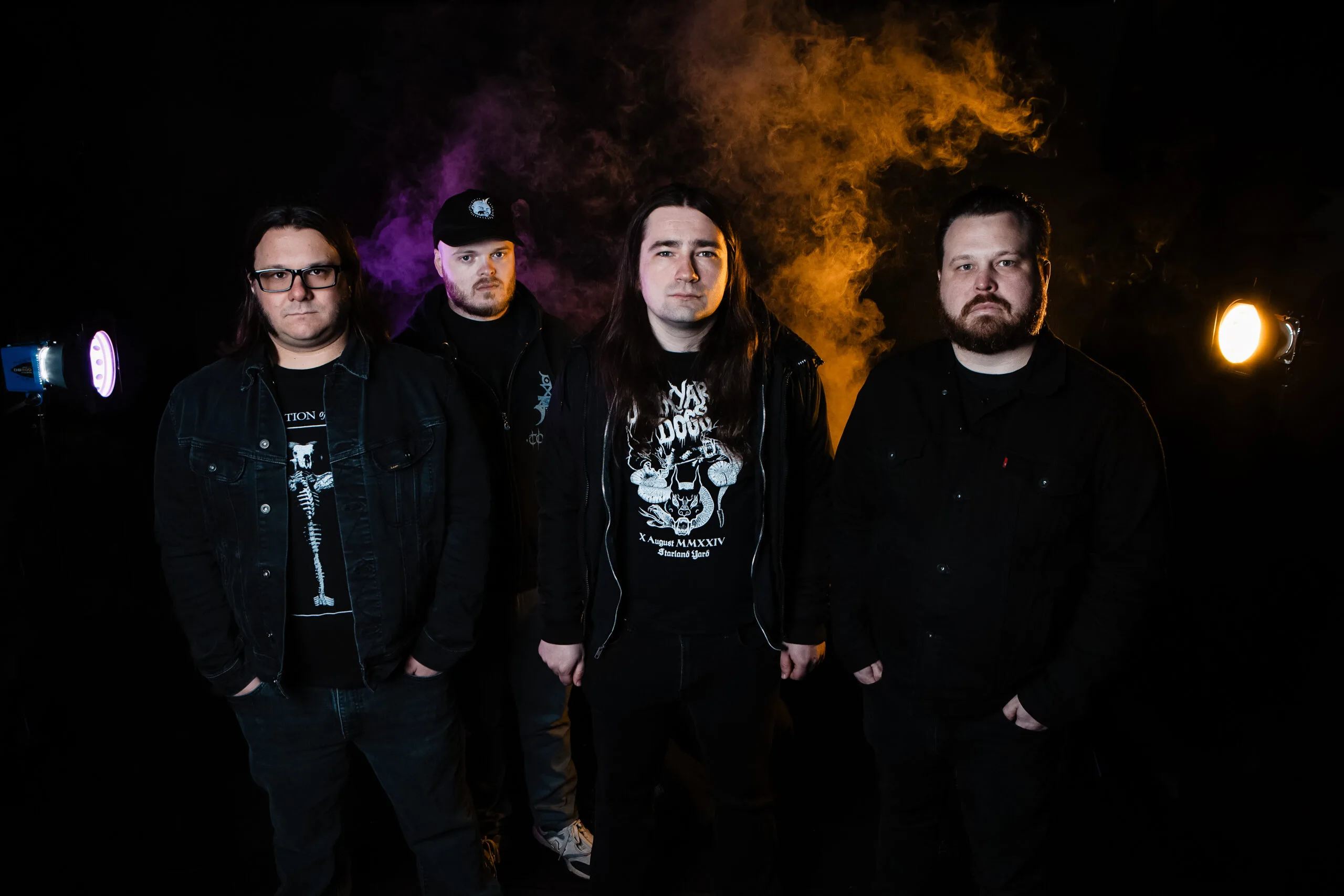
Header image credit: @epic_sessions
I’m in a packed room at Beer Study for what might be the most unlikely cultural mashup of the year. If I lived anywhere else, that is. The Durham County Library is presenting “The End Of The World: A History of Apocalypse” — half academic lecture, half doom metal concert — and the local metal scene has turned out in force. It’s quintessentially Durham: intellectual curiosity meets heavy riffs, food, and drinks with the community.
The headliners of this apocalyptic-themed evening is Doomsday Profit, Durham’s four-piece purveyors of crushing, groove-laden metal. Over the past five years, they have established a reputation for delivering tight performances that draw from an eclectic blend of influences and a profound appreciation for the genre’s variety.
I had met with the band (minus guitarist Kevin See due to illness) the week prior and was immediately impressed by the local music credentials that each member could flex. Bryan Reed was an Indy Week music journalist for over a decade; Ryan Sweeney devotes time to his WHUP radio show “Global Garage” and podcast “Let’s Make a Mixtape”; Nat Parkinson is also the drummer for Hattricks and ZEALOTROUS. Together, they bring a level of professionalism and musical curiosity that elevates their work beyond typical “weekend warrior” territory.
That was on full display during their 45-minute set at Beer Study. Bryan described their performance as “shaking the rust off,” but they were locked in, creating a wall of sound with satisfying grooves, shredding guitars, and cathartic vitriol.
What have you been listening to lately?
Ryan: I’ve been listening to the new record from Press Club [To All the Ones That I Love] on repeat lately. It’s not at all related to anything that we’re doing, but a really good, fun record.
Nat: Listening to a lot of stuff, but probably the new Viagra Boys album [Viagr Aboys].
Bryan: On the way here, I was listening to the new album from Bleeth out of Miami called Marionette. And we were just talking about Pig Destroyer before you arrived.
What is the first musician that you remember discovering on your own and obsessing over?
Bryan: Third Eye Blind’s self-titled album, when I was in the seventh grade. I remember that being the first one that really stuck with me, and that led to being obsessive about whatever I was listening to. It pretty quickly went from that to 90s punk bands like Rancid and Social Distortion, and trying to find as much as I could. “What’s this band Pennywise all about?” It was all downhill from there.
Ryan: Chris Cornell. I was first introduced to Audioslave and that connected me to music in a deeper way. I became obsessed with Soundgarden and that led me to Temple of the Dog, then Pearl Jam, Green River, Mother Love Bone, and that whole grunge family tree. Euphoria Morning is still one of the greatest records that he ever did, his tribute to Jeff Buckley. Beautiful record.
Nat: It’s hard to say without any influence. The first CD I ever bought was Permission to Land by The Darkness. My parents were really into music but they had no influence on this at all.
Ryan: There was some stuff that my parents listened to that I liked, but mostly it was me hunting for things on my own, which is pretty much how I roll.
Bryan: I didn’t have a particularly musical household, so it was a lot of self-discovery, Napster, and message boards connecting the dots.
How has your musical taste changed since then?
Bryan: For me, it was fairly linear. There were detours along the way, but I was always looking for louder, more aggressive things. When I got to college, I was doing music journalism at The Daily Tar Heel, so I had a good opportunity to explore all of the different genres and find things that I liked across the board. But at the same time, I was discovering bands like Boris, Earth, Mastodon, and Thou that I circled back to later.
There was probably a period of time I would have considered myself an indie rock kind of guy, but I never stopped listening to punk or metal along the way. I just fell out of the scene. I’ve always had a hunger for loud, heavy, aggressive music. Something that’s sort of purposeful and a little confrontational. When you go to a show, you can feel the sound as much as you can hear it and you have that sort of intensity that you really only get with loud music.
Ryan: I love a good hook. I like things that are melodically interesting, a lot of harmonies and the like, so I tend to go for things that are a little bit more pop in nature. But I’m still looking for something different. I’m always on the hunt for something new, some sound that I haven’t heard before. And I think that’s been the foundation of my listening evolution.
I started with grunge and classic rock, then went into indie with Elephant 6 stuff like Neutral Milk Hotel and Beulah. And then into Wilco and down the whole Uncle Tupelo family tree, to prog rock and some prog metal. I was never really hunting heavy stuff, I was just hunting new and interesting music. I still am today; I have a radio show on WHUP and we’re trying to find rock tangential music from around the world. It’s me and my co-hosts scouring the internet for cool new music from around the world.
Within the last 10 years I got more into the heavy shit. Harsh vocals were a big barrier for me. It is for a lot of people. I finally found what I like and saw harsh vocals as just another instrument and stylization and tone of music. That helped me get past my initial apprehensions of it.
Bryan: Metal has admittedly some barriers to entry for people, but thinking of the vocals as an instrument is one way to make sense of it. The other is recognizing that there’s a lot of kayfabe in metal. Cannibal Corpse aren’t actually serial killers; they’re just telling gory horror stories. We’re all in on the joke, we all know how silly it is and that’s why we like it. It’s not in spite of that or whatever. But either you get it immediately or it absolutely repels you.
Nat: The first metal band I ever got into was Mastodon in high school. Opeth was the first death metal that I got into not long after. I still think [Mikael Åkerfeldt] has the best harsh vocals. But we all have our Neutral Milk Hotel phase at some point or other.

Image credit: epic_sessions
How would you describe the sound of Doomsday Profit to someone who only listens to mainstream metal?
Nat: Do you like Black Sabbath?
Bryan: Pretty much. The foundations of sludge metal are Black Flag and Black Sabbath. If you start there and that doesn’t scare you off, then you get it. If I’m talking to people who don’t display any obvious sense that they’re into metal, I’ll just say metal and leave it at that. Most of the time, that’s enough. The subgenre is only as useful as you want it to be.
We fall into a middle ground sometimes. I feel like sludge has embraced a lot more noise and a lot more extreme immensity and droning quality. We still have a lot of groove and melody going through the arrangements, which leads us more into the stoner metal vibe. But a lot of people who are into that kind of stuff, like Clutch or Fu Manchu, don’t really care for harsh vocals.
There’s bands like Weedeater, Buzzov•en, and Thou that we look at as sort of our closest influences. But we’re pulling from a lot of different places, too. It ends up being a mix of somewhere in that stoner/doom/sludge metal, somewhere in the umbrella. It’s slower, but not super technical. It’s more groovy and a little bit more punk in that it’s simple. The vocals are more enunciated than real guttural death metal vocals or anything like that.
Ryan: We’re not really trying to write for any genre tropes in a specific way. We’re just riding on our weird wave of influences and writing what we’re feeling.
Bryan: We’ve been doing this about five years now. At this point, I’m starting to recognize the same tricks that we pull out of our bag every time. When I’m writing a guitar part, I have some go-to things that just sound and feel good to me. But once everybody gets their fingerprints on it, it ends up as its own, tighter thing.
What have y’all been up to since your debut EP?
Bryan: We did a split LP with Smoke last year. It took a lot longer to get it out because vinyl always does, but we were glad to have that. We ended up having three songs that we weren’t quite sure what to do with and our friends in Smoke also had some stuff they were working on that didn’t quite fit what they envisioned for the next album. It just made sense for us to do a split, which was very cool.
We’ve been doing the weekend warrior thing pretty consistently. I think this is the longest break from shows that we’ve ever had.
Ryan: At the beginning of this year we got Nat in as our drummer. So we’ve been working on getting Nat caught up to speed and he has very quickly. We’re also working on shaking the rust off after having not played. We have a really solid repertoire and a bunch of shows coming up for the rest of this year. We also have a handful of songs that we’ve started writing, so let’s start to fleshing those out and work on the next record before this one is even fully out.
Bryan: A lot of our effort, the first half of this year and continuing, has been on releasing new songs. We took a different approach with it than the standard. Trying to play the algorithm game, but also keep the album [Doomsday Profit] as an entity.
Ryan: It’s a weird thing because metal is such an album-oriented genre. But, modern music distribution favors singles. If we just release an album, the first song will get the majority of the streams and the other songs won’t have as much time to shine.
We sequenced the record in a way that we think flows like a record. We also put a lot of love and thought into these songs and we want to give them the best opportunity to find whatever potential they might have. That’s why we are counterintuitively releasing the album one song at a time. But if you go on Bandcamp and you pay the $8, you get the full record.
Bryan: In other words, the record has unofficially been out since January.
Nat: It’s a soft release.

Image credit: samuelmillershoots
How has that approach played out from your perspective?
Bryan: We have our favorites, but every now and then it surprises us what people will ask for when you play shows or what will seem to resonate with folks. Doing it this way gives each song a chance to find its audience and see who resonates with which themes or sounds within the 44 minutes.
Ryan: Since we’re releasing independently, we have the freedom to use this as a way to test and learn and just try to get the music out there as best we can.
Bryan: Ryan is big on analytics, so we have that ace up our sleeve of being able to look at the metrics that we get from streaming and social media, and actually know what to do with that, which is super helpful. That helps when we’re trying to figure out how to promote each one and put an artist statement behind it.
What has the early reception to the record been?
Ryan: “Spirits” has done the best so far, from a streaming standpoint. It’s also gotten one of the more personal responses. A handful of people have said it’s really connected with them. At the end of the day, we want our music to connect with people on that personal level.
Bryan: Once somebody downloads something, we don’t have a great view on it. But within Bandcamp, we do get to see what people are listening to who have bought it. “Spirits” and “The South Will Sink” are the two most popular so far among supporters, but “Spirits” has the most like complete playthroughs. I feel like when you’re at a show, it’s a different experience though. People have their favorite songs or whatever, but at the end of the day, our goal is to just get up there and not bore anybody.
There are things that you could probably do on an album, like adding some different dynamics and types of sounds that don’t necessarily make sense for a live show. So far, we’ve tried to keep the two pretty close. There aren’t too many overdubs or accoutrements to build out the sound beyond what we can recreate.
When we write songs, we tend not to keep them hidden. We go out and play them. Seeing us live is the best way to hear new music because you’ll hear it months before we even get to a studio.
Ryan: If you hear it the first time, there’s a chance it’ll be the only time that we play it that way. There are at least two songs that we’ve debuted and they’re like, “Oh no, we need to scratch and rework that.”
Beyond getting the record officially out, what are some of your goals for the rest of 2025?
Bryan: Get back out and play shows. We’ve got a handful through the summer. The first one is a week from today at Beer Study. I’m really excited about that one because it’s a partnership with the Durham County Library and part of their series of joining metal bands and professors.
Ryan: It’s so cool. I’m so glad that we get to be a part of it. It’s a perfect pairing.
Bryan: John Jeffries Martin teaches a seminar class at Duke about the history of what he calls the apocalyptic imagination. Basically how people’s ideas of the end of times, throughout time, have shaped the way that civilization has developed. He’s a really interesting historian with a lot of focus on the Renaissance, Italian history, and medieval stuff. I’m really excited to hear him speak and then yell at people about the end of the world when he’s done.
After that, we are doing a pair of shows with YULE from Wilmington. We’ll be at the legendary Reggie’s 42nd Street Tavern with them, Lie Heavy and Fox Noose. And then going down to Sugey’s Bar in Charleston with Snargle.
We’ll be doing three dates with Bronco from Wilmington: one in Charlotte, one for Asheville Doomed and Stoned Fest, and then wrapped up at Local 506 in Carrboro. There are a couple shows in September around the official album release. Two are with the band Drugs of Faith from DC, which I’m really excited about. More details will be announced hopefully sooner than later. Those will kind of be our “as official as it gets” album release shows.
And then at the end of October, we’re going to be headed down to Florida for the Tampa Doom and Gloom Festival. I’m working on putting together a few days leading up to that to get us down there.

Who are your favorite local/North Carolina bands?
Bryan: I’ll speak for Nat. Hattricks is a really great band. ZEALOTROUS is another really great band, both of which Nat plays in.
Ryan: Antiquity, our former drummer’s black metal project, is fantastic. That’s based out of Durham. We mentioned Lie Heavy earlier; that’s former members of Corrosion of Conformity, Confessor, and Leadfoot. Just all around badass, heavy rock veterans. DUNUMS is amazing.
Red Collar was a defining band as I was coming into the local scene. They’ve had such a huge influence on me as a performer and doing band business things. They’re still one of the best rock bands to come out of Durham.
Bryan: Survival Tactics sold out The Pinhook for their EP release, which is awesome.
Nat: We’re big fans of Snide.
Bryan: Valletta, Crystal Spiders, and Noctomb. U.S. Christmas, Buzzov•en, MAKE, and Sourvein. Just within sludge and doom metal, there’s been so many bands in North Carolina. Also anarcho-punk bands like Catharsis, Żegota, and Facedowninshit. I could listen to music only from North Carolina and never get bored.
Nat: I really like My Sister Maura, a really good shoegaze band from Raleigh. We also just met our neighbors in our storage unit. They’re an Americana country band called Ol’ Joey Scrums.
This interview has been edited for length and clarity.

Leave a Reply