
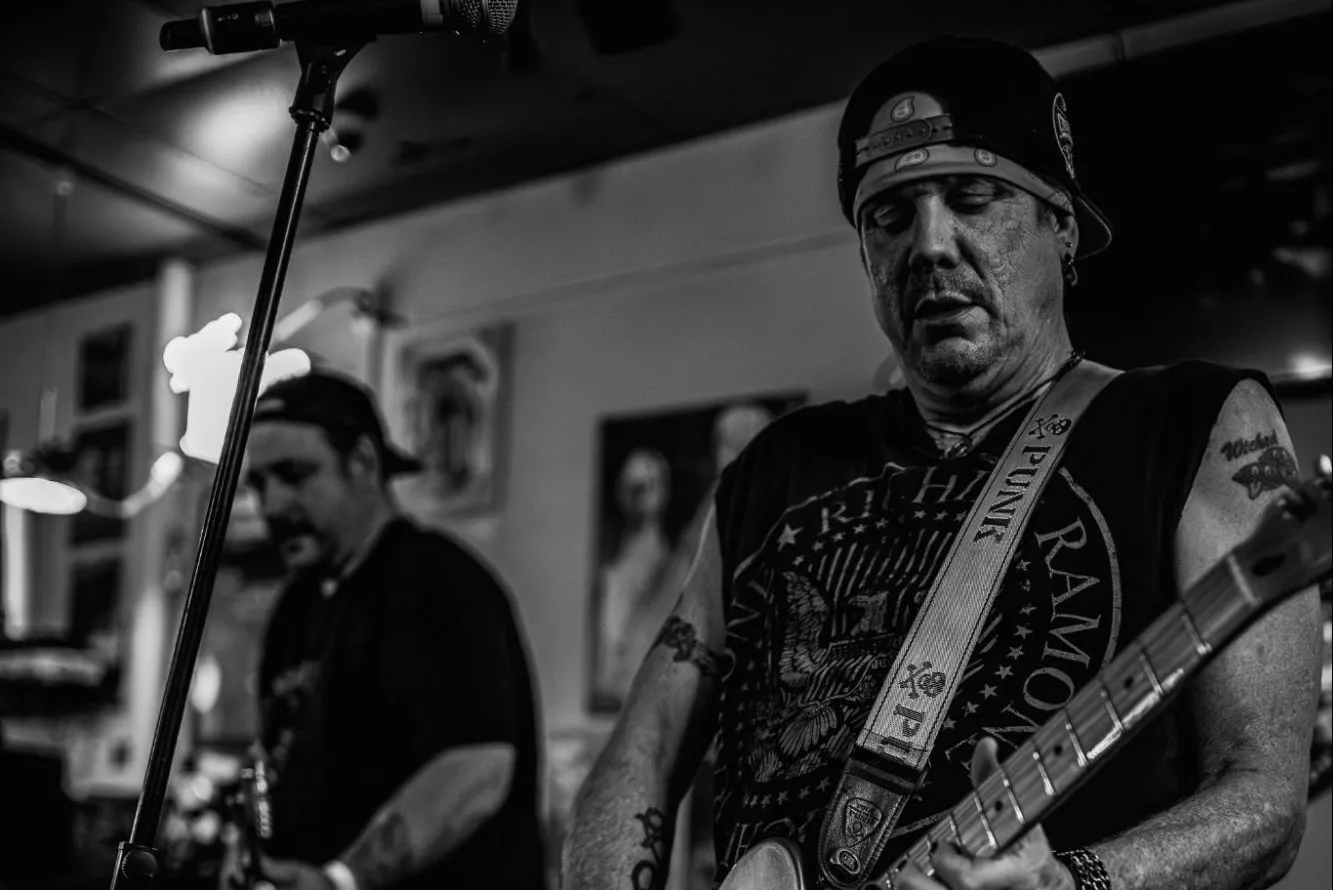
Most punk bands don’t last sixteen years. Fewer keep getting better with age. Winston-Salem’s Drat the Luck has managed both. And they’ll tell you the current version of the band isn’t just the latest iteration, it’s the best one, and it isn’t particularly close.
What started in 2010 as a half-joking idea to punk up country covers has slowly become a tight three-piece with a shared philosophy about simplicity, restraint, and knowing when not to play. The current lineup doesn’t just fill roles in someone else’s project. Every song in the catalog, including those that existed long before two of the three current members came aboard, has been shaped equally by all of them.
They’ve got a seven-inch out now and their eyes on a full-length. But before all that, we sat down with the band to talk about where they’ve been, how they got here, and what they’re building toward.
What’s something you’ve been listening to lately?
Brian (vocals/guitar): Ren. He’s this kid from England, maybe early 30s. He started out as a busker, completely self-taught. He was in a mental hospital for several years, misdiagnosed with all kinds of things, but it turned out he just had Lyme disease. He’s just a crazy writer and performer. I’ve been listening to him a lot. And then beyond that, just the classics on rotation.
Jon (drums): The new Poison the Well record [Peace in Place] is fucking incredible. I loved them around the turn of the 2000s, like the nerdy The Opposite of December era. That stuff just crushed for me, and their new record is just as good. Also, the new Converge record [Love Is Not Enough] is very fucking good.
I’ll also give a plug to the new AFI record [Silver Bleeds the Black Sun…]. I know AFI has had a series of really terrible records, but this most recent one is the most mature thing they’ve ever made. I’m wearing a The Cure shirt, and it is a very goth rock record, so I love that.
Chris (bass): Honestly, it’s been the same five songs on rotation, just the old standards. I pull out Knapsack a lot lately, always put on Strike Anywhere, Bad Religion is probably my go-to, Face to Face, and The Gaslight Anthem. Nothing really new.
Jon gets me into new stuff though; he’s got me on a Drain kick lately.
Jon: We’re both big Scowl fans. They’re an incredibly wonderful female-fronted hardcore band, as is their sister band Initiate. Both from Southern California, both female-fronted, with incredibly aggressive lyrics, sometimes tongue-in-cheek. Really good stuff.
Who’s the first musician you remember discovering on your own and completely obsessing over?
Brian: The first musician I ever obsessed over was Buddy Holly. When I was a kid, my mother gave me a plastic bag full of old 45s, though we’d call them seven-inches now, and there were tons of Buddy Holly in there. I just listened to him all the time, and I still do. I think he’s a huge influence on what the first wave of punk became, whether it’s the Ramones and that old-school three-chord rock.
Chris: For me, it was the Ramones and Ten Foot Pole. It was the 90s, there was a big resurgence in vinyl, and I kind of grabbed both of those by accident. The first show I ever went to was the Ramones, so that was a good intro. Ten Foot Pole was probably not as popular as a lot of the other bands [on Epitaph], but I loved them.
Jon: Super easy for me. My sister is 16 years older than I am, and her husband is from California, so I always wanted to hang out with him because he was older and cooler. He had a copy of Damaged by Black Flag, and I remember hearing that record when I was 12 years old. I did not understand it at all, but I remember thinking, “Oh my God, that’s the coolest thing I’ve ever heard in my life.”
I’ve since come around to thinking Keith Morris-fronted Black Flag is better than Henry Rollins-fronted Black Flag. I did not think that as a teenager, but I’m a convert now.
What inspired you to start playing music and ultimately start playing in bands?
Brian: Music was always it for me, even as a little kid. Growing up in the 70s, there was no internet. Records and radio were it. I had a little record player, and I sat in my room and played everything my mother gave me over and over: the Rolling Stones, the Beatles, all of it. And then it turned out my father was a road musician, and all of his family were musicians too, so I just naturally got interested, got a guitar, and started trying to figure it out. I always wanted to be in bands. And I always thought Elvis Presley was super cool and wanted to be a rock star.
Chris: I just grew up listening to what my folks listened to. I thought the coolest guy in the world was Clarence Clemons (E-Street Band/Bruce Springsteen) playing saxophone, so in fourth grade I started playing sax. I also remember trying to record myself singing like Bruce Springsteen into one of those little cassette recorders, making a gravelly voice. It was terrible. When I moved down here, there was a middle school band, so I kept up with saxophone for a year, but that wasn’t really my scene.
Then, in my freshman year, I just started getting into bass through all the bands I was listening to. I don’t even know why I gravitated toward bass specifically; it just clicked. And then it grew from there, just playing with friends until it became something more serious.
Jon: I was a band kid and picked up sticks in sixth grade to play snare drum in middle school band. I only wanted to play drums. They told me to try trumpet or clarinet, and I was like, “No, I want to play the drums.” So I played drums in the middle school band, and when I got to high school, I had the same realization as Chris: this is not my scene.
Some friends were trying to start bands, which really just meant hanging out, smoking cigarettes, and beating on stuff. And I thought, “Well, I want to hang out and smoke cigarettes and beat on stuff.” So I put together a group of folks I called a band, and have pretty much done it ever since. I took a couple of breaks during college and when I first got married. But when I’m not playing, I’m very unhappy. So I always try to play with folks and stay connected to the scene.

How did each of you end up in the band?
Chris: I found out about Drat the Luck through Nick Badgio, a guy I met playing hockey. He was the old bass player and had since quit, but we got talking hockey or whatever and I started playing (hockey) with him – Holy Divers represent! Turned out we were both bass players, and he introduced me to Brian. We met up, tried it out, and it seemed to work.
Jon: I’m the newest member and also the newest person to move to Winston-Salem. I had been in bands in the Charlotte area since I grew up in Rock Hill, South Carolina. When I moved to Winston, I found a Craigslist post from a group of musicians in their 30s looking to start a punk band. That band was called Hey Revolver, and it included Scott André Bowen, who was the original Drat the Luck bass player. Scott had left Drat the Luck to start Hey Revolver. We played a bunch of shows in Winston-Salem and Charlotte, but the project never really came together and was naturally winding down.
One of the bands we’d played with several times was the Camel City Blackouts, which Chris plays bass in. Their drummer couldn’t make a show, so the other member of Camel City reached out and asked if I could fill in. I knew their songs from playing with them so much. I hopped on the kit, played the show with Chris, and I think Chris told Brian, “Hey, maybe John will fill in for us.” I auditioned, and they said I wasn’t terrible.
Brian, what’s the origin story of Drat the Luck, and how has the band evolved over the last 15 or 16 years?
Brian: In 2010, I decided I wanted to start a punk band. I’d done cheesy cover bands with older people when I was younger, and then I had an acoustic project for a while down here, but punk has always been my favorite genre. I knew I was going to call it Drat the Luck because that’s a phrase from where I grew up, something my father often said, and it just struck me as a great band name.
Originally, we were going to be a country cover band that just did punked-up versions of country songs. That’s what we started as. I put out an ad and met Scott, a founding member who was in the band for a long time. We got a drummer and started playing. But we never even played out before we started introducing originals, because Scott and I quickly realized we had a great writing collaboration. So it became a 50/50 set of half punked-up country covers, half Drat the Luck originals. Over time, it morphed into mostly original Drat material, and now we just occasionally throw in a cover. That’s kind of still what we do.
We’ve never really stopped except for one year, and that was COVID. Since then, with Chris and Jon, we all write together and it’s the best version of this band by far.
What’s the songwriting and rehearsal process like? How has that evolved?
Brian: The way I’ve always done it is I usually come in with a pretty complete idea of lyrics and structure, and then we polish it as a group. Back when Scott and I were the principal writing team, he’d come in with more raw ideas, and I’d bring melody, lyrics, and song structure. With Chris, who I write with most now, he’s similar to me in that he tends to come in with a full idea already, and then we scrub it together as a team.
Chris: There’s no real rhyme or reason for me. Sometimes I’ll just come up with a riff and throw it out there at a low moment in practice and see if it catches on. Other times, I’ll bring in something pretty complete. The last few songs I’ve brought in were pretty much done, and the guys just took them and made them better. And sometimes I’ll riff on something with the group, take it home, work on it on my own until it’s more developed, and then bring it back. Jon actually brought a song to the table recently that I hope we can get working on.
Jon: That’s always the downfall of the band, when the drummer tries to write songs. My job is to show up, listen to what these guys have to say, and find the underlying groove. I’ll say this is the easiest project I’ve ever worked on in that regard. Brian has a really innate sense of rhythm that most guitar players don’t have. There are plenty of times when we’re writing that Brian will call out an accent I didn’t pick up on, and I genuinely enjoy that collaboration. These guys give me a lot of freedom in what I do, but their feedback is constructive, which makes for a better end product.
Brian: And just to add to what John was saying, we’re all very similar in our approach. Even if someone comes in with a whole idea, the song still gets written together. Simplicity is key for me. Everybody playing exactly the same thing at the same time is what makes it tight, and that’s what can make you stand out on a bill. We all share that mindset, and it flows naturally when we’re working on something.
One more thing I want to say on this: Jon and Chris have contributed to songs that existed before they were ever even aware of this band. Every song in the Drat the Luck catalog has been touched and made better by all three of us. There are no hired hands here. We’re all three equal members of this project.

Where has the band played over the years, and how have you seen the local scenes evolve?
Brian: When we first started, we played mostly in Winston and then developed small followings in Charlotte and Roanoke. More so than even in Winston, honestly. For the first five or six years, we were playing two or three times a month and going to Greenville, Raleigh, all over. We even played in Boston and Worcester, Massachusetts, with a stop in Baltimore on the way. But now it’s much more concentrated. We pretty much just play Winston and Wilmington, and if we get invited onto a festival bill somewhere, we’ll do that.
As for the scenes themselves, they go up and down. In Wilmington right now, there’s a pretty prevalent punk scene with some real steam behind it. Here in Winston, there are only a couple of places where you’re going to see a punk show. When we first started playing around here, we’d genre-mix; we’d be on a bill with a pop band and an R&B band at a popular club at the time, and it worked. The scene didn’t matter; in fact, it was more successful at mixing genres. Now it’s more back to pairing up similar genres. It just ebbs and flows. Sometimes there are great places to play, and sometimes there aren’t.
What does the future hold? Any shows, recordings, or goals for the rest of the year?
Chris: We’re trying to concentrate on more meaningful shows, as Brian would say. We’re really trying to find national acts or bands we like to open for or team up with. We also recorded three songs in the studio at the end of last year. They’re streaming now, and we just sent the records off, so we should be getting a little seven-inch back any day.
I’d like to get back in the studio again this year. If we’re early enough, maybe we could get seven more songs down and put out a full-length. But the big priorities are writing more songs and playing meaningful shows. We can pretty much play whenever we want in Winston, but I’d like to broaden the base a little in Greensboro, Wilmington, or wherever. A lot of bands we’re friendly with play locally very frequently, and I don’t want to do that. We’d rather store the energy and blast people once a month or once every two months. Keep it from getting diluted.
Who are some local or North Carolina bands worth shouting out?
Brian: There’s a band called DIT right now that is one of my favorite bands. I played shows with them when they were in high school under the name Scissor Stash. Same band, same tunes. Just incredible.
KILLER ANTZ from Winston are amazing. Emergency Nothing in Wilmington, Bat Asterisks in Wilmington, Busted Radio in Wilmington. And Wolves & Wolves & Wolves & Wolves is a machine. I still love Possum Jenkins too. They don’t play many shows anymore, but if they’re playing nearby I’ll go every time.
Jon: I second DIT, they’re probably my favorite. I’ll take a chance to shout out some North Carolina bands I’ve always loved and that I love getting to share a state with: Between the Buried and Me, He Is Legend, Corrosion of Conformity. Growing up in South Carolina, those guys were right above me, and it’s pretty cool to be in the same state as them now.
Chris: DIT, KILLER ANTZ, Bocanegra, Emergency Nothing, Bat Asterisks, Orphan Riot (RIP), Superchunk, Overton, Worthington’s Law, Wolvesx4 (who also have a fellow Holy Diver). I’ll also give a shout to the Camel City Blackouts; I hope we get back out there soon. And I don’t want to forget anyone, so let the record show that we could go on. There are a lot of great bands out there in NC.
This interview has been edited for length and clarity.

Leave a Reply