
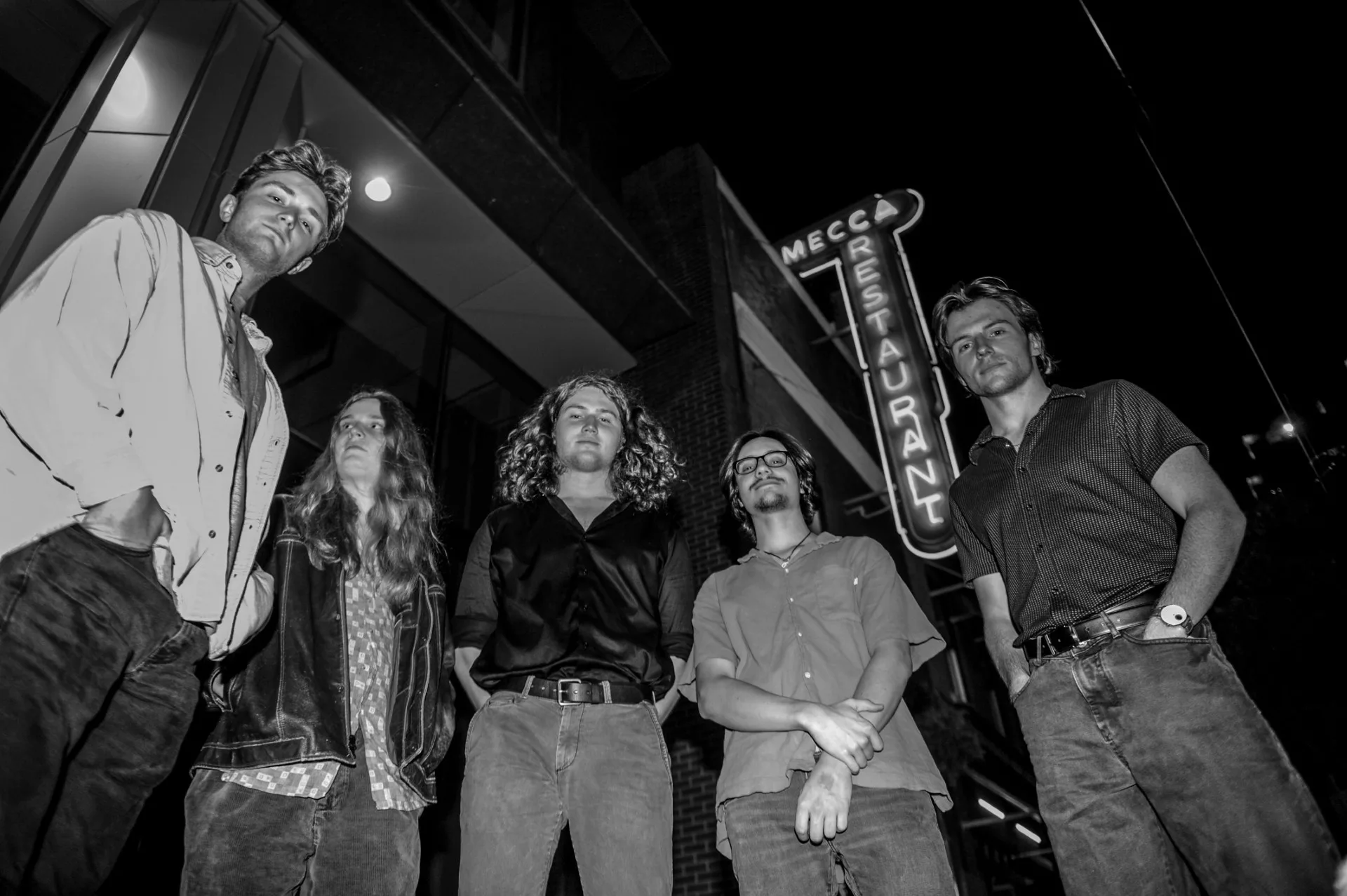
Emerson Bruno spent the first chapter of his recording career as a solo act. His debut, Sincerely, arrived under his own name. Less than three years later, the Durham songwriter returned with Sounds for the Restless Mind, now billed as Emerson Bruno and the Undercurrents.
The new record keeps one foot in the 1960s, building on a Laurel Canyon foundation (think Crosby, Stills, Nash & Young or The Byrds) with a modern surfy and psychedelic sound. Bruno tracked it at Deep River Studios in Sanford with engineer John Davenport, whose credits include Bruce Springsteen and the Rolling Stones, then brought in the ever-prolific Max Gowan to finish the work.
Since its release earlier this year, songs from the album have found a home on the airwaves of WXYC, WKNC, and 98.3 The Penguin in Wilmington. The LP has provided plenty of new material for his sets at Shakori Hills and the North Carolina Folk Festival these last few weeks. With the Pour House headlining show in Raleigh set for January 29, I caught up with Bruno about how the record came together and what he’s building as a songwriter in the Triangle.
Is there anything new, or maybe an old favorite, that you’ve been listening to lately?
Emerson: Elvis Costello and the Attractions and their album This Year’s Model from ’78. I’ve had that on repeat all day today. It’s just the urgency they play with, and the compelling songwriting. It embodies a lot of what I want to bring across in my music. I feel blessed to have stumbled upon that gem of an album.
Do you remember the first musician you discovered on your own and started obsessing over, or maybe who inspired you to start playing music?
Emerson: The foundation of my taste is pretty much the same as my dad’s. He instilled a lot of the same tastes and genres, and from there I started to branch out; a lot of what I discovered, I’d bring back to him. There’s almost a game of wanting to impress him, wanting to show him a song that’s good to his ears.
There’s this band, Grizzly Bear, I remember finding in late middle school, early high school. “Two Weeks” was the first song of theirs that really stuck with me, and then I dug in and found the album, Shields. They’ve become a staple in my catalog. I always go back and listen through their whole discography.
Now, coming full circle, it’s the same deal with writing music. My dad’s my biggest sounding board. I’ll throw some songs at him and if I get a sort of nonchalant reaction, and I’m like, okay, I’ll put that in the reserves; that’s not a front-runner. But when I show him a good song, and I can tell his eyes light up, that’s satisfying. Usually it makes the A-list at that point.
What was the kickoff for starting to write music under your own name, and then eventually incorporating the band into it?
Emerson: I played music with a bunch of friends in college in a band called Late Notice. We played around the Raleigh circuit. During those formative years, I wrote on the side while we co-wrote as a band, and it was a very democratic process. I’ve always had kind of a twisted point of view on this, and maybe some people would disagree, but I’ve felt like songwriting, at least the skeleton of the song, is hard to build when you’re trying to include and value everybody’s input, especially with four or five people sitting around working collaboratively. I’ve almost felt like somebody needs to take it home, create the bare-bones structure, and then bring it to the band.
All of that to say, I was writing with this group and felt compelled to write on the side, and that’s really where my love of songwriting kicked off. I enjoy playing and performing, but I love most of all just sitting there toiling, spending a lazy Saturday afternoon trying to pull something out of thin air. It gives my life real purpose.
From that band, Jared Marino, who plays bass with me now, has been a dear friend for years. He’s an essential part of it, and he’s not afraid to tell me exactly what he doesn’t like about a particular song. He also helps navigate the ship. So as much as it looks like a singular solo project, there’s a lot more collaboration behind the scenes than meets the eye.

What were the biggest differences going into this latest album, in the way you wrote or curated the songs? Have you seen that side grow as you’ve put out more material over the years?
Emerson: The recording process, if you could call the first one, Sincerely, an LP, the difference is a stark contrast. Sincerely was very spur-of-the-moment. If I wrote a song, I’d chart it out that day by myself, and I performed a lot of the instrumentation. Sounds for the Restless Mind was the first time I really handed off and entrusted others; I’m a subpar drummer at best, so I handed it off to the pros to take it and run.
I put together this group of guys, and over two or three years we rehearsed these songs and played them live, playing this unreleased material for about two years until I felt like we had something special. We were fortunate to go to the studio of one of my dad’s friends in Sanford, North Carolina, and spend time in a real-deal shop, cutting the songs the way we intended. We tracked everything live with minimal overdubs, then added supplementary textures afterward.
It was the first time I could take a holistic view of my music, which was wonderful. I love the way that album turned out, and I listen to it often, which sounds conceited, but the essence of the moment we captured is what’s so special about it.
What was it like working with John Davenport, who has such a long list of names attached to him that are legends in their own right? What perspective was he able to bring that you didn’t have before?
Emerson: John’s approach: he’s an engineer at heart, and he’s there to capture the audio in the highest fidelity possible. It wasn’t so much a producer’s ear as it was a “let the band roll” approach. Many times, a lesser producer wouldn’t have kept the tape rolling, and John would capture something we otherwise wouldn’t have been tracking for. He was just there to gather the moment and put it on tape.
His studio is immaculate, and he’s got a lot of fancy gear I couldn’t even afford, not even close. He’s such a kindhearted soul too, and a goofy guy. I love him. He’s a dear friend.
That makes sense, given what was on your website about trimming down songs you’d written and been playing before that final album track list. I could see how, with that “capture the moment” approach versus more hands-on producing, some songs would end up left on the cutting room floor.
Emerson: Yes, and Max Gowan, in the later part of the recording process, was able to help navigate that as well. He was there for a lot of the harmony parts, the supplementary textures, and any auxiliary percussion we added. He’s kind of the right-hand man for that portion of the process, and so encouraging. I want him to coach me through the rest of life. I’d be in the vocal booth filling with self-doubt over vocal takes, and he’s just like, “That’s great, I think you can get it better, let’s snap this next one.” Perfect for the occasion.

With this album, there’s been some consistent radio play, whether that’s college radio stations or local stations, especially across a wider area than just locally. What has that experience been like?
Emerson: It’s surreal. 98.3 The Penguin is a Wilmington-based station, and I grew up listening to them. My parents still live in Wilmington. Over Christmas break, maybe a year ago, right before the album officially released, I dropped off a CD at the radio station and met the hosts I’d been listening to my whole life. I gave them the elevator spiel, told them I’m a Wilmington-based artist, that I love the Penguin, that I can attribute some of my taste to the music they’ve played over the years, and here’s a record I put out, absolutely no pressure. They said they’d love to check it out, had me star a couple of my favorites, and ended up giving the full record a run-through.
Every once in a while, my mom will be listening to that station, a song of mine will come on, she’ll squeal with joy, and send me a little video: “You’re on the radio!” It always makes my day when they decide to play the stuff. I also listen to and have heard it on the UNC station WXYC and the NC State student-run station WKNC. And then occasionally I’ll see some random Colorado radio station cycling through, so that’s cool too. I think Apple Music for Artists lets you know who’s playing your stuff, which is pretty neat.
Looking at the geographic reach of the record, going from Wilmington to Raleigh, recording in Sanford, having local Triangle connections, it feels like a reflection of that effort and the moment you described capturing.
Emerson: Yeah, it’s North Carolina through and through. It’s got the cackalacky bones.
Looking ahead to the rest of this year or next, do you have any goals or things you’re hoping to achieve in the next six to twelve months?
Emerson: We would love to record more music. I know I’m not going to rush that process, it’s so delicate that as much as I wish I could expedite it, you can’t. You’ve got to let it take its time. I don’t even know if I’ve written the best of my material yet, so I keep writing, keep adding to the catalog, introducing new songs, and hopefully bring something even better to the table next time around.
Any shows coming up?
Emerson: Yeah, we’ve got a handful. Two of our first festival appearances, Shakori Hills and the North Carolina Folk Festival, so we’re ecstatic about both of those. And we’re headlining the Pour House in Raleigh on January 29th, which is a big one. I love that spot, that balcony setup, especially in a venue as intimate as that. Seldom do you get a balcony in a 200-capacity venue.
Who are some of your favorite local or North Carolina musicians you’d want to shout out?
Emerson: There’s this really sweet band from Asheville called Paprika that we’ve played a handful of shows with. I really love their sound. Drew Foust & The Wheelhouse, he lives in Burlington but plays around the Greensboro, Winston-Salem area, pretty much around the state. Just bluesy, got the soul, such a sultry voice, phenomenal player.
Max Gowan, of course, shout-out to the greatest of all time. And M. Roomie from Raleigh, I’ve really liked their sound, all three singles they’ve put out so far have really caught my ear. Definitely one for folks to keep an eye out for.
Anything you want to add before we wrap up?
Emerson: I’d say to the listeners, keep supporting local artists. It’s always very much appreciated. North Carolina’s got such talent, and this is the ecosystem that will bring forth the next big thing, the next big bands, even the ones that don’t make it in terms of whatever “success” means. It just brings such a sense of community, and it couldn’t happen without the people who attend the shows and cherish the music. So thank you.
This interview has been edited for length and clarity.

Leave a Reply