
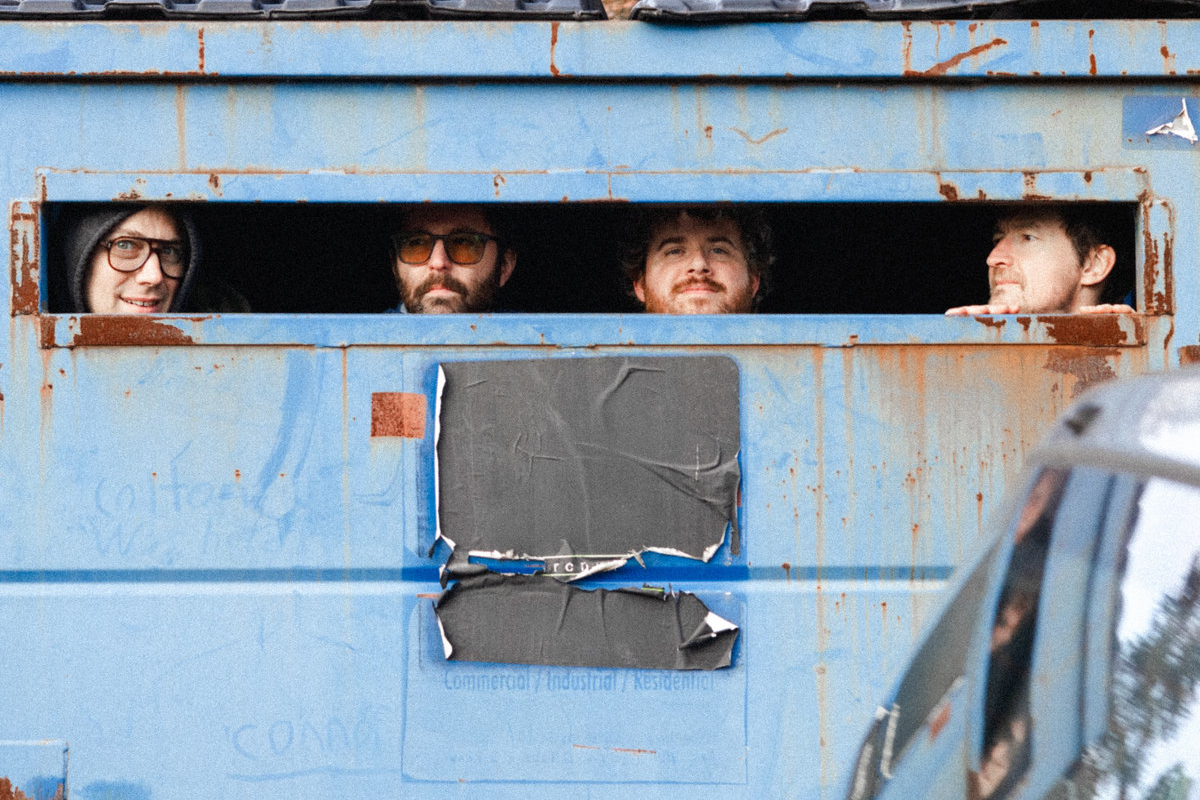
Raleigh’s RIBS is a band of veterans. Together, its four members have played in 20 to 30 Triangle groups (by my count), including Verity Den, Birds of Avalon, Headkicker, The Nein, and Drag Sounds. That much history could have made for an easy “supergroup.” Instead, the band spent years working without a singer and scrapped its early material before landing on a sound that borrows from classic rock, post-punk, and the jagged end of the Fugazi and This Heat lineage.
Their second album, COLD RIBS, came out in August on Three Lobed Recordings. The Jamestown label has spent more than 25 years putting out left-of-center records from Tropical Fuck Storm to Steve Gunn, and it has lately turned its attention back to North Carolina, with recent releases from Verity Den and Object Hours. Label founder Cory Rayborn has described the band’s frontman as a Southern Mark E. Smith, and the folks at Stereogum covered the album’s lead single, “Not A Boogie”, ahead of release.
For a band this deep in the local scene, the record is a notable step forward. I got to talk with all four members over an impromptu dinner, from how it came together to what it means for a label like Three Lobed to keep investing in local music.
What’s something each of you has been listening to lately, new or old?
David (bass): I’ve been listening to the new L’Rrain record [Fata Morgana]. Really great, I was on it all weekend. Also a lot of The Lyres lately, because their singer just died.
Mike (vocals): I’ve been on this band called Four Hundred Years, a screamo group from the late ’90s/early 2000s that still hasn’t been reissued yet. They started in Arizona, moved to Richmond, and were contemporaries with Sleepytime Trio, Max Colby, and Frodus. All those bands were happening around the same time.
Josh (drums): I’ve been listening to this anthology from a band called The Necessaries from New York in the late ’70s/early ’80s. Arthur Russell was actually in the band for one of the records, and they just put out a box set of everything. Some serious power-pop jams in there.
Finn (guitar): Over the weekend, I was on the new Open Mike Eagle record [Doomed!] a lot. It’s not an immediate “okay, I get it” record — it takes a minute to figure out what’s going on — but I really like Kenny Segal’s production on it.
When you were first getting into music, who’s the first artist you remember getting completely obsessive over?
David: My answer is pretty boring since I was listening to my parents’ Beatles and Rolling Stones records before I had real memories of them.
Josh: It’s funny to think about because Adventure Landing in Raleigh is about to close, but I remember going there when I was 11 or 12 and hearing “In Bloom” by Nirvana blasting inside and being completely mesmerized. That’s what got me into all the grunge stuff at 12.
Mike: Mine was MC Hammer. It was the dancing, really. I had the cassette, knew every song.
Finn: For me it was always phases. My dad would play classic pop and rock — Elvis Costello was a big one — and play bass along with the records while I listened. From there I worked my way through Led Zeppelin, the Rolling Stones, and eventually Ice-T.
So with this band specifically, what was the origin story? To me it sounds like classic rock filtered through ’80s post-punk. For musicians who’ve all played in other bands, what was the catalyst, or the common denominator, you landed on?
Finn: It was a lot of tinkering. The music we started with, we don’t play any of it anymore. We went years without a singer, just getting to know each other as players even though we’d all been in bands together before. Putting it together musically took a while. Eventually we got bored with the instrumental version of it and realized we’d landed on a vibe worth exploring further.
David: Everybody brought their own taste, and there’s a Venn diagram in the middle. A lot of the more classic-sounding elements probably come from all of us growing up on the same records. The edges of it come from all of us having played for a long time and wanting to keep it interesting. Maybe hearing something from one style and asking what it’d sound like pulled somewhere else. A lot of experimentation, workshopping, and trying to trip each other out.
How would you describe the progression from your first record to the second? Did the songwriting approach change, or was it more just getting more comfortable with each other and the sound?
David: The second record came together a lot faster, out of necessity almost. The first one went through a whole set of songs that never made it anywhere. Those got developed over a long time while we were also starting to play out. By the time that record actually came out, we were basically already getting ready to record the second one.
It happened fast. We wrote the songs over a few months, went into the studio, and it all moved quicker than the first time around. Some of that’s just from having spent that time figuring each other out and landing on what works.
Mike: For me it’s about getting more comfortable with the vocal side. I’ve never just been a singer in a band. I’ve sung in plenty, but I’m trying to lean into my limitations and push past them, past what I think my lyrics or my melodic ability can do. It’s slow progress, but I’m getting more comfortable with what I’m actually trying to do, which I still don’t totally know. Luckily there are finished instrumental tracks already, so I can figure out how to layer on top of something that’s already complete.
Finn: Early on it was much more like: I bring a demo, you bring a demo, and we rearrange from there. Now, knowing how those ideas tend to land in the end, it’s more like “If I bring an idea to these guys, it’s a roll of the dice,” but I’m excited to see what happens rather than needing it to come out a specific way.
Josh: Everyone writes their own parts, so it was never really a “this is how the song goes” situation. Everyone’s allowed to do what they want and scratch their own creative itch.
David: Early on, someone would bring in a full demo and say, “Here’s the verse, chorus, bridge, the whole structure.” After doing that for a while, we realized we’d just end up taking it apart anyway. So now it’s more like “bring in a seed and let everyone build around it”. Some of the newer songs started as a completely accidental moment at practice that just kept going.
Josh: We’ve written songs off a drum beat, off guitar riffs, off bass lines. It really can start from anything. Sometimes it’s as small as “these few chords sound good, what do you think?” We’ve also got almost half of another album written already.
With this more spontaneous, collage-style approach to writing, are you chasing a cohesive message or theme, or is it more about gathering pieces and letting meaning sit on top afterward?
Mike: It’s a lot of different things. Sometimes I have a clear idea of what I’m trying to say. Other times it’s just words that sound good together, or a phrase I don’t think anyone’s said in a song before. That alone feels worth chasing.
David: Overall, though, I think there’s a perspective that comes through. A worldview, at least. Maybe not more specific than that. It’s less “the lyric as a stand-in for some bigger idea” and more that the sound and the feel of the song is the message. When we’ve been sitting with an instrumental for a while, and Mike takes it and builds his part on top, that’s when it clicks. Like, “Oh, that’s the gap that needed filling,” and now it completes the song’s personality.

When it came to putting out the new record, how did the connection with Three Lobed come together?
Finn: I’ve known Cory since he started the label, and we’d stayed in touch for years. He’s good friends with a guy who was in a band Josh, Mike, and I used to play in called 300 Dog Night. That friend posts show recaps on Instagram, so Cory had seen us from that. He also already knew about Mike’s other band, Verity Den. It felt like a place that made sense for us, even before it was fully on my radar. He puts out stuff across a pretty wide spectrum, but there’s a through line, and it felt like we fit into it.
Mike, that gives you an interesting angle on this since you’re coming at it from multiple bands and have more of that local, Triangle-specific presence. What does it say about this moment for the North Carolina rock and punk scene to have that kind of focus and investment?
Mike: I think it’s great, and Cory’s the best. There used to be more small labels and imprints doing this kind of thing; most of the Durham labels have stopped. Sorry State is of course still very active.. It feels like so much of that smaller-scale, small-run record label culture just faded out. It may also just be changing.
Cory’s been doing this for 26 years, which is wild, and he’s still doing as much as ever. Even when someone’s not trying to turn a band into a full-time touring act, having someone invest in what you’re doing is energizing. It’s a genuinely important part of the ecosystem.
Finn: It’s a hard thing to keep doing. He’s got a professional life and a family, and he still does it. And not on the condition that you tour constantly or owe him money for it, the way some labels operate. He’s not doing it frivolously, but it’s special that someone’s still doing it at this level of quality, basically single-handedly.
Mike: There’s real value in that documentation, too. So many bands never recorded, or recorded, and nobody put it out, and they were great. It just takes one person willing to lose money on it so people can hear it later, especially stuff from before everything lived on the internet.
How did Lump Gallery come together as the venue for your COLD RIBS release show?
Josh: They’re actually closing down. We might be the last thing that happens there under the Lump name. We wanted to do something DIY rather than just booking a normal club show. Keep it small, and fill the room with good energy.
David: A release show can be a tough proposition. All that work goes into making the record, and then it just becomes another club night. We’ve all had that experience, where the release show ends up indistinguishable from any other night, which is fine, but we wanted this one to feel more like a party than a regular show.
If you do the release show at a club and it just becomes a random Tuesday, you don’t really remember it. Here, we’re setting up the PA ourselves, running beer service, handling ticketing. If it bombs, at least we did it to ourselves, and we’ll know better next time.
[*LUMP has now officially become plum with a new group running things; they’re already doing awesome programming and events.]
Any local or North Carolina artists you want to shout out?
Josh: Patois Counselors out of Charlotte is one of my favorite NC bands. They just put out a great record.
David: I just saw Late Model; they’re really great and some old friends of mine.
Josh: Canned Snakes [One of David’s other bands] out of Raleigh are also old friends, and an excellent band. Also, Mike’s other band, Verity Den.
Mike: Woke County Speedway. There’s a newer band called Dowsers I haven’t seen yet but is an incredible lineup.
Josh: Beeper, who we played with recently and who’ve been getting a lot of well-deserved attention. Carpenter / Cohen, which is Finn’s other project.
Finn: All the weirdness coming from the Outer Banks. Zack Mexico, Zulitas, and the duo of Harry Harrison and Matt Wentz. Matt’s an absurd guitar player, and the two of them together have this chemistry that’s ridiculous live. It’s like watching Martin and Short if they could also shred.
Mike: Truth Club is great. Ashrae Fax, people still sleep on them. Taija Rae!
Finn: Honestly you could write a whole book about Triangle bands that never put anything out but were incredible. That’s actually part of what got me and some friends talking, years ago, about starting a label just to release all the CD-R stuff from the early 2000s that never made it to vinyl. Those bands broke up, their Myspace pages are gone, and the music only exists on physical CDs that are slowly falling apart in cardboard boxes.
This interview has been edited for length and clarity.

Leave a Reply