
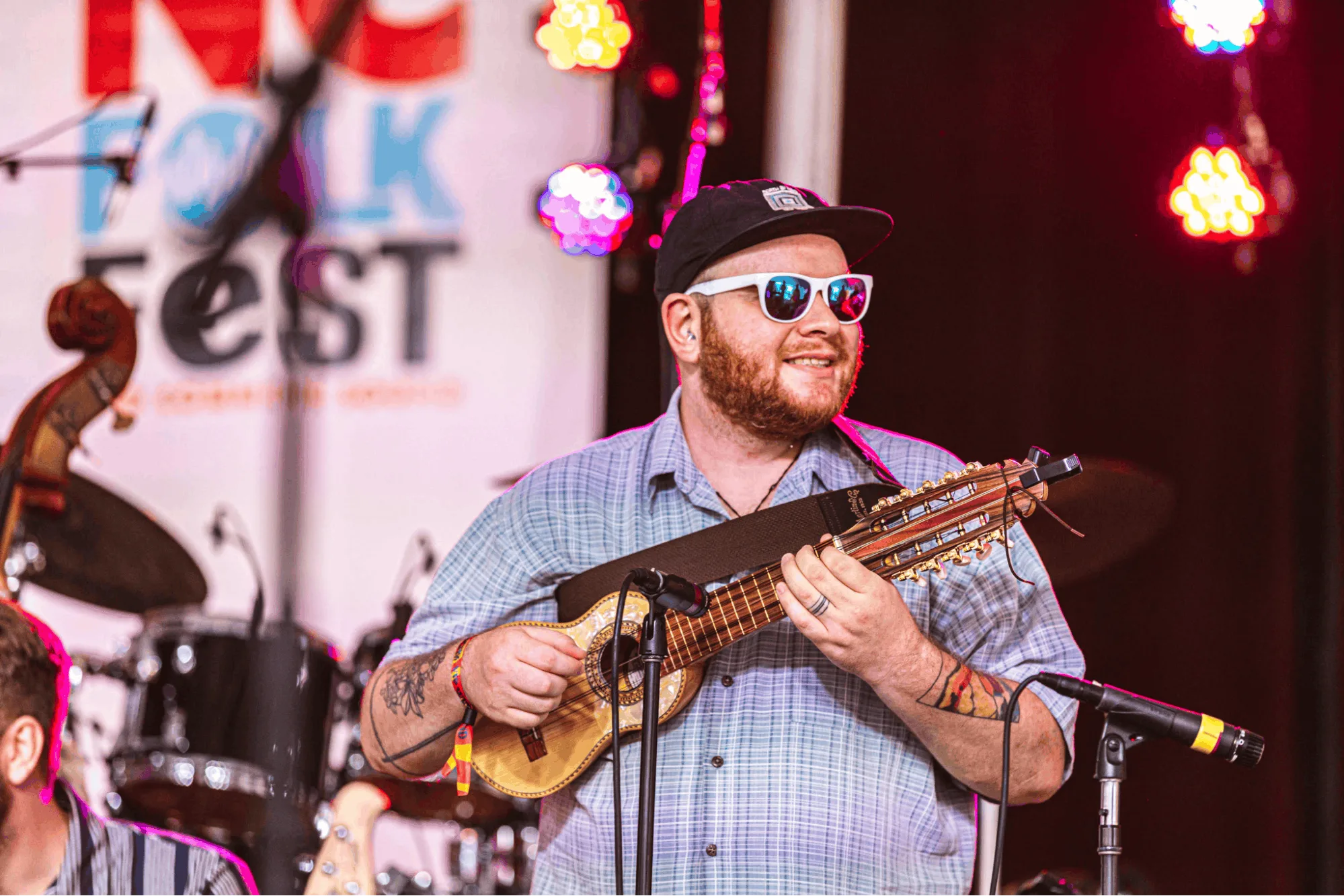
“Oh lord, one day my body will lay with the leaves / oh lord, that’s where the future will find me” croons Cameron Rabb on “The World’s Freshest Spring”. Though FM Snow‘s frontman and songwriter didn’t know it when he recorded, that line would eventually become the title of his project’s second LP, THE FUTURE WILL FIND ME. Released this past August, the album is a musical diary, documenting Cameron’s efforts to make peace with an increasingly hostile world.
FM Snow is the result of Cameron’s pristine will to express, unmediated by external motivators and tempered only by skill and circumstance. Appropriately, THE FUTURE WILL FIND ME‘s arrangements center Cameron’s guitar and vocals. Even with the band breaking it down or funking it up alongside, the cores of these songs stand alone. FM Snow could be a solo act. In fact, Cameron tours alone, armed with his acoustic guitar and the flexibility to adapt at a moment’s notice.
While his music is firmly rooted in the singer-songwriter “indie rock” tradition, Cameron casts a broad net of influences and interests. Tuareg blues, afrobeat, house music, and something called “electronic folklore” all bubble up in our talk, alongside local shoegaze and math rock. Between asides about Discworld and his enthusiasm for North Carolina, we get into the creation and release of the new record.
What have you been listening to lately?
Cameron: I just listened to the new Rapsody album [God Gotta Afro and Gold Hoops]. It’s really fantastic, man. However much credit Rapsody gets, it’s not enough. I first got to know her as part of the hip-hop group Kooley High, from Raleigh. They’re local legends.
Other than that, I’ve been listening to a lot of the Tuareg blues stuff, guitarists from the Sahel — Niger, Chad, Mali — specifically bands like Tinariwen and Mdou Moctar; I’m a big fan of those guys. There’s a band out of the U.K. whose frontman is from Nigeria; they’re called Pigeon. Their album is really fun. That’s the best way I know to describe it. Other than that, I listen to a lot of cumbia and Latin tropical stuff.
Oh, there’s a band from Japan called Minyo Crusaders, which is really, really fascinating. They take Japanese minyo, which are folk songs, really old folk songs, and they musically translate them and arrange them in various styles, like cumbia and salsa. On the newest album, they have one that’s basically “So What” by Miles Davis. There’s one that is very close to an Ebo Taylor afrobeat song, but the name escapes me. I love playing them for my Latin American friends who go, “Oh yeah, it’s cumbia,” but then they start singing in Japanese; it’s like whiplash. There’s so much to listen to and so little time.
You listen to a lot of things outside the Western contemporary canon; how’d you get into that and what about it appealed to you?
Cameron: I’ve always been interested in music that I don’t understand when I first hear it. It’s really hard for me to pinpoint exactly what draws me to something. Lately, I think it’s things that draw on folk traditions and bring them, whether by force or kindly, into a more modern setting. I think I’ve been really fortunate in the corners I’ve visited online. I’ve been online for quite a long time.
I discovered dubstep and ska through the Newgrounds audio portal in high school. They just had a list of genres, and I was like, “What is any of this? I’m 14, and I don’t know what ‘ska’ is.” Around that same time, my parents took me to Shakori Hills GrassRoots Festival. I think I saw Tinariwen there and forgot about them for years until I saw people talking about them. I was like, “I know this band.”
I’ve always been curious. It helps that my parents are into all kinds of stuff, musically speaking. I’m certainly into some things they aren’t. I’ve never been super into pop. In high school, I discovered something called ethnomusicology, and through that, I discovered all this other stuff. I think it was all a natural progression, being curious about music and wanting to understand what can happen musically.
As soon as I could tell what I wanted to listen to, I wasn’t that interested in pop music. Of course, in high school I was a snob: “It’s not real music; real music is Led Zeppelin and The Head and the Heart” or whatever I was into at the time. Over time I’ve tempered that down to “that’s not for me,” but I see the purpose of it. There are some artists I get extra harsh and judgy about.
You mentioned your parents took you to the Shakori Festival. What were they playing in the house growing up, what was around you as a kid?
Cameron: My dad’s a harmonica player, so I have very early memories of going to his blues and soul shows. He was in a couple of bands. One was called the Soul Survivors; one was called The Usual Suspects. I remember they had a CD with a cover that was a photoshopped film poster for The Usual Suspects. My dad was always excited to show me music, or any media, that he was into. I remember being forced to watch at least one Elvis movie and really hating it. Both my parents are big Elvis Costello fans. My mom showed me The National, and they’re one of my favorite bands. That three-album run of Boxer, High Violet, and Trouble Will Find Me is spectacular. My dad loves Sade and is also a big Marcus Miller fan. It’s all over the place with them, but looking back, it really tracks. I think I can remember being four and loving “Do the Locomotion.”
Do you remember when you broke away and started making your own choices? What did you choose?
Cameron: I remember getting really into Daft Punk in late middle school. One of my friends probably introduced me to them. I got into dubstep in high school, probably about a year before Skrillex was everywhere. I remember talking to a friend who was really into electronic music. I told him I was into dubstep, so he asked me about Skrillex, and I had no idea who he was. Six months later, Scary Monsters and Nice Sprites is everywhere, unavoidable.
A lot of that had to do with being online, scrolling through Newgrounds and YouTube, discovering ska and listening to Streetlight Manifesto and Reel Big Fish. My dad told me I had to listen to The Specials and The English Beat. The National was part of that, but it felt like it was my own thing. Later, it was what we now call the “stomp clap woo” music, specifically that first album from The Head and the Heart. I think it holds up, but it’s probably nostalgia. I think a lot of that stuff still holds up.
My parents preferred to spend their money on traveling, so I’ve been fortunate to travel to a lot of places. In high school, we went to Scotland and volunteered at the Hebridean Celtic Festival. It’s a music festival in the middle of nowhere on the Outer Hebrides, super remote. It was in the only sizable town out there. We discovered this band called Admiral Fallow. I really love them. I think they’re the most underrated indie rock band of all time. I’m the only person I know other than my parents who knows this band, or even knows of them.
When did you start playing?
Cameron: I started taking guitar lessons in fifth grade, so 2005. I did not take it seriously at all until about 2013ish, when I wanted to make my own music. I had always thought about that but was always scared to pursue it because of obvious things: “What if it sucks?” the normal anxieties we all have. I think I really started taking guitar more seriously around 2015-16. I was firmly in college for the first time then. I did drop out and go back. I’ve been playing guitar off and on since 2005, so 21 years, which is wild to think about.
I picked it up because when I was really little, I did karate after school. When I decided I didn’t want to do that anymore, my parents said, “You can’t just come home and play video games after school,” so I took guitar lessons because a few of my friends were taking them, and it seemed like the thing to do.
When you picked it up in a serious way, in college, were you playing with anybody? Were you mostly solo?
Cameron: Even when I wasn’t taking it seriously, I was still learning covers. I went to an open mic in Durham in high school to do covers. Now and again I would perform with a friend. I didn’t write anything original until 2013. At that time, I was trying to imitate the things that I liked, which I think is pretty normal. I didn’t start playing with anyone until about 2016. I was in this band, and we were all scumbags; it just sucked. Typical college band stuff like “we’re going to smoke a bunch of weed and write,” “we’re going to go on a tour that we’re totally unprepared for and lose a bunch of money.” At the end, we all hated each other, typical first band stuff. I found a couple of the guys in that band really inspiring; it pushed me to write better music.
How does FM Snow write a song?
Cameron: It’s the question I always dread. It depends on the song. My friend, Ashley Virginia — she’s a local musician who’s really fantastic — she said once that “sometimes writing a song is like taking a shit.” You can feel like you have this song you need to get out, and you’re constipated, and it won’t come out, until at some point you just run to the other room and it all comes out. Sometimes it’s like that, where I’m trying to write this song over and over again; I have multiple versions going, and then eventually it actually happens.
A lot of times I’ll write just one line and a whole song will come from that. Sometimes I’ll get a melody in my head, and it’ll flow from there. Sometimes it’s a chord progression or a riff; often it’s a combination of all of these things. With my best song, I say, “I got really lucky with that song.”
David Lynch has the whole thing about “creativity is like fishing,” where you’re trying to catch the big fish. A lot of people say inspiration and ideas don’t necessarily come from within ourselves; they come from elsewhere.
I’m a big fan of Terry Pratchett’s Discworld series. In that series, he’s like, “Inspiration is particles flying through space, hoping they hit the right brain, but usually they hit a duck. And the duck doesn’t know what to do with that, so it just keeps quacking. But sometimes they hit the right person.”
I like a metaphor that this one Buddhist guy I follow on Instagram uses. He puts it this way: the thoughts happening in your head are like trains. You end up on this train that you didn’t necessarily mean to get on. The whole idea of meditating is to make it easier to step off the train when you want to. Being able to pay better attention to the trains you end up on helps you notice the trains that surprise you. I like to think of it that way, like I’m trying to catch the right train.
I always say that 90% of all the art that gets made is mediocre at best; you’re just not going to make bangers all the time. That’s not how it works. But that small percentage will be something really good. I like to say I got lucky with all the songs and lyrics I’m proud of. It’s like when we look at AI, and it surprises us — it’s emergent intelligence — the idea that, like, an individual ant is not so smart, but a colony of ants can do incredible things.
We have all these neurons, but a neuron on its own is not that interesting or impressive. But however many we have, together they can produce this crazy stuff and make connections that may not make logical sense. I think that’s where metaphors about ideas coming from “somewhere else” originate. We often surprise ourselves when we’re trying to make something great, and it actually happens.
Favorite Discworld book or throughline?
Cameron: Oh man… I really love Small Gods. On our album, I wrote the last song after reading Small Gods. There’s that part where they’re reading fictional Diogenes’ book on the lifecycle of gods, and it’s like “the structure is built around the god, but then everyone worships the structure instead of the god. The god dies. This may not be noticed.” I remember thinking about that. That’s a song I tried to write five times before I finally got it. That’s the recording I was least worried about, “I just gotta get this song out and be done with it.”
How fully formed is a song when you bring it to the band?
Cameron: It’s typically 90% of the way there. I try to be sure of what I want the arrangement to be like. They’ll add their own thing, but the general framework is there. If you think of it as a living organism, I bring in the skeleton, musculature, and nervous system, but they may have some say over the hair color. I like to work with musicians who have ideas. I try not to micromanage too much; they’re here to do their job, and they’re better than me.
On the first album, I was incredibly fortunate to have Tyler Monroe (of the band Maps) on drums and Curtis Tenney on bass. Those guys are awesome, and I’m grateful to them. Now I have Ryan Metevier (of Crushing Quiet) on drums. He was the recording engineer on the second album. We recorded bass and drums live in my living room; he brought in all his equipment. All the guitars and vocals were recorded in this room here with an SM58. On bass right now, I have Adam Norris, who you may know from the project Lofield. They’re a cool post-rock, mathy type thing.

THE FUTURE WILL FIND ME has been out for a month now. How has it been received, and how does it feel to have it out there?
Cameron: It’s gone well! People have been really kind about it. Last year and at the beginning of this year, I was feeling very cynical about music and making it, like no one would care if I didn’t finish the album and that I didn’t want to play the social media game because it’s a demeaning nightmare. Who am I to say that my music is more worth listening to than someone else’s?
Thankfully, both my wife and my bandmates pressed me to finish the album. I went in, finished one recording, and felt really good about it; that was enough momentum to finish the rest over the spring and summer. The most insane compliment came from the sound engineer for Ethno USA, who’s worked with everybody. He sent me a really nice message out of the blue, and when I talked to him at Ethno USA this year in Greensboro, he said, “It was really perfect.” Then he walked away. I called my wife about it like, “Can’t nobody tell me nothing!”
It feels good to get it out and for people to listen to it. I feel that this album is a lot more representative of what I’m trying to do than the first one. I don’t think the first album is bad, just that a lot of those songs were old by the time I put it out. The album came out in 2024; at least one of those songs was written in 2019. Even on this album, some songs are from 2022-23.
To avoid burnout, I’m not playing too many shows right now. I’m aiming for one a month. I’m hoping to do a solo tour through North Carolina next fall. I actually applied for a grant with the Arts Council of Greater Greensboro to help make that possible. I love North Carolina; I think it’s secretly the coolest state. I’m biased because I live here and I’m from here. North Carolina is incredibly musically relevant and has produced some of the greatest voices of multiple generations. If I ever “make it big,” whatever the hell that means, I would love it if the core of that fan base is in North Carolina.
What would you say the album is about?
Cameron: There are definitely themes that recur. My wife would say that a lot of my songwriting ends up like a diary. I think recurring themes are things like coming to terms with mortality, wanting to reject being online all the time and what that does to us, the ways we are divided along such stupid lines, wanting to live better in general and be grateful for what we have.
That title ended up being appropriate. It comes from the song “The World’s Freshest Spring”. It’s a little folkier than what I usually write because my wife had just made me listen to that first Noah Kahan album. While it’s not entirely for me, there are moments that, even as a hater, I can say, “I get it.” Sometimes there are some good words or melodies in there. This was a song that just came out all at once, on the first try, which never happens. It was a song I got really lucky with. One of my friends says it sounds like nostalgia for a future that doesn’t exist yet, looking ahead at death with peaceful acceptance, almost anticipation. It’s interesting, Ashley Virginia has this song with the line “what’s on the way is already coming.” I think a lot of the album deals with acceptance with an asterisk; accepting what is to come while acknowledging the power that I have to change it for myself and the power we all have to make things better.
The song “Better Life” is about how social media is just a parade of people blasting their trauma for everyone to see, and us traumatizing ourselves with it, and how it’s dumb; we should stop. This is insane, and no one likes it; everyone talks about how much they hate it all the time.
Do you have a favorite song on the album?
Cameron: I have a couple that I like for different reasons…
I know I’m asking you to rank your children.
Cameron: Well, it’s not that hard. “Oh, Good” and “Better Life” are up there. I’m happy with “Slow Hope”; that’s a fun song, and Tyler goes fucking hard on the bridge, and it’s so sick. I’m so grateful he’s on the album; you get to hear him go ham on the drums. I think my wife would be upset if I said I didn’t like “The World’s Freshest Spring.” I love how spacey and weird “Oh, Good” gets. I’m proud of all of them, but as whole recordings, I think some are better than others. I think “Better Life” would just barely be number one. I haven’t really listened to it since putting it out. I had to listen to it a lot to mix it, and I feel weird listening to my own music. What I’ve noticed is that everyone likes a different song on the album.
One thing I’m happy about is that each song has its own sonic identity. For me, that’s a big pro. I tend to stop listening to albums if they’re all the same. I like when albums are a little bit all over the place, and I think I’ve accomplished that.

My notes say that your latest record was mixed in-house; is that true?
Cameron: Yes. I was literally sitting right here with my little monitors and my AKG headphones. I mixed everything in this room here, and I’m happy with how it came out. There’s an entire internet ecosystem of “here’s how to make your snare pop” and “here’s what you really need to do with your mix,x” and I got to a point of “who cares?” Can you hear the song? Is the song good?
I’ll admit the mastering was Logic Pro’s auto-mastering. I tried to see if it was AI. It’s hard to tell, because they call everything “AI” now. I know the Logic Pro thing isn’t “generative AI”; I could figure that much out. It used just to be “algorithms” or a “neural network.” It’s hard to tell because to get any funding as a company, you have to say you use AI. I’m pretty open that I’m broke, and I’d rather just use what I have. My goal was to get the mix as good as I could without the automastering, and then I still tweaked the EQ on the automastering because I thought they made it too bright.
Was this your first mixing project?
Cameron: No, I’ve put out many albums under different names. You can’t find them anywhere; don’t try. There’s a couple on another Bandcamp; I think it’s under “magnolia.” They sound like shit, and some of the songs are decent. They were all recorded in my bedroom at my parents’ house in GarageBand, and I didn’t know what I was doing. There was no mastering involved, just “I guess it’s done.”
I went to UNCG for music – I think they changed the name of the major, but at the time it was Popular Music and Technology – so for a couple of classes I had to make a recording and mix it. It was usually lower-stakes and simpler. I used to run Radio Greensboro on WUAG, the UNCG radio station. I got a lot of mixing experience there, and it was all live on this old Allen & Heath analog board, trying to make these live bands sound good on the radio.
I was involved in the mixing of the first FM Snow album, mixed by the drummer, Andrew Merrit. He and Grant Stainback did a great job on that album. I think the big thing I learned from that was to keep the mix a lot simpler. You don’t have to use compression or effects everywhere.
Who were the highlights of your tenure with Radio Greensboro?
Cameron: A big one was Cloutchaser; I love those guys. They’re so cool and super nice. I liked Stan y Denghy. They’re not still around; a couple of the members were international and went home. They’re like indie Latin reggae. I like to joke that they were cast like a Nickelodeon show in the 90s. Two Venezuelans, one of them is a gay, black guy on saxophone, an Asian guy on percussion, and an Egyptian guy on bass. They were clearly all friends at NC State; their one album is fantastic. I selfishly hope they can make a comeback one day.
Mystic Syndicate was fun because they’re such a big band, and the WUAG boardroom wasn’t that big. There was so much audio bleed; it’s the worst recording environment. Not the worst, but not the best, either. I ran one for this young beatmaker named Beats by JT who brought a bunch of guys in to freestyle; that was cool. Lora Mouna, she’s so cool. Bedroom Division was in there at one point, so was American Death Cult.
Let’s circle back. What is Ethno, and how did you get involved?
Cameron: Ethno is a program that hosts world music gatherings. They’ve performed at the North Carolina Folk Festival the past few years. They bring in 30 to 40 musicians ages 18-30 from all over the world, and you put together a folk concert in four days; you rehearse for a week and perform three times. The camp happens every year, but it’s never the same people, repertoire, or orchestra. As a musician, it’s a spiritual experience that reconnects you to what made you fall in love with music in the first place.
My friend Ashley Virginia got involved in 2022; she went to Folk Alliance International, the big conference, and someone she met there told her about it. At the time, it was in Black Mountain, NC, and Ashley worked for the North Carolina Folk Festival, so she brought Ethno to the NCFF. She told me I should do it, and I did. I’m really glad I did it. I’ve done five now: Ethno USA twice, Ethno Chile twice, and Ethno Argentina once. My wife and I did the three South American ones together, although she was more on the staff since she was doing photography. She’s an incredible musician in her own right. I might as well plug her; my wife is Savannah Thorne, and she’s the artistic director for the North Carolina Folk Festival.
Holy crap, dude.
Cameron: She’s the coolest person in North Carolina. She just brought The Roots here, and that crowd was so insane. I’ve never seen anything like that in North Carolina, let alone in Greensboro. To be fair, I don’t go to big concerts or festivals, but still. It’s The Roots for free. And the other artists on that lineup were so cool. I can’t wait to see what they do next.
How does your consumption of folk music and diverse traditions influence the music that you make?
Cameron: I don’t know how much the folk stuff influences it… on the last song, I play charango. For Americans, I’d say it’s halfway between a ukulele and a mandolin. It’s really cool, five double sets of nylon strings. I would say the artist this album most closely resembles is The National, maybe some Admiral Fallow in there, although their arrangements are more complex than what I do. I was really into this one album, Civilian, by Wye Oak. There’s a chord progression on “The Future Will Find Me” that I basically stole and transposed from that album. The album is very indie rock; there are some funk elements, like on “Slow Hope,” and I like to use jazz chords. When people ask me what kind of music I make, I lead with “lyric-forward indie rock.” I’m sure the folk stuff makes its way in there somehow, but it’s not really intentional. I listen to a lot of music that isn’t the music I want to make.
I believe that once you put a piece of art into the world, it’s not really yours anymore. I was in a songwriting class at UNCG. I’d present it as being about a subject and get feedback like, ” That’s not what I thought it was about at all.” That’s awesome. I’m so glad it’s not obvious what I’m going for; I feel like that would be boring.
Where did “FM Snow” originate? From what I gather, it started as “Ephraim Snow”?
Cameron: I used to listen to this history podcast, and they mention this mid-century crime guy named Ephraim Snow. I just thought the name sounded cool. I changed it to “FM Snow” because I had thought of it as a stage name for an electronic project, but really I was genuinely sick of people mispronouncing “Ephraim”. I prefer the music to speak for itself; I was sick of being on stage like, “Follow us on Instagram, Ephraim Snow music, e-p-h-r-a-i-m.” It’s much easier when the name is the spelling, and I think it’s easier to remember. It’s a good enough name on its own, I’m happy with it, and I’m proud to be releasing music under that name.
You mentioned you like to keep the ensemble to three, and you tour solo. Why is that?
Cameron: Practicality. It’s easier to play shows when it’s just me, bass, drums. Easy to fit three people in small spaces, easy to move around. The price balloons as you add more people. I toured solo because it was cheaper. If it’s just me, I’m happy to sleep in my own car in someone’s driveway or a highway rest stop. With other people, it adds liability and costs. The way I write songs, it starts with just me and a guitar, so the songs often work fine solo.
What kind of car do you tour in that is comfortable for sleeping?
Cameron: I’ve only toured once for this project. Then, it was a 2007 Toyota Prius. I shoved a foldable mattress in the back. I only had to sleep in the car once or twice; the rest of the time I was at an Airbnb or on friends’ couches. For the New York show, the drummer and bassist spent money to play with me. I slept in the car the first and last nights of the tour. The first was in the driveway of a member of another act; the last was a highway rest stop. I didn’t sleep all that well, but I woke up and went to Waffle House, went home, and was fine. Now I’m in a 2012 Kia Sorento, which is a little bigger. If what I’m planning to do tour-wise works out, it’d be more like car camping.
You’ve seen a lot of North Carolina; what are your favorite spots?
Cameron: The Blue Ridge Mountains are really special to me. Great Smoky Mountains National Park is great. Pisgah National Forest is up there, and I love the Outer Banks. There’s a specific vibe down there that doesn’t seem to exist anywhere else. My opinion as of late is that “everywhere has problems. Culturally, the US rules, the South rules, and North Carolina rules.” I refuse to shit on rural North Carolina.
I was on a weekend backpacking trip in Pisgah National Forest in high school, and we went and had dinner on top of Pilot Mountain. It’s the tallest in its region, so as the sun goes down, you get this crazy 360-degree view of the whole area. I remember shivering, eating warm lentils, thinking, “this fucking rules.”
Would you consider expanding the band? Is there a world where we get FM Snow: the maximalist project?
Cameron: I think so. I’d need to sit down and do some arranging and composing. I don’t think it’s that far off. I tend to write songs in such a simplistic format; when I go in that direction, it feels like I’m doing more than the song asks, but it wouldn’t surprise me if I wind up going bigger in the next five or ten years. I love those big textures. Admiral Fallow especially; their arrangements are super complex and tight, and I love that stuff. I like to do it, but doing it live means bringing in all these people, having time and space to rehearse, and making sure everyone can hear themselves and each other; it’s a whole thing. One day I’ll have those resources and that patience. Or I’ll just buy a harmony pedal and call it a day.
Who’s doing good work in the scene?
Cameron: Cloutchaser is really cool. Our next show is with Larry. And I like those guys a lot. In Greensboro, I like Lucid Amethyst; I think they’re super interesting. I don’t think I’ve heard “R&B-shoegaze” before, but it’s what they go for; I find them fascinating. Gotta give it up for bedrumor; they’re brilliant. Tom Troyer is awesome, a great songwriter. And Ashley Virginia. Great singer, great songwriter, works really hard. Gotta shout out Crushing Quiet. I play rhythm guitar in that band. Matthew, the bandleader, is a super good dude and the kind of scene member we all want. He goes to other people’s shows, buys merch, and when he plays, he stays for all the bands. That guy fucking rules.
I always feel some shame that I don’t go to more local shows. Greensboro has every kind of music you can think of, but there aren’t many places to play, and post-pandemic, people aren’t used to going to shows. From what I understand, pre-pandemic there was a thriving house show scene; now it’s fallen on its face. I think it’s piecing itself back together with places like the Pyrle and the Flat Iron. It’s tough; I want to have a scene where people go to shows and support each other. But you can’t blame people for being tired and broke and busy. A lot of the time, there are shows I want to attend, but I’m practicing or working or something and can’t be there even though I want to.
Leave a Reply