
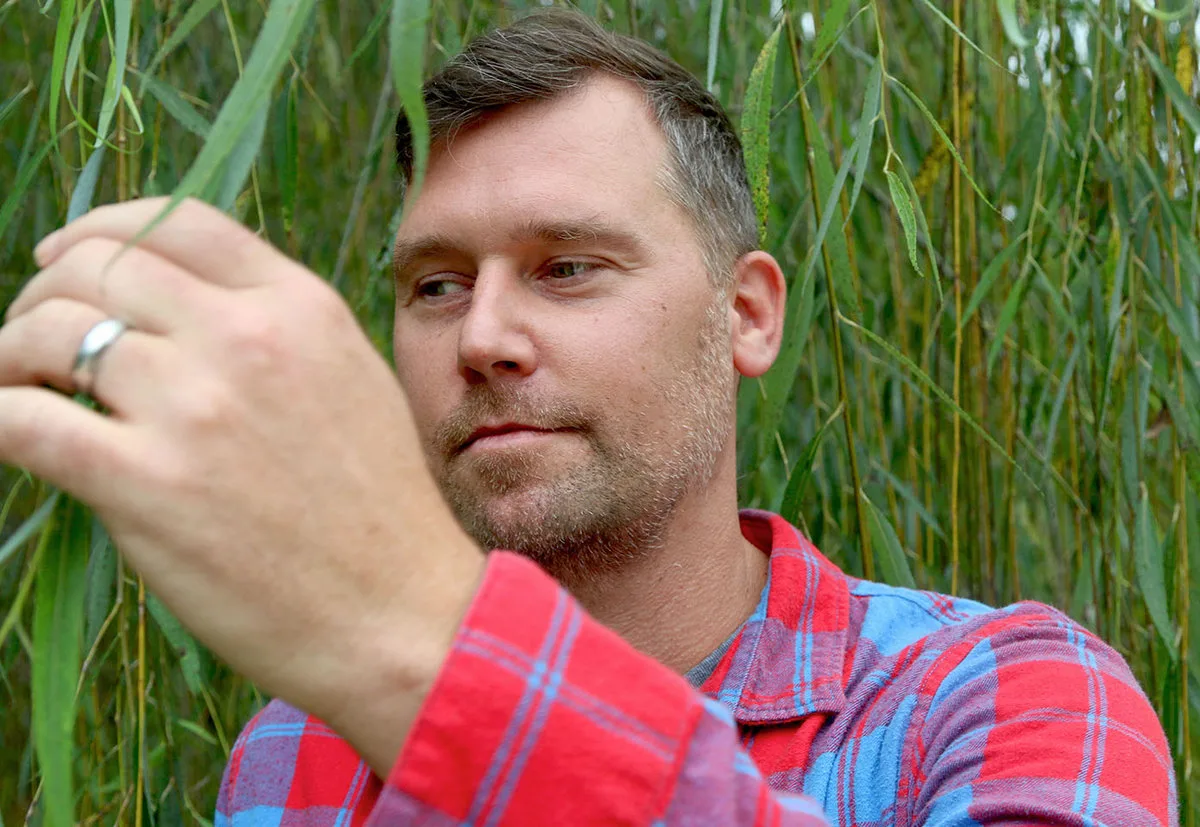
Randy Bickford has put out music across several projects, from the alt-country with a hint of punk The Strugglers and solo under his own name to the latest efforts as Scivic Rivers. The way he sees it, the songs were never the through line as much as the experience gained from learning how to record them. The by-product of that process is a sound that exists in some liminal space between a Father John Misty and The War on Drugs.
After years of working with producer Scott Solter, whose credits include the Mountain Goats and Spoon, and a self-titled LP that wrestled with fatherhood and political dread, Bickford is keeping it simple and human. Lord knows we need more of that these days.
That shift is playing out in two parts. Ghosts of My Life, a June EP centered on the deaths of his father and a friend, is the first side. Legacy Admission, recorded closer to home with a loose, skilled band that includes drummer TJ Maiani and keyboardist Charles Cleaver, is the second. It looks back on the handful of people he has loved. Whether the two belong together as one record, he isn’t sure yet, but he’s making the most of it in a time when the album format seems passé.
What have you been listening to lately — something new, or an old favorite you’re just catching up on now?
Randy: Let’s see, I was just looking at my recently added stuff. Eric Dolphy‘s Out to Lunch. Pretzel Logic by Steely Dan, too. There’s a song on that record called “Through with Buzz” that’s a minute and a half and really weird, not a typical Steely Dan song at all. It’s odd and kind of creepy, and I’ve been enjoying that. The new RIBS album [COLD RIBS], too. I was curious about that one, and I know some of those folks.
Oh, can’t forget Bert Jansch’s L.A. Turnaround. That’s a classic if you’re into British folk. It took me a while; when I was younger, it might have sounded a little too Riverdance for me or something. But now it makes total sense.
When you first got into music, either as a listener or when you picked up an instrument, who did you discover and obsess over to the point they basically became your whole personality?
Randy: I went through phases, and I’ve thought about this a lot over the years. I’m middle-aged, so I was the prime demographic for MTV at its height of influence, the mid-’80s. Seeing Van Halen videos and wanting to be Eddie Van Halen and David Lee Roth when I was really young influenced me, and I sort of made that part of my personality. I like how you put that, because I feel like that doesn’t happen as much anymore, or it’s gone away with streaming and music being more like wallpaper. Before 2000 or so, music was more political. It was your identity.
I was into metal for a while, then the Seattle bands. From Pearl Jam, so emotional but poetic, to Pavement, like the absence of emotion, the coldest you can be, and still poetic. And then the obvious guy I get compared to, Bill Callahan. I discovered Smog and thought, “Okay, this guy pairs both of those things: a coldness and a distance, and humor, but also intense emotion.” There’s a new champion for my identity, because you can combine all those things.
By then I was in my late teens and twenties. This is a huge generalization, but I feel like that stuff gets fully imprinted on you, then you branch out, and it’s no longer like whatever music you’re into is your identity. Those are my phases.
You’ve released music as the Strugglers, then under your own name, and now as Scivic Rivers. Do you see a through line across those phases of songwriting and making music?
Randy: It’s all been one continuous thing in terms of songwriting. But it’s also been a huge learning curve in terms of learning how to actually make those songs happen. That’s a real skill set. A lot of people develop it quickly if they get famous, because you have to make records fast and learn on the job. For me, it happened over a much longer period because I’m not that prolific, and nobody was asking me to keep making music. It just happened in its own time.
On the songwriting side, it’s been a slow, organic process of learning to be okay with repetition and keep things simpler. I used to feel this unconscious pressure to add more detail, more interesting poetic language. Like if I repeated things or kept them simple, people would be bored. Quite the opposite. People’s cognitive loads are already overloaded; they need things repeated for them. That’s kind of what pop music is.
On the production side, I didn’t have that skill set when I was younger. I just wrote the songs, and whatever happened when we recorded them, happened, because I thought my influences were people who just sort of winged it. But they were way more savvy and self-conscious than I gave them credit for. I wasn’t trained musically, so I didn’t have that thoughtfulness about arrangement, about making songs come to life. That’s been a long, slow process.
Working with Scott Solter — producer of Mountain Goats, Spoon, John Vanderslice — was kind of like boot camp for me. Having higher standards, knowing what it means to find a drummer who really has feel. I just didn’t know what those things were. The Strugglers was way more punk rock, lo-fi, indie. When I started working with Scott under my own name, I took from his influence on having high standards — he’s an art-rock guy, but he also likes things almost Steely Dan pristine. I made two LP’s with him under my own name as Brice Randall Bickford, and then the first Scivic Rivers LP.
My forthcoming new record feels like coming full circle. I know enough to be dangerous now, and I put together a highly skilled band. TJ Maiani on drums, who’s my favorite drummer, played on the new Sylvan Esso record and pretty much everything you probably like; Charles Cleaver on keys. I’m co-producing this one with Charles and letting things be looser. I’m trying to take what I learned from Scott about high standards and find my own way to let things be loose, too.
You touched on cognitive load and everybody being stretched thin in an unstable world. How has fatherhood — or even just the prospect of it — changed the way you express yourself, lyrically or musically?
Randy: The first Scivic Rivers self-titled album, the one I made with Scott, was the middle-aged-guy-has-a-child record — going through all the phases you go through and writing about that. That was the tail end of the first Trump administration, so there was a lot of horror about that, on top of having a very young child. I’ve since moved through that phase. I’m still in it, but it’s more part of the larger soup of everything I’m sorting through now.
Ghosts of My Life was mainly about the death of my father and my friend Neil. That one was unapologetically personal and confessional, with the concerns about the larger world lurking in the background rather than up front. It’s the opposite of the first Scivic Rivers record, where I’d moved past confessional relationship songs to focus on what’s going on in the world and what it means to be a father. Now I’ve passed through that again, and I’m back to being unapologetically a confessional songwriter.
It can be a genuinely tough thing to write about, because who wants to listen to music about the horrors we’re already living through? You don’t necessarily want to escape from it, but we all have to face the news every day. So how do you not run away from that, but also not make every song a commentary on it? Some protest songs are just insufferable. I’d say the vast majority of political music is bad — watch one of those activist documentaries, the music is almost always terrible. That’s been a cautionary tale for me: don’t stare at the sun. Too on the nose, and the results can be bad. You have to weave it into something more universal, something everyday that people can actually relate to.

Image credit: Mariel Pfiffner
With the decision to work in something like a “Side A, Side B” structure, but with different sounds and themes, do you see them as two halves of the same project or two separate things that started to meld together?
Randy: I’m not sure yet. I recorded Ghosts of My Life with John Pfiffner, who is amazing but lives just far enough away to make recording challenging.
Once [Ghosts of My Life] was out, I just wanted to record something closer to home with a group of chill guys. I wanted maximum ease. What came out of that is more minimalist, with a different theme of looking back on the small handful of people I’ve been in love with. It’s going to be called Legacy Admission.
Whether the two sides fit together remains to be seen. I’ve been conceptualizing my work in album form for so long that being forced into a smaller, bite-sized format actually felt freeing. My Gen X brain kind of hates EPs. I’m not an amateur, I’ve been doing this a long time.
But it made me think: “Okay, I have one album side with this theme and this sound, and I could have another side with a different sound and subject. Who’s to say I couldn’t do that twice more and it eventually becomes a double album on the installment plan?” I don’t know what it’ll be. I’m not going to press vinyl unless someone wants to pay for it — I’ve done that too many times and ended up with boxes of records in my house.
I will say I’m genuinely excited about what we just recorded. It’s very minimalist, very human, and organic. In this age of AI, we left a lot of mistakes in, kept things looser, and didn’t fix everything. I worried I wouldn’t be okay with that, and I’m actually very okay with it. Hopefully people are into it.
With Legacy Admission coming out via the Potluck Foundation, how did that connection come about, and what made it feel like the right home for this side B?
Randy: Honestly, I don’t know yet what form this will take. I assume by default I’ll release it that way, but I know and love John Harrison and Eric and Reid and some of the other folks who put stuff out under that imprint. It’s really just a little collective, but a place for what would otherwise be self-releases to go. No money, no promotion; it’s just the little human labor we can offer each other, helping out and playing shows together.
So I don’t have a fully formed answer on that one. And of course you’re always secretly hoping that someone will hear it and say, “This is really great, this is a new milestone, I’d like to put this out.” I don’t know why that would happen, but I don’t know what else I have to offer, so.
Who are some of your favorite local or North Carolina musicians?
Randy: Going back to those phases I mentioned earlier: when I was in high school, in the early-to-mid ’90s, everyone thought Chapel Hill was going to be the next Seattle. I’m from Danville, Virginia, about an hour north of here. Growing up, it seemed surprising that a contingent of kids at my high school were really into the cool bands from this area — Polvo, Archers of Loaf, Superchunk, the big three at the time — along with Pavement and some of the bigger national acts.
Where I grew up, cool culture felt like it only came from MTV, this nationally broadcast thing, so being an hour away from a real scene you could actually go see and talk to people in was exciting. A friend from high school could somehow pick up the signal from WXDU at his house, even an hour away.
Polvo was incredibly influential for my 14- or 15-year-old self. They were aggressive enough but also weird, not too poppy, with real aggression that really appealed to me. Ash Bowie played guitar on one of my records, and we’ve gotten friendly. He’s the one hero I’ve gotten to know who’s managed to be both humble and approachable while still keeping that impossibly cool mystique.
More recently, Erie Choir put out a record, Golden Reviser. A few of those songs really speak to me. There’s one called “National Malaise” that feels like it could be about my life. I really dig Tacoma Park too; that’s been a cool left turn for John to get involved in. Chessa Rich has a great voice, and I like her songwriting – plus she’s singing on our new record.
Some people may not realize Tim Smith of Midlake is local to the area. I love Tim’s songs, and it’s one of the great honors of my life that he seems to dig what I do. If you don’t make money in this business, if you’re not famous, the way you get paid is by meeting your heroes and getting these little experiences. You get to smoke weed with Alan Sparhawk in his dressing room, throw up in his shower, and have him tell you that you have a great voice. That’s your payment.
This interview has been edited for length and clarity.

Leave a Reply