
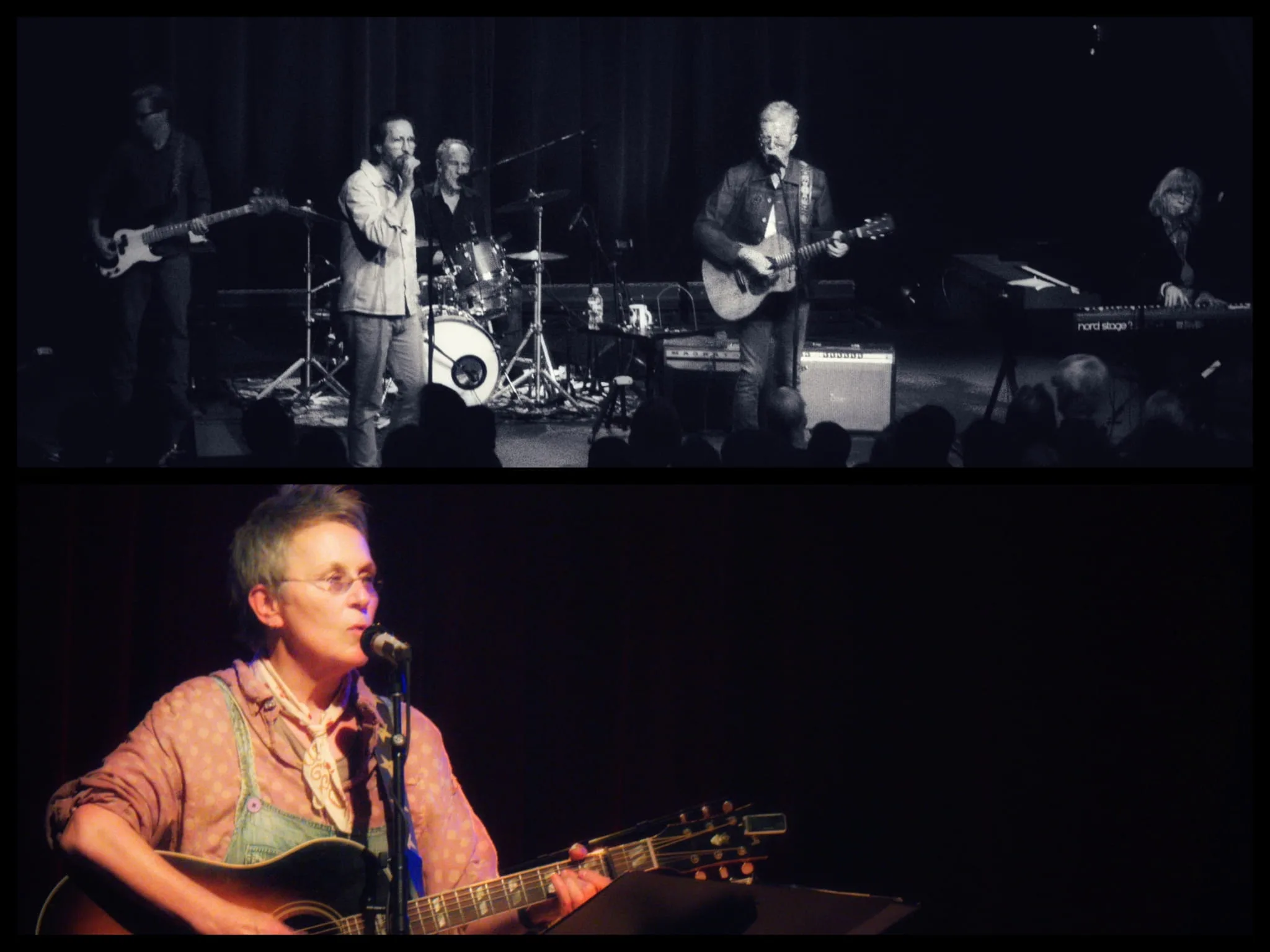
All photo credit: Pamir Kiciman
On a mild November evening in Saxapahaw, the Haw River Ballroom welcomed two distinct yet kindred songwriting voices to a full house: The Jayhawks, whose melodic Americana has endured for four decades, and Mary Gauthier, whose songs have long found their way into the complicated corners of the human experience.
Both arrived with new albums and plenty to say about the world beyond the stage. It was an especially fitting pairing for a venue with a history of reinvention and longevity, transforming an old textile mill dye house into one of North Carolina’s most distinctive live music destinations.
Mary Gauthier approaches songwriting with an almost disarming directness. Her songs don’t skirt around difficult subjects or dress up uncomfortable truths. Instead, they inhabit the lives of people confronting loss, addiction, fractured relationships, moral uncertainty and the possibility of redemption.
Her latest album, Reckoning, continues that tradition while looking outward at a world in turmoil. Across nine songs, Gauthier moves between intimate personal narratives and broader questions of justice, faith and accountability. The album’s tension is between acknowledging how broken things can become and maintaining the hope that something better remains possible.
A longtime practitioner of the singer-songwriter tradition, Gauthier has developed a voice that’s unmistakably her own, which she shared with gusto on her solo set. It matched the record’s sparseness, rendered mostly by herself on guitar and harmonica. She opened unblinkingly with the anthemic title track (co-written with Aaron Lee Tasjan); the line “A reckoning is beckoning, and the old world is fading into black” felt prophetic in light of the 2026 midterms. Gauthier makes no bones about her activism. Between songs, she celebrated victories, told stories about finding songs in the newspaper, and read from her memoir, Saved by a Song.
Born in New Orleans and now living in Nashville, she told the story of co-writing “Some Times” with Vince Gill. It originated as a simple remark Mavis Staples made to him, leaving the stage after a show: “We sure have seen some times, haven’t we?” There was a melody and some words, but the song remained undeveloped. Gauthier found an old B&W photograph of a waiter in the dining car of the Orange Blossom Special (mentioned in one verse), a high-speed train between Manhattan and Miami from 1925 to 1953 — and with it the song’s narrator who had a front-row seat to decades of American life.

The Jayhawks and Mary Gauthier may occupy different corners of the Americana landscape, but share an appreciation for the enduring power of a well-crafted song. One draws on the melodic richness of country-rock and roots-rock, the other on the narrative intimacy of the folk singer-songwriter tradition. Both, however, understand songwriting as a way of making sense of the world.
Forty years into their musical journey, The Jayhawks have little to prove and plenty left to say. Formed in Minneapolis in the mid-1980s, the band helped shape the alternative-country movement with a hybrid country-rock, folk, and classic pop sound distinguished by its melodic sophistication and close vocal harmonies.
The new Sanctuary Park, the band’s 12th studio album, celebrates that musical identity and reflects the present. Reuniting with producer Bob Ezrin (Pink Floyd, Alice Cooper, Kiss, Lou Reed, Peter Gabriel), who previously worked with the group on 2000’s Smile, The Jayhawks deliver a collection that draws on their familiar strengths without simply revisiting old territory. Its songs move between personal reflection, historical storytelling, and observations on the contemporary American landscape.
The current lineup of Gary Louris, Marc Perlman, Karen Grotberg, and Tim O’Reagan has been playing together for more than three decades. They opened their 90-minute set with the album’s bouncy and catchy first track, “Keepin Our Heads Above Water”. The Jayhawks explore well-crafted pop sensibilities these days, grounded in their Americana-defining work. Fans were treated to favorites like “Smile”, the closer “Blue”, and the singalong encore, “Save It For a Rainy Day.”
For a rendition of “All the Right Reasons,” area musician Django Haskins (Old Ceremony) joined on vocals (Louris lived in North Carolina in the late 2010s and has maintained musical connections, including headlining at Haw River Ballroom). The lush three-part harmonies he, Grotberg, and O’Reagan are known for were featured throughout the entire set and shone on “Leap of Faith” from Sanctuary Park. Also from the album, “Mr. Lincoln” and “American Midnight” dealt with weightier issues.

It was inevitable that current affairs would be part of the night since it was Veterans Day. Gauthier has spent years using collaborative songwriting to help veterans and their families heal from trauma. Louris, who now lives in Canada, acknowledged Remembrance Day and was wearing a red poppy on his jacket.
It’s especially satisfying to hear music in a place with its own history. The Haw River Ballroom occupies what was once the dye house of Saxapahaw’s historic cotton mill, whose former purpose remains visible in exposed brick, architectural details, and salvaged machinery. Opened in 2011 after an extensive restoration, the three-level space combines historic features with modern sound and lighting, and a riverside deck overlooking the Haw River. It has since become a destination for touring musicians from across the country and beyond, bringing an impressive range of musical experiences.
The Jayhawks and Mary Gauthier are working within a tradition in which songs are more than entertainment. They are storytelling vehicles for cultural observation, personal reflection, and collective memory. Both engage with the contradictions of American life, and beneath the political and cultural perspectives, both are interested in people: their relationships, vulnerabilities, mistakes, hopes, and efforts to keep going. Neither relies on production gimmicks or musical spectacle to make the songs work. Melody, lyrics, arrangement, and performance remain central. Their latest records and live sets in Saxapahaw demonstrate the continuing relevance of a songwriting tradition always ready to respond to its times.

Leave a Reply