
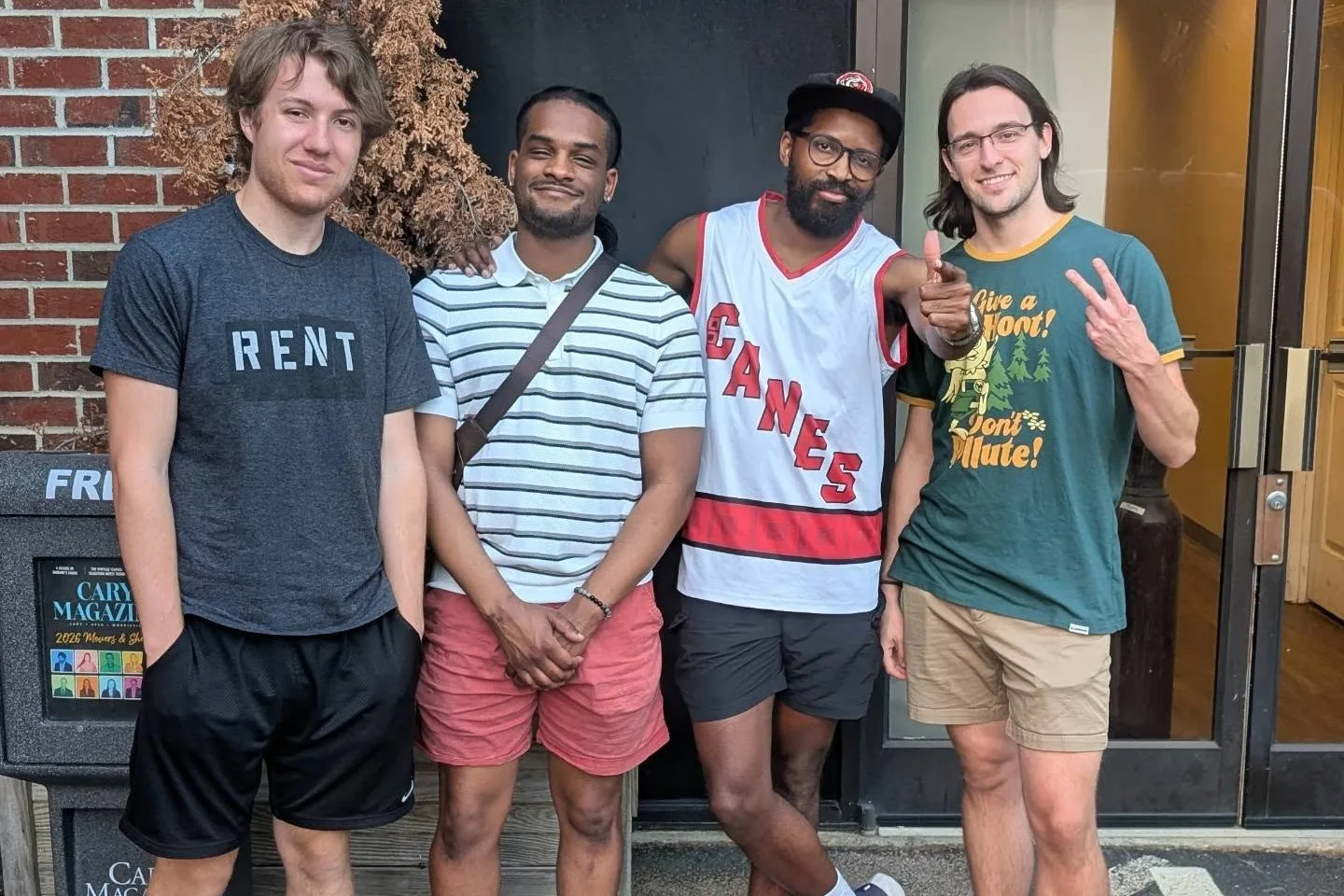
Header image credit: Julian Creech-Pritchett
Jonathan Duren got his first guitar from his sisters about 20 years ago, but it was always waiting for a band. For most of those years, his work in sports broadcasting left little time for it. It wasn’t until a difficult stretch in his life a few years ago that he picked up the guitar again and began writing songs as his creative outlet.
Over time, he started playing open mics around Raleigh as Practical Dinosaur, a solo emo project inspired by bands like American Football and Modern Baseball (no relation). When January 2026 arrived, he noticed that February would lay out as a perfect square on the calendar, four weeks running Sunday to Saturday. So he planned to write four songs, one per week, about how time changes people. He recorded them with one acoustic guitar and his voice and released them as 16 kHr2.
After releasing the debut EP, Practical Dinosaur is ramping up from a solo project to a full-fledged trio. Drummer Shaun Peart and bassist Kyle Blochl have bolstered the live show and add plenty of layers for Jonathan to work with as he starts tracking a second EP, Subaquatic.
Is there anything you’ve been listening to lately, new or old, that you want to shout out?
Jonathan (vocals/guitar): I’ve actually been tapped into the new Movements album. I came across them earlier this summer, and their record Happier Now just came out a couple of weeks ago. It was very funny when it came out; I had friends telling me, “Hey, I think you might like this, it’s right up your alley.” I’m like, “Yeah, I actually just discovered this band a couple of months ago.” I listened to that one in full for the first time today, actually, and it’s been really, really nice.
I’ve also been getting a lot of discoveries through Music League with my friends. If you don’t know it, it’s an app where a group gets together, and each round has a theme. Everybody anonymously submits a song that fits it, then you all vote on your favorites. I’ve found so many great bands through that. Bike Routes was one; I saw them last year opening for Arm’s Length at Cat’s Cradle, which was really cool. I also really got tapped into Origami Angel through it. I love discovering music that way, the same way you’re doing with this question.
Thinking back, who was the first musician you remember discovering and obsessing over?
Jonathan: I grew up in a very musical household. I always joke that my first job was drummer, because I actually was the drummer at my church growing up in Illinois. So I came up with a lot of gospel influence, and from there, funk and soul. My parents are both on the older end, and on our cross-country road trips from Illinois to North Carolina and Maryland, they always had tapes they’d put together. That’s how I learned James Brown, the Temptations, the old Motown and Stax stuff. My siblings went to college in Virginia, so trips out to the DC area got me into go-go music too, like Rare Essence, Backyard Band, whatever tapes they’d bring home.
I’m an early-90s kid, so growing up in central Illinois, when Kanye came out, that was a huge deal, and Nelly and the St. Lunatics reached us too. So there was a lot of hip-hop in there.
But honestly, the soundtrack to NCAA Football 06 really shaped me. That was the punk soundtrack: Jawbreaker, Ned’s Atomic Dustbin, Lush, Bad Religion, Pixies, Superchunk. The Clash‘s “Train in Vain” was the one rock song that didn’t really fit with the rest. “Bad Scene, Everyone’s Fault” by Jawbreaker is still one of my favorite songs to cover at open mics.
It was actually wild moving here and realizing Superchunk is from Chapel Hill.
What brought you to North Carolina?
Jonathan: I moved here with my family. My parents are both East Coast natives and wanted to get back closer to family, so once I finished high school in Illinois, we packed up and moved east. I transferred to a college here and have been in the Triangle ever since, sixteen years now.
Moving to Raleigh actually felt like moving to a second home, since we already had family here. I’ve gotten to know the state well, though I still haven’t done the touristy stuff in Wilmington, since we always went there to visit family rather than sightsee. Getting into the local music scene has been the best part.
Before this project, had you been part of the music scene here, or is Practical Dinosaur your first time putting yourself out there?
Jonathan: This is really my first time. I’ve had a guitar for about 20 years; my sisters got it for me as a birthday gift. I play left-handed, so left-handed stringed instruments aren’t easy to find, but I’ve built up a nice collection now that I have my own income. I’ve worked in sports for a long time, and still do, but for years my schedule didn’t leave much room to play.
A few years back I went through a period I call “the everything,” and I latched back onto the guitar as an outlet. It became genuinely therapeutic, a way to process and just enjoy making something. That led me back to material I’d worked on before, and once it started rolling, it just kept going. I’ll be walking around the office with a melody stuck in my head, take out my phone, hum it or write down whatever words come to me, then sit down later and figure out what to do with it.
This is also such a great scene to do that in. I’ve lived in other cities and states where there’s a real gatekeeping instinct, like you have to earn your way in as a newcomer. Here, maybe because so many of us are transplants, it’s a lot easier to just show up, start doing the thing, and have people say, “Yeah, I like this.”

Image credit: Zachary Pomeroy, La Flecha
What drew you to emo and punk specifically as your vehicle for songwriting?
Jonathan: It’s so honest. I moved here in 2010 for college, and moving halfway across the continent for school makes it hard to build friendships, especially somewhere new. You go home for the summer, and the people you knew aren’t around anymore, and by the time you’re making real connections, you’re already leaving again. It was a tough transition.
I finally latched onto My Chemical Romance in college, listened to The Black Parade front to back constantly, and that opened the door to bands like Taking Back Sunday. Growing up in church, Relient K mattered a lot to me too. Those are all melodies I recognize, things I can hold onto.
But beyond that, it’s the genre’s willingness to just say what you feel. There’s a Harrison Gordon song, a band out of Bloomington, Illinois, not far from where I grew up, called “Driver’s Side”, and the chorus is basically: “Make sure if you hit me, you hit me on the driver’s side, because I only drive at night with no headlights.” That’s an intense, almost caricatured way to say something, but that’s the point; it gives people a way in. That’s not exactly where I want my own writing to live, but when you’re dealing with loneliness or loss, sometimes you need a way to say it plainly so someone else can recognize themselves in it.
Spanish Love Songs‘ Brave Faces Everyone got me through “the everything.” A friend of mine, Stephen, put me onto it. The closing lines of that album: “We were never broken, life’s just very long, brave faces everyone.” Being able to say something that honest, in a way that reaches someone else, that’s the goal. Sometimes I want to write the fun, classic pop-punk thing about running around your hometown with your friends. Other times you have to say the difficult thing. Somebody’s got to.
It’s interesting watching bands evolve, too. The latest Prince Daddy and the Hyena record is so different from where they started. I listen to “SHITSHOW” or “Boulevard of Soaking Dreams” constantly now, a song about not wanting to leave the shower, or “30days30days30days,” about trying to get your head on straight when everything’s breaking you down. It’s a long way from “Bloodhound” or “As I Shrink.”
Bands grow a lot, and it’s interesting to watch how they shift. I never expected to track which bands from high school would stick around. Similarly, American Football is a big influence for me. Being from Illinois myself, I made a trip to Asheville to see them tour behind LP4, their fourth album in 27 years. They don’t tour, so that was a big moment, and it’s part of why I recently traded in my Strat for a Telecaster.
One thing that stood out to me about 16 kHr2 is the very specific reflection on time, the framing of February as a perfectly square month. Where did that idea come from, and what were you observing across those four songs?
Jonathan: As January rolled around, I looked at the month and realized it was a perfect square, four weeks, Sunday to Saturday, and thought that would make a cool project. At first I planned it as four tracks, one per week. From there I just started writing around the idea of the passage of time and how things change. The first track was inspired by Modern Baseball‘s Holy Ghost, where the opening track is short but sets up everything that follows.
Much of the record comes from that moment when February hits, and January’s resolutions are still fresh: are you still choosing to improve, still pushing forward, or have you already left that behind? Who are you choosing to be?
“Post Credits” is about loss, about losing someone you care about, and about not being ready to move on when things change without your permission. There’s a line: “I love these memories, a treasured part of me, a verdant garden full of flowers with poison berries.” That’s the idea that something can be beautiful and still not be good for you to keep looking at, and you have to leave it behind anyway. “Leonine” closes it out with the same idea: time moves whether you’re ready or not, so you choose to be ready anyway, every day.

Image credit: Summerfuss
Has bringing on a full band changed how you write? Is it more collaborative now, or still you with guitar and voice, then fleshed out?
Jonathan: I’m still spearheading the writing. It’s a three-piece now: myself, drummer Shaun Peart, and bassist Kyle Blochl, a longtime friend of mine from early on in North Carolina who’s played in a few other projects. As I write and hear things in my head, I’ve realized I need people around me to fully bring the vision to life, and I’m grateful to have them. I’m actually already thinking I need to bring on a second guitarist.
Right now I’m getting ready to start tracking the new EP, titled Subaquatic, named after one of the first songs that felt like it was truly in my own voice. I wrote it in the American Football tuning, FACGCE, the same tuning as “Never Meant”. I put together a rock-forward arrangement of that song and realized I needed to write something else in that tuning if I wanted to keep going, and that turned into a song I wrote for my nephew, who passed away unexpectedly in 2023. That loss was a big part of “the everything” I mentioned earlier, and a lot of what I went through during that time still informs my writing now.
Working with the band has been really fun, bringing an idea to them, seeing how it sounds, getting their read on it, and then drilling it until it’s ready for the stage.
What’s the difference between performing solo and performing with a full band now?
Jonathan: It’s been a lot of fun for me. I see myself as a storyteller by trade; I’ve worked in sports broadcasting for 13 years, and I’m naturally energetic. If you come see us play, you’ll see me moving around the whole time. Our tagline is that we’re here to stomp and thrash, and that’s exactly what I do on stage, jumping around, moving with my guitar, getting all that emotion out to the crowd. It’s been great working with people who’ve been in other projects and know how to perform, and sharing that energy with them.
We played a basement show hosted by Summerfuss, along with Bradlei Griffin, a good friend of ours who I also met through open mics at Bond Brothers Eastside in Cary. It was so much fun being able to jump around down there and get a response from people who hadn’t been able to make it to an open mic to see us. Realizing people actually wanted to be part of what we’re doing felt really cool.
Aside from people you’ve already mentioned, who are some of your favorite North Carolina musicians right now?
Jonathan: I’ll start locally. Bradlei Griffin is a great performer, usually popping up at different open mics, though I wish he’d put out more recorded material for people to hear. Andrew Kelley, Michael Leix, and Ben Sullivan make up Summerfuss, who recently put out Summerfuss’ Summer Bash, Vol. 2, available on Spotify and Bandcamp. Joe Ralli, who goes by Ol’ Joey Scrums, recently hosted Scrum Fest at Compass Rose Brewery, where I got to meet a bunch of new people, including Square One, another local emo band. And Dreamscent blew me away recently. I wasn’t prepared for how good their shoegaze, dreamy rock was, but I’ve been telling people about them since.
On the more established side, American Aquarium was one of the first bands I really leaned into after I got here. Their album Wolves came out while I was working in sports and constantly on the road, never home, and it felt like it was written about me. Mount Moriah‘s first two records, the self-titled and Miracle Temple, are extremely important to me too. Those are always the two I point people to when they want something a little more well-known from this state.
This interview has been edited for length and clarity.

Leave a Reply