
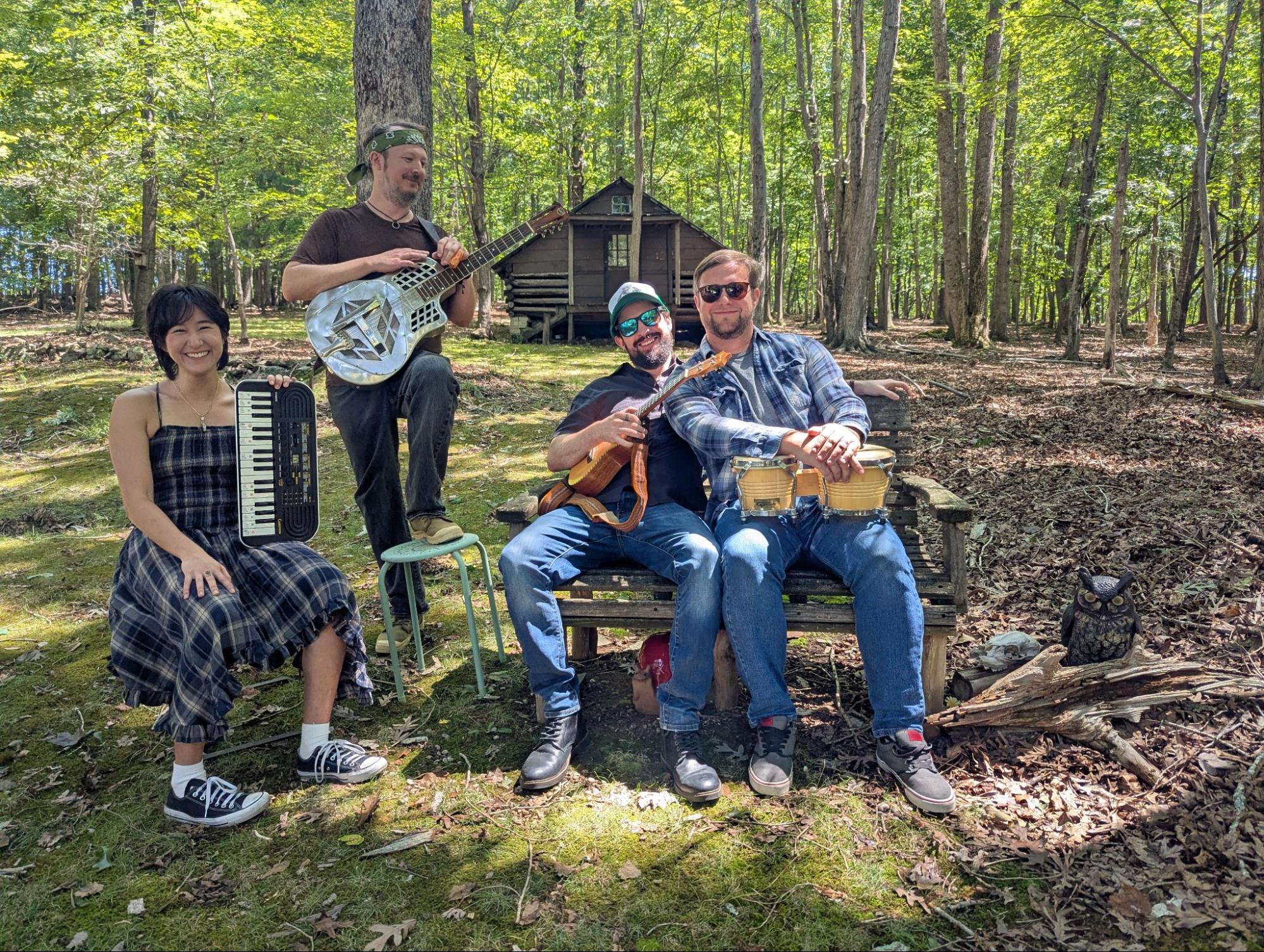
Header image credit: Sandlin Gaither
Guitarist and vocalist Robinson Earle used to think every song needed words, until he burned out on them. That led The River Otters’ songwriter and guitarist to turn to instrumental music, and the band ended up with Adshusheer, which drummer David Barrett describes as “a landscape rendered in sound,” dedicated to the forests that surround them.
With their latest single, “Skinny Jeans”, the words are back, thanks to the addition of Lillian Faith, a vocalist and keyboardist with a jazz background. The band’s next album, Romp, pairs instrumentals with poppy indie-rock songs and sets out to celebrate life, love, and friendship, a sharp tonal turn from its predecessor.
Robinson and David, who have played together for about twelve years, sat down to explain how a band that began in Carolina drone-blues ended up writing forest soundscapes and indie-rock hooks. Part of that transition is fueled by Robinson becoming a father, with the songs providing an outlet for the nostalgia, pensiveness, and happiness that experience brings. But another part is a refusal to stay in one lane.
Is there anything you’ve been listening to lately, either something new or a longtime favorite you’re hearing with fresh ears?
Robinson (guitar/vocals): I’ve been digging into some stuff from the Hausu Mountain record label. A band called Crying Laughing put out a record called Talking, and I thought it was pretty good. There’s also this strange one on that same label, Euphonic Sounds by Ragger, which is literally old ragtime tunes played through analog synthesizers. Kind of like Switched-On Bach, but for ragtime. I was digging it. I went on a run the other day and felt like I was in black and white.
I’m always listening to new music, always finding new sounds. I’ve also been on a bit of a Feelies kick — never really listened to them much before — and some early Brian Eno. Honestly, I think that’s the coolest thing about me as a musician, more than the music itself. I’m always trying to find new things and getting excited about them.
David (drums): It’s been cool to watch, actually. Robinson and I have been playing together for, I’m guessing, twelve years or so by now. I’ve seen him get fascinated by different things and find ways to absorb them and repurpose them in his own voice. It’s less “Robinson trying to do Irish folk tunes” — which is one of the more recent things — and more like, “This is Robinson’s take on XYZ.”
Robinson: Yeah, I see what you did there. I have been listening to some Irish folk tunes lately, but I didn’t think it was that on the nose.
David: I’m still kind of living in a Jeff Parker jazz world, he’s the guy from Tortoise. And I grew up in the mid-2000s, so that was the heyday for me, and I’ll always be a sucker for that indie rock stuff. MJ Lenderman is stuck in my head way too often these days, and The War on Drugs too. Both are in heavy rotation.
I think my listening is super eclectic, and that factors pretty heavily into what we produce. Our last record was all instrumental. I think of it as a soundscape, a landscape rendered in sound, dedicated to the forests we love that surround us. The next record has some instrumentals on it too, alongside some more poppy, indie-rock, vocal songs. It’s just a reflection of everything I listen to.
There’s a lot of genre-fication happening right now. Everyone’s trying to find their lane, find their audience, and there’s real merit to that. It works from a marketing perspective. But as a creator, I don’t want to be limited. The last thing I want is to feel like I have to appease somebody by making the same thing over and over, or stay in my lane. I refuse to stay in my lane. I think it’s a lot more fun to drive all over the road.
When I see a band do that, I get excited. You could say that about The Beatles, but the first one that comes to mind for me is Ween. They’re just like, “We’re going to do what we want because we like it.” Here’s a straight country song, then some absurdist psychedelic rock. I think that’s fun. It honestly reflects the absurd journey of life. I always love artists who go to different places rather than sticking to their go-to moves, even if it means some records lean into one sound and then they go somewhere else entirely. It’s more fun not knowing exactly what you’re going to get.
Genre-crossing requires real craft to pull off. Writing convincingly on the upbeat, for instance, isn’t easy if it doesn’t come naturally. We’ve dabbled in it; probably the most ska-punk moment in our catalog shows up toward the end of one of our instrumentals. Mostly it’s about the mood, though.

Robinson, you mentioned the last record was instrumental, and the new one is bringing back more vocal, poppier songs. Is that a change in formula for the band, or just another way of experimenting with genre?
Robinson: We actually started out with vocals. My original idea was something like an acoustic Black Keys, deep Carolina drone-blues territory. I intentionally wrote very simple, groove-driven songs early on. I was digging into old Mississippi country-blues music for inspiration, but I wanted to put my own spin on it and make it authentic in my own way. We did that for a while, and I started to burn out on lyrics—I’d always been really focused on that side of storytelling, and I realized I’d been limiting my output by feeling like I needed to attach words to everything.
Then I had this revelation and started producing a lot of instrumental music. David was a little bummed out at first, honestly, but he came around. When I started singing again, my friend Claire helped me. She supported me as I found my voice again, and I took some lessons with her. That actually happened in parallel with us releasing Adshusheer, our instrumental record. It was going to have some vocals, but one day I listened back and cut them all because it felt better as an instrumental piece. One of those songs will actually be on the next record.
It took me a while to find my voice again, technically speaking, in a way that felt real. I came up through punk rock and then into a dirtier punk-blues territory, and I was always pushing my voice hard. Now I take it a lot gentler, most of the time. It feels closer to how I actually talk and who I am as a person. Becoming a father, all the adulting stuff, sometimes that’s harder to put into lyrics than 20-something angst. It’s more complex emotionally. It took a while to figure out what kind of songs those should be, but I feel like this next record represents where I’m at as a person right now: nostalgic, pensive, but happy.
David: I’d echo a lot of that. Going instrumental got us stretching different muscles, and hopefully we’re carrying that back into the lyrical songs now. I remember thinking a lot about how people want to hear people. So if we’re trying to be engaging without vocals in the mix, we have to work a lot harder to hold people’s attention musically. I think Robinson’s playing got more complex during that stretch, and I focused more on how I was hitting things than on straight rhythm.
We were also practicing a lot outside, in the woods by the house I was living in at the time. Sometimes it was all acoustic, with birds chirping along with us. There were a lot of magical moments writing that material. Going from our first record, plus the stuff from that era that never made it onto a record, to what we did with Adshusheer — musically, it’s just more interesting.
Robinson: Definitely. We stretched new muscles and found new ways to express ourselves. David’s background is in classical percussion, more formal than mine, and he did a lot of the arranging on those pieces. Thinking through what should come when, how things unfold in real time, when to leave space and when to bring something in.
We still carry that with us, even now that we’ve added a new member with Lillian. She’s awesome. She’s got more of a jazz background as a vocalist and keyboardist, which is great for us, because she totally understands the pull of instrumental music and can hang with us on that side, coming up with great riffs. But she’s also got this incredible voice, so if we want to sing harmonies, we can do that too.
My hope is that when you come see The River Otters live, you get a lot of different things, and that variety is entertaining, even though I think something cohesive runs underneath it all. I grew up with a folkiness I can’t really shake. Even the songs I’d call my most straightforward, happy indie-rock songs, people still come back and say there’s a bit of sadness to them, a bit of folkiness. If that’s what you hear, that’s yours to call.

Does adding another member change the band’s dynamic at all, or is it more of an extension of that same evolving sound?
David: It’s felt pretty natural. We’ve had a succession of bass players over the years. Mike’s the exception; he’s been with us long enough now that the earlier bass players have kind of faded from memory. Mike is our bass player. There’ve been some good ones along the way, but Mike is our bass player.
Robinson: I’ll just add that the interpersonal relationship matters as much as the musical one. The hang is important. David, Mike, and I have loved and enjoyed each other’s company for a long time.
And I’d known Lillian for a few years before she joined; I didn’t just recruit her out of nowhere. She teaches after-school lessons at the same school I do, so we’d see each other, hang out, talk. One day it just clicked and I asked if she wanted to come record some vocals with us, because the vibes already felt right. The vocals turned out great, and eventually I asked if she wanted to join the band. She said yes. We’re having fun with it.
David, since you handle the engineering side, is there anything you’ve deliberately done differently on this record compared to Adshusheer, from a recording and production standpoint? Adshusheer had that whole cabin-in-the-forest thing going for it, but does anything similar feel like it’s shaping this record?
David: Definitely. On the last record, we were tracking a lot closer to what you’d get from an actual live three-piece, not a ton of extra overdubs. Most of it was tracked with all of us playing together, and that was basically the finished take. On this one, we’ve done more overdubbing with guitar solos over an existing rhythm track, that kind of thing.
That ties back to bringing Lillian in. A female voice on the record is obviously the top thing you want represented live, and I’m thrilled to have her in the mix. Even before we talked about bringing her in officially, I’d been lobbying to bring in a couple of friends when they were available, like sometimes we’re a three-piece and other times we’re a five-piece.
Some of the overdubbed parts are really cool, and I’d love to represent them live, but the songs still hold up without them if we don’t have the extra players. We haven’t really brought anyone else in beyond Lillian in any ongoing way, but I’m still hoping to.
Robinson: Some of that comes down to physical space. Before Lillian joined, we were recording out of a ten-by-ten shed. She did her vocal overdubs in there. Right now I’m working out of a carport at my new place while we get a proper cabin built out there.
Finding a place to rehearse, a room where everybody’s comfortable, that’s half the battle. Honestly, Adshusheer was really about working those muscles, proving to ourselves that we could sit down and do a take good enough to release. It’s easy to get caught up in chasing some notion of perfection — using a click track, isolating everything so it’s easy to manipulate later — but perfection doesn’t really exist. So the approach was: play the song all the way through in the moment, then do that same thing on stage. A continuum from studio to stage. We proved to ourselves we could do that.
This time around, we let ourselves take it a little easier. We tracked the drums more conventionally for parts of it, when we were doing a more proper studio session, and we really needed a good drum room for that. But we did most of everything else in cabins, shacks, and sheds.
Who are some of your favorite local or North Carolina artists you’d want to shout out?
Robinson: Magic Tuber Stringband. Jake Xerxes Fussell. Kill the Buddha. They’re all great.
David: I actually play in a band called DUNUMS, and they’re also great.
Robinson: It’s such a fertile music scene around here. We’re never at a loss for people to play with. So many cool people doing great things. Fun place to catch shows, too.
The last ticket I bought was for a Magic Tuber Stringband show with a band coming in from Baltimore called Horse Lords, who I’ve been a fan of for a while. If you like Angine de Poitrine, go listen to Horse Lords because they’ve been doing that microtonal shredding stuff for years.
This interview has been edited for length and clarity.

Leave a Reply