
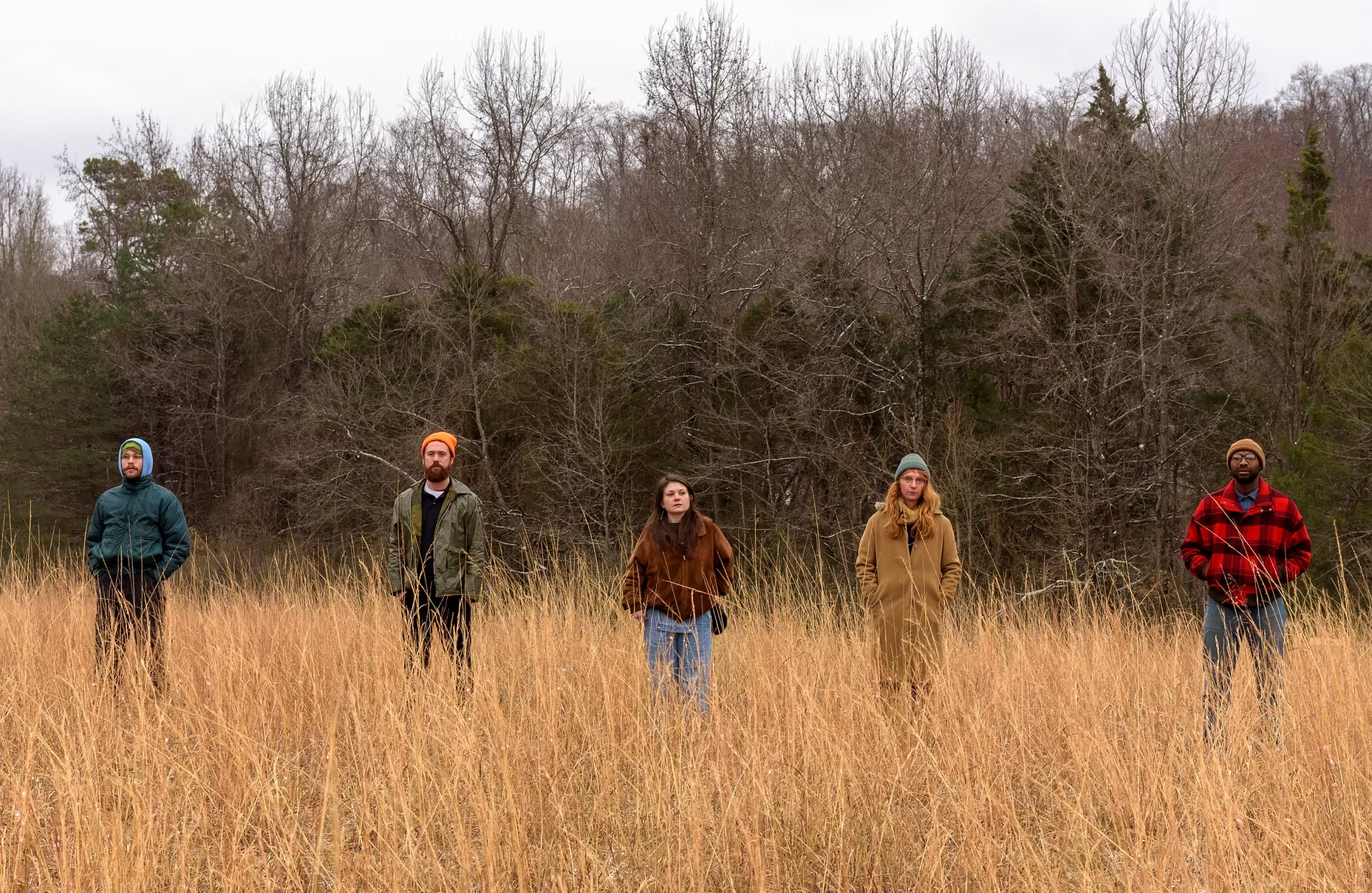
I’m a sucker for bands that feel like a hodgepodge of influences coming together. Like Kill the Buddha, who could never be accused of chasing a one-dimensional sound. Across five members, you get hip hop and Phish, Édith Piaf and Streetlight Manifesto, marching band horns, and Grateful Dead bootlegs. Their self-titled debut treats that sprawl as a feature, not something to sand down into a single lane.
The more interesting story, though, is how the record got made at all. Singer and guitarist Lenwood spent years circling the project until a friend’s gentle push and a producer willing to meet the band where they were turned hesitation into a finished album. What started as a recording session with Brian Haran at Moths Recording Company‘s Hypogeum GSO studio in Greensboro ended with Moths deciding to launch a label just to put the record out.
I sat down with all five members ahead of Phuzz Phest in April to talk about the records that shaped them, what it means to play hometown festivals, and how Greensboro’s tight-knit scene helped their album cross the finish line.
What has everyone been listening to lately?
Nick (bass): I’ve been listening to Nourished by Time’s The Passionate Ones. That album is super good.
Gabi (lead guitar): I’ve been listening to Van Black. He’s an indie R&B artist from Detroit. Sometimes I listen to Soul Sugar on TikTok; she spins the best of the best, great eclectic mixes. And local stuff too. I got introduced to Maps recently, which was fun.
Daniel (drums): I’ve been listening to a lot of classical music, actually. Just driving around with the radio on 89.7. Sometimes the signal is all scratchy, but I’ve been stuck on that station.
Greer (vocals, keys, shruti box): I’ve been listening to Édith Piaf. Just something I put on in the car to be immersed in while everything else is going on.
Nick: Are you familiar with Blossom Dearie? She’s sort of a swingier, American Édith Piaf. If you like one, I think you’d like the other.
Lenwood (vocals/guitar): I’ve also been going back through Can. Future Days is the one for springtime. I’ve been trying to listen to more local groups, mainly to find bands to play with, but also to see what’s going on. I just got into Burlap Circus; I saw them in Greensboro about a week and a half ago. I really like what they’ve got going on.
When you were first getting into music, who was the first artist or band you truly obsessed over?
Daniel: Probably Weezer’s Blue Album. I was going through my mom’s stuff, didn’t really know what I liked yet, and when I heard it, I thought it was the coolest thing ever. That got me into Weezer, then the Dead Kennedys and punk stuff, and then I found jazz and just started liking everything from there.
Nick: I was really into pop punk in middle school. Bands like Alkaline Trio and We The Kings. But the first music that actually made me want to play music was Streetlight Manifesto, because of the horns. That was the first time I tried to learn something by ear. I was in marching band, so it made sense that I’d gravitate toward that.
Greer: The first album I remember having was Monster by R.E.M., which my brother bought for me on CD. The first thing I ever bought myself was the Fugees. Then I got really into Lauryn Hill, Bob Dylan, and Leonard Cohen in high school. Growing up, my mom would play Leadbelly, Muddy Waters, a lot of blues, and Paul Simon‘s Graceland. She always had a really unique palette.
Gabi: I went through a pop-punk phase in high school, played in a rock band doing covers of classic rock songs. But I also did jazz band, and I ended up studying film, not music. Coming back to music after that, I was drawing from neo-soul, R&B, folk, alternative, and experimental. All of that shapes where I’m at now.
Lenwood: My first love was hip hop. The first tape I had was Heavy D, then Tupac, Biggie, Mobb Deep, Gangstarr, The Roots, Jedi Mind Tricks. But then it switched to Phish. [laughs]
Nick: That’s a hard switch.
Lenwood: And then the Grateful Dead. I didn’t like the Dead at first. Jerry’s voice, I just wasn’t into it. But then it clicked. There were still songs, you know? Whereas Phish felt more like jams, the Dead had songs that could go anywhere. I was also getting into Radiohead and John Coltrane around the same time.
What inspired you to start this project?
Lenwood: It was a yearning to write songs. I was playing bass in another group with Daniel and Nick, and I just had this obsession with writing. So I shifted from bass to guitar and started approaching things differently.
Daniel: He kept whipping out that acoustic guitar all the time. [laughs]
Lenwood: Daniel hated me playing acoustic guitar. [laughs]
Gabi: We eventually played a house show together, the first thing after the pandemic, everyone was itching to get out. It was a rager. Housewife played, Velvet Arrows played, people came from Charlotte, Greensboro — it all just came together. After that, things evolved. Daniel had always been generous with the space for us to rehearse, and Nick is connected with pretty much everybody. The community out here is really talented and full of love. That introduction just became a thoroughfare of collaborations and family.

Image credit: blur.iso
Once the five of you came together, what was the process of turning these songs into a full-length collaborative record?
Lenwood: I feel most connected to music when I’m not just learning a part, but when I get to find my spot in the song and be part of creating it. I feel like that’s at the core of this group. Everyone is so gifted that I don’t have to figure everything out, and it’s usually better when I don’t. Each person gets to bring something.
The recording process was really cool. We recorded with Brian Haran at Moths Recording Company in Greensboro. We did drums for all songs in two days, so about nine and a half songs total.
Nick: We already knew the songs for the most part, so it was really about just showing up and playing. I played some saxophone and clarinet in the mixing process too.
What’s cool about recording is that you have to solidify the part you’re going to play. Sometimes you don’t even know what you’re going to do until you do it, and then that’s it, because now it’s recorded.
Gabi: Brian kept me accountable in this really unique way. There’s perfectionism, but in a different way. It wasn’t about executing perfectly; it was about getting the idea across. He meets you where you are.
What does it mean to have folks in the community, like Moths Recording Company, who are invested in local artists and put out their music?
Lenwood: Before that record, I was always like, “It’s not ready, it’s not ready.” My friend Sam Logan from Nightblooms had been giving me the gentle push to just go record. And I finally realized it was never going to feel ready. Having Brian as a producer and an integral part of the recording process, everything just clicked. It was also really cool to do it all here in Greensboro at their downtown studio, Hypogeum GSO. About halfway through, Brian and Renee Haran were like, “We’re going to start a label and put this out.” The way that lined up felt like some higher-power stuff. This would not have been possible without the Harans and Mike Duehring.
Greer: I love that they’re also musicians and creative people. They understand in a different way. They actually show up; not just sending emails, but showing up to help with things. They genuinely care.
You’ve played Hopscotch, Sleepy Fest, and now Phuzz Pest. What does it mean to perform at these North Carolina festivals?
Lenwood: It really means a lot to me. Playing music when I was younger, I didn’t appreciate it. I kind of squandered things. So to have a group of people who are all invested, and to be invited into these spaces, I just have more gratitude now. There’s a level of preparedness that comes with that, too. It’s not more serious, but it’s like, I want to show up even more.
Nick: Being invited is awesome. And performance-wise, every show is the same for me. I just want to have fun. We do the best we can in that moment. Sometimes it isn’t that great, and that’s okay.
Daniel: Sometimes you get a new song in a new setting, and you just go for it, and it comes out better than you ever rehearsed it. Trial by fire.
Nick: Even when it’s not good, it’s good.
Gabi: We’ll record on a phone tucked in a pocket and listen back later. Sometimes you’re like, “Damn, I hate that solo, I need to work on that.” Other times you listen back a month or two later and you’re like, “Holy shit, when did we do that?” It’s a totally different experience outside of the performance space.
Greer: And most people don’t know what a mistake looks like. As humans, we’re wired to remember the worst things, so we can avoid them — but on the receiving end of someone else’s worst moment, you just don’t have that same reaction. The community here is generally just like, let’s show up and have a good time. They’re not coming at it hyper-critical.
Who are some of your favorite local Greensboro or North Carolina bands you’d want to shout out?
Lenwood: DUNUMS, Verity Den, and Real Companion.
Greer: Sonic Blooms is great. They’ve got two drummers.
Gabi: Bedroom Division and bedrumor. Shout out to SCOBY.
Nick: Convalescent from Asheville. And my friend Taylor Byer used to be in a band called Flea Trap, but he just started a band called Dumpster Pups. He writes insanely novel, unique music, so be on the lookout for them.
This interview has been edited for length and clarity.

Leave a Reply