
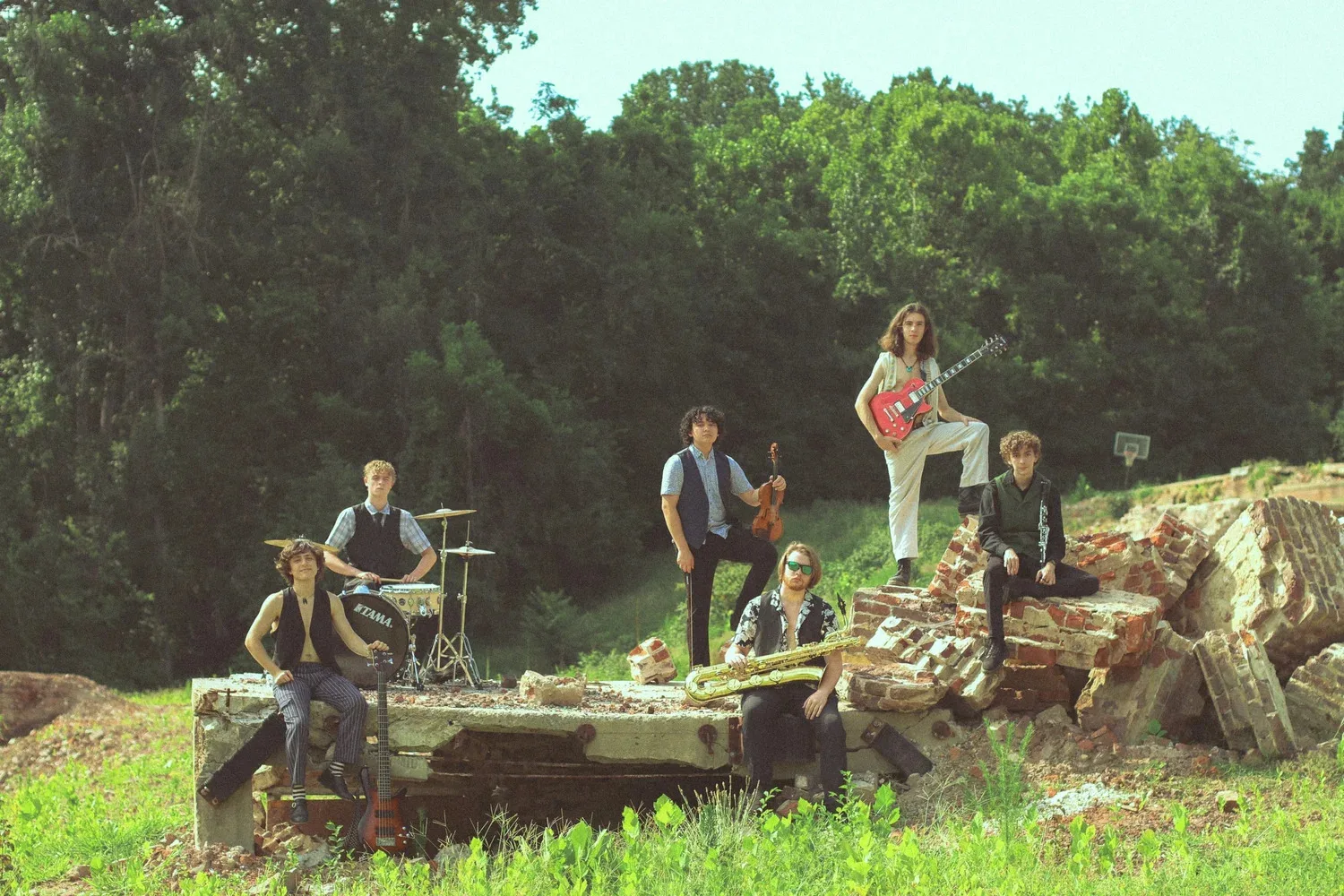
Header photo credit: Haydon Bode
These days, it’s hard to go far into a musical discourse without bumping into some hot take that rock as a genre is dead. But take one look at a band like General Purpose, who doesn’t fit neatly into any one bracket in the current rock landscape yet marries such an inspired blend of influences into a haunting yet symphonic medley. The Greensboro five-piece plays progressive rock complete with saxophone and violin; guitars trade melodic lines in compositions that reject verse-chorus convention, all driven by mind-melting bass grooves and sharp percussion weaving through it all.
Songwriters Xul Rutty and Uno Dos Santos met in high school, bonding over the Beatles and Pink Floyd before digging into Yes, Genesis, and Jethro Tull. The band they eventually built around those influences is a real ensemble, not a backing crew, and their debut album, One Last Word, makes that clear from the jump. It’s the kind of record that rewards close listening, which fits a band that describes their live show as one that demands the audience’s full attention.
What have y’all been listening to lately?
Xul (vocals/bass): I’ve been listening to Alan Holdsworth and a lot of his later stuff, like The Sixteen Men of Tain album and his live Tokyo record. But closer to what we do, I’ve been going through Yes‘s live catalog and seeing how it differentiates from their studio work. I was trying to find out how they create a live experience. That’s where my head’s been.
Uno (vocals/guitars): For me, partly because of music school, I’ve been getting more into Pat Metheny and learning some of his solos. Been on a guitar kick recently.
When you first got into music, who was the first artist you really obsessed over?
Xul: The Beatles. I had Let It Be and Magical Mystery Tour on CD, and I would just loop those over and over as a kid. And then there was Charly García; my family is Argentinian, so my parents grew up with his music. His groups, like Serú Girán, had a prog phase as well, which exposed me to that stuff pretty early.
Uno: Pink Floyd was a really early obsession for me, and I’d say they are what made me want to start playing guitar and actually making music.
When you started playing instruments, was it through lessons? And what was the progression from picking up your instrument to where you are now?
Xul: I was drawn into violin lessons from a young age because my parents are musicians. So I was in the classical world. But in my teens, when I started listening to those groups, I really fell in love with music. I just learned the easiest bass lines on double bass and transferred them to electric bass. I started with Queen’s “Another One Bites the Dust” and “Cool Cat” and just progressively got better from there.
Uno: No one in my family plays music, but my cousin had a guitar sitting around that she never used. I asked her if I could have it when I was around 10. My parents got me lessons once I showed I really wanted to learn. I kind of always stayed in the rock realm, but later in high school and college, I started branching out into jazz and classical, which is kind of the reverse of what Xul did.
We met in high school, started doing something for our school’s battle of the bands, and that’s when I realized we could actually start a band. We both bonded over growing up on the Beatles, so we formed a cover set around a lot of Beatles and Pink Floyd. Some stuff that maybe wasn’t so great. We’d cover King Crimson, really early psychedelic Pink Floyd that almost nobody wanted to hear except for one old guy at every show. And those guys would encourage us to keep doing more of that stuff, which is probably why we’re where we are now.
Y’all clearly have a lineage to that’ 70s-era prog rock. When you were starting to write original songs, what pulled you in that sonic direction?
Xul: I wrote the first song for the band, and my initial thinking was: I wanted to write something completely free of typical pop structures. I grew up with jazz and classical music and came to rock later. I felt like if I were to fully express my voice, I’d just let my mind go where it wants. When I’d sit down and write sheet music, I’d say, “Where do I want this song to go?” and just let the musical ideas flow. I’m not going to limit myself to a typical verse structure. That can become a bit of a salad, but once I started mastering the process, it led to a really immersive experience. Progressive rock was probably the most akin to that, and that’s what brought me there.
Uno: For the songs I wrote, “River’s Lover” — our first single — was the first one I wrote for the band. I didn’t go into it with any expectations. I was kind of just splurging, vomiting out music, and then crafting it later. Some people have said it sounds like Radiohead. Someone told me Jethro Tull, which I love, but I don’t quite see it.
In none of the music are we trying to go for a specific band’s sound. I kind of think about what a song sounds like after I write it. It’s easier to get into your own head if you try to fit a box instead of just doing what you want.

Adding clarinet, violin, and saxophone on top of a rock setup brings a unique flair. Was that an intentional decision, or did it develop more organically?
Xul: That was definitely more of an intentional decision, though maybe not in the way people think. It wasn’t like “we need a violinist, we need a clarinetist.” These guys are our friends. They play these instruments. Let’s just get together and play. That’s the premise. I included my sister in the beginning. And we didn’t always have a saxophone, so it’s definitely been an intentional decision to start shaping our songs around the members we have as we added them.
Uno: Yeah. And I’ll add that we’re also conscious about who we recruit. Classical and jazz musicians tend to be very focused on their instrument and their technique. They’re performers, not necessarily composers. So our members, Grace, Grant, and Gabe, are focused on serving the music. That’s not to say they don’t have ideas, but the creative process for them kicks in once the song already exists.
With so many different instruments, how do you manage giving everyone their moment without it becoming disjointed?
Xul: That style of passing the baton happens because we’re in a band where we have purely melodic instruments. Guitar is the only one that isn’t strictly melodic, and then there’s drums and bass. But we have guitar, violin, saxophone, and a vocalist; that’s four voices. When you have singular melodic voices instead of chordal ones, the best way to create an interwoven texture is through very thought-out counterpoint. Songs like “Marionettes” have a flurry in the violin, and then it comes back down register-wise, and the guitar can come up as they descend. That creates harmonic fullness without needing a keyboard.
Uno: I kind of treat guitar as a keyboard in this band. If we had a keyboardist, there honestly wouldn’t be a need for guitar with our music. We already have violin and saxophone handling the beautiful melodic stuff. So I try to do what the other instruments can’t do, which is really lay out a bed for the music. That tends to vibe better with our compositions.
When you went from writing and performing live to actually recording, was there anything surprising about that transition?
Xul: It was difficult. The music is written to be live. In the studio, we had to rethink everything, especially “River’s Lover”, which is surprising, given that it’s our most straightforward song. The main issue was the drums; they sounded great live, but the moment we put a mic on them, they overpowered everything, and it took a lot of massaging and re-recording. It was subtle things like that. You don’t know why it sounds so different, but recording just changes where your ears focus.
Uno: What helped was going in knowing it would not sound like the live version, and that’s okay. That gave us the liberty to layer in vocal harmonies that we don’t normally have live. Our saxophonist is the only other person who sings, and he’s got a low register, so most of the high harmonies you hear are things we added in the studio. We also had the space to double-track guitars and try things we couldn’t pull off on stage.
The difference between the live and studio versions is a good one to have. That’s partly why I’ve been studying Yes‘s live concerts compared to their studio records, just trying to understand what they keep and what they adapt. When they play “Close to the Edge” live, they can’t bring a giant church organ on tour, so they do it on a Hammond, and Steve Howe doubles it on guitar. Hearing that was really enlightening. It gives you precedent.
When it comes to writing lyrics and crafting the vocal performance, what themes or influences do you draw from?
Xul: Lyrically, we’ve been going for more of a narrative style. Kind of like Peter Gabriel-era Genesis. Maybe not quite as absurd as them, but they’re definitely a big lyrical influence. Some songs are about myths, another is a bit more politically minded about recent events. But my vocal performance doesn’t change based on the subject matter.
Your voice is the most intimate thing in music, and a person can tell when something isn’t genuine. So I try to sing as purely and honestly as possible. I try to blend a raw, genuine rock voice with vibrato and the grandiose sound typical of the genre, which mixes well with the esoteric, somewhat spiritual lyrics we usually have. Vocal health is a big thing for me too. I’ve heard records I can’t listen to because the vocalist is just pushing too hard, hurting himself, and it affects the music’s enjoyment and meaning.
Uno: I try not to tell Xul how to sing too much, but what I’ve noticed is similar to what the great jazz guys do. John Coltrane isn’t going to change his sound just because he’s playing with Miles Davis or Thelonious Monk. You know what you sound good at, and you shape the music around that.
The example I think of is Sting. His voice is always the same, but it fits every genre he’s played in because he knows how to build the music around his voice rather than changing his voice for the music.

Can you walk through how the band is run in terms of the creative and decision-making structure?
Xul: There are several models bands operate under: extremely democratic ones, totalitarian dictatorships, and everything in between. We fall somewhere in the middle. There are two songwriters because if there are too many cooks in the kitchen, it gets difficult. We’ve been conscious about who we recruit.
The classical and jazz musicians we’ve brought in tend to be performers rather than composers. They’re focused on technique, their ability to solo over changes, serving the music. So Grace, Grant, and Gabe are mostly performers. The creative process for them kicks in once the song already exists. When the skeleton is there, I’ll have my bass line, and I’ll tell them, “Here’s a part I wrote for you. If you play something you like better, do it.” That’s where the democracy comes in. It’s not democratic all the time, but there’s a process to it.
Uno: Even between me and Xul writing songs, there’s a fair bit of collaboration, but there’s a balance. I’m not going to bring an idea to you until I’ve developed it enough and can articulate it. Then we shape it, and one of us takes the reins to finish it out. Sometimes one of us has the majority of the lyrics, and then we’ll put the finishing touches on them together. It changes song to song, but there’s usually a back and forth between when it’s more solitary and when it’s more collaborative.
What was the album release show like, going from writing to recording to finally presenting the finished product?
Xul: It was very much a case of trying to replicate how we sound in the studio. We brought in the actual backing singers from the album for this big, full operatic sound. And we’d actually continued evolving the songs even after recording by cutting certain sections, or changing a melody here and there.
Uno: It wasn’t your run-of-the-mill rock bar gig. We knew over 100 people would show up and we were trying to make it a real event. We played at the Van Dyke Performance Space inside the Greensboro Cultural Arts Center. It’s more of a dance stage, so we were on the same eye level as the audience, which was fun. And we got access to great stage lighting and a projection screen that you don’t usually see in dedicated music venues.
The format was very different from how we typically approach concerts. With a multi-band club bill, you’re trying to grab the audience’s attention immediately with your first song and end with a bang before the next band. But here, people were coming specifically to see us, so we had more flexibility with pacing. We could sit in softer songs longer without it feeling like it was dragging. That felt really freeing after playing clubs for so long.
Any goals for the rest of the year?
Xul: We’re organizing our first tour in May through North Carolina, South Carolina, and Georgia. We’ve made contact going north, but we really wanted to see if we could carve something out going south first. We’re also working to get more involved in the broader progressive rock community in America. We’ve made friends with people from Vermont, and we’re in contact with some festivals, so we’re confident things will start to arise there.
Uno: We’re also still writing new material. That hasn’t stopped, just slowed down a bit since we’re both college students. We’ve got three to five new songs, either finished or in progress, that didn’t make the album. We’re figuring out what that shapes into, whether it’s a full album, an EP, or a triple-disc concept rock opera. We’ve played a couple of the new songs live already, and I like the direction it’s going.
Who are some of your favorite local Greensboro or North Carolina artists?
Xul: Once Below Joy from Charlotte, they’re a really fun hard prog rock group. Their drummer is the lead singer and sounds just like Geddy Lee from Rush. They kick ass. And the guys in Greensboro who’ve been an immense help to us have been Sweet Dream. Great bunch of guys, extremely talented.
Uno: And our friends in Burlap Circus. We’re good friends with everyone in that band, and we play music together a lot. And Watch Party, some UNCG guys who have a really interesting thing going on. They’re mixing shoegaze, rock, hip-hop, and R&B, and their sets are energetic. I’ve never seen anyone mosh at a shoegaze concert the way they do at Watch Party.
This interview has been edited for length and clarity.

Leave a Reply