
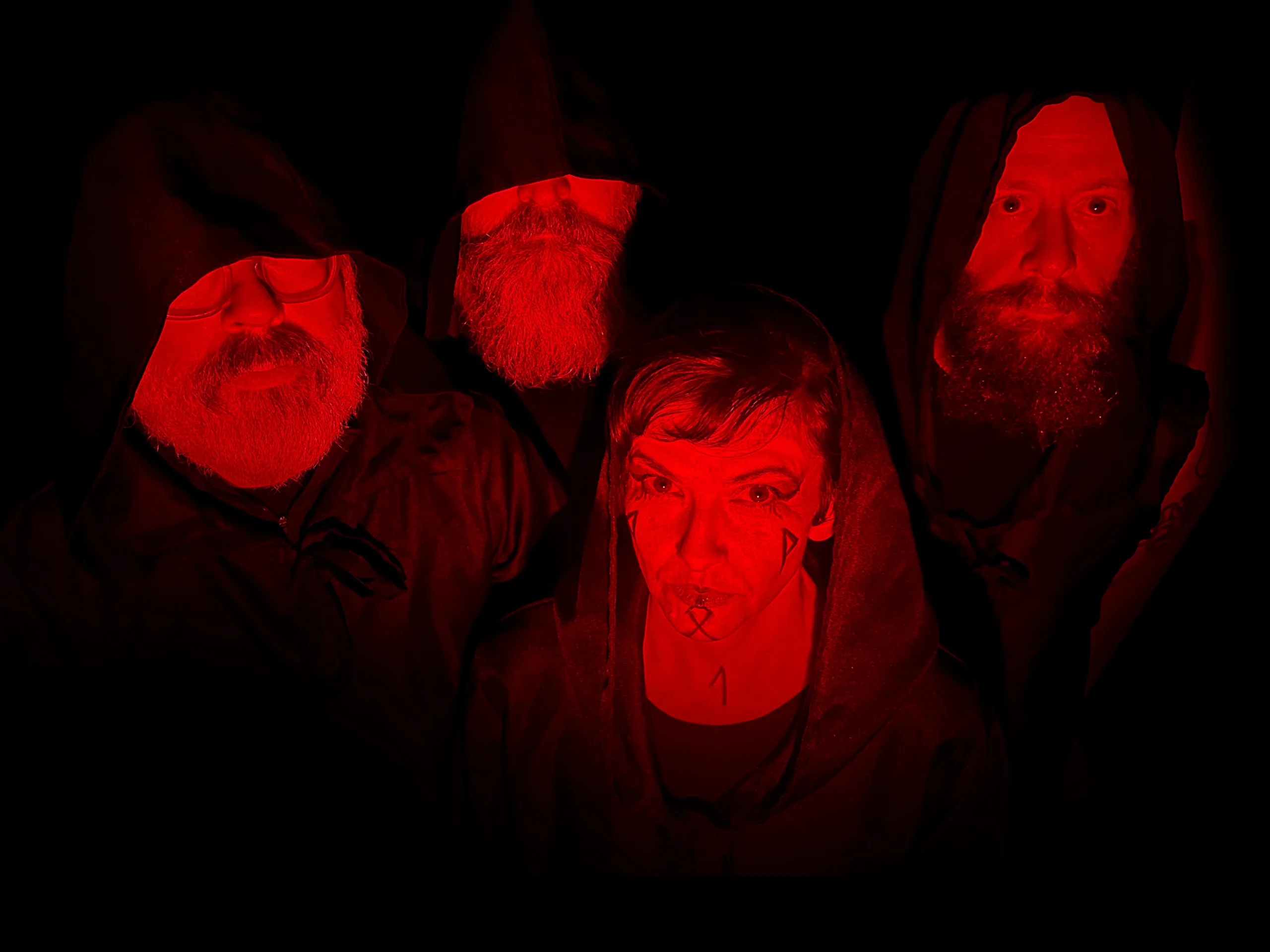
THNG (pronounced “thing”) wants you to know that everything else about them is exactly as intentional. Whether it’s their red Druid robes, the rattles they shake to open every set, or punk-meets-metal meditations on collective power. None of it is an accident, except maybe the parts that happen completely organically during their on-stage rituals.
The band formed back in 2021 and has spent the years since carving out a space that’s equal parts goth night and doom fest, without fully belonging to either. Their two EPs, Depths and Resurrection, map a band that only gets more comfortable with becoming heavier, stranger, and more collaborative with each release. Now, they’re treading new ground with a full-length record in the works.
But what comes through in talking to them is that THNG‘s mythology isn’t just a mood board. It’s their genuine organizing principle that shapes how they write, perform, and think about the scene around them. (Perhaps unsurprisingly, they’re pretty funny about it.)
What’s something each of you has been listening to lately?
Asa (guitar): I listened to the Melvins earlier today, and then some Mares of Thrace on the way over here. They’re some emo-y, doom-y goodness out of Canada. Really depressing.
Ben (drums): I listen to Beak> a lot, and a band out of the UK called Gnod. It’s a lovely band that changes what they do every album.
Greg (bass): I actually listen to a lot of hip-hop. Lately I’ve been listening to the new JID and the new A$AP Rocky. And I’ve randomly discovered this band called Ho99o9. They’re kind of Death Grips-y. It’s pretty crazy stuff.
Who was the first artist you discovered on your own and completely obsessed over?
Olivia (vocals): It was probably Poison. My friend’s older sister, who was already driving and a lot older than me, played it in the car. Then I saw a billboard of gorgeous women with all this makeup and beautiful hair, and it said “Poison” and I thought it was a girl band. [laughs] That was the first CD I ever purchased on my own.
Asa: I remember becoming conscious of music, listening to the Black Album by Metallica and a lot of Pink Floyd. But the first time I really moved and got into it was Violent Femmes‘ self-titled record. I listened to that a million times, over and over again.
Ben: Prince, for me. I was nine or ten years old and I was like, whoa, this is amazing.
Greg: KISS. Being a kid in the ’70s, that blew my mind. Guys spitting blood and breathing fire had me like, “This is way beyond Neil Sedaka,” which is what my mom was into.
Ben: I gotta agree with Greg. I remember seeing in the news that KISS was going to play at the Greensboro Coliseum and I really wanted to go. I didn’t know what they sounded like, but they looked amazing. My mom was like, “no, you’re not going to see that.”
Greg: I missed them in ’76. A couple of friends went, and they came back and said, “This girl in the front row passed out when Gene Simmons spit blood on her face.” [laughs] I still wish I’d gone to that show.
How did each of you go from that first obsession to becoming an active music maker?
Olivia: I was 15 when I was first asked to be in a punk band and play live shows here in Greensboro, with people who were old enough to drink. I was playing in underground clubs in the ’90s. I was in several different bands since then, then took a break for about 15 years, and came back when I moved back to Greensboro. This is the first band I’ve been in since then.
Asa: I grew up in a house that was always full of musical instruments. I’d be watching TV with a guitar on my lap, trying to pick along with commercials. I started playing in bands at the end of college since that’s when I had the wherewithal to put stuff together with people. I’ve been kicking around Greensboro for almost 30 years, on and off.
Ben: I started my musical journey in church choir, then middle school band playing clarinet. My first real band was a mid-’90s theatrical costume band called Slumlord, kind of a cross between Alice Cooper and GWAR. Then there was a band called Midget Bar Mitzvah, in the same general territory. I’ve been in countless bands since, as drummer and vocalist, and often both at the same time.
Greg: When I first moved to Greensboro in ’89, I fell into this music scene. Before that, I didn’t really believe an ordinary person like me could make music I actually liked. Then, all of a sudden there were people my age in bands making really good music. I started on guitar, played in bands for several years, then got recruited on bass, and I’ve played bass ever since.

How did THNG come together? Who reached out to who?
Asa: It was kind of during COVID. I had a mutual friend — big shout-out to Joe Garrigan — who said, “Hey, you want to jam?” So me and him started playing, and after a while we wanted another instrument. We got Greg involved. He wasn’t exactly itching to do it, but we twisted his arm until he joined us.
Greg: It’s true. I didn’t think I was going to play anymore.
Olivia: Then I moved back to Greensboro from Austin. I ran into Joe at a show and he freaked out and was like, “Olivia!” He texted me and asked if I wanted to put some vocals to some stuff he had going. I said “Yeah, that sounds cool.” And that very night I saw him and Greg out at a restaurant and I was like, “This is magical.” And then we started playing out.
Asa: So Joe was the drummer. Our first show was at a club called ETC, a local DIY collective. Ben at the time was one of the cooperative people managing it. That’s when we met him. But then about two years in, as we started going in a new direction toward metal and more complicated time signatures, Joe had another project he was working on. He decided he wanted to go in that direction instead.
He was actually the one who said, “Why don’t you get Ben to drum?” So that’s how that came about. Joe is now doing Rabbit Fighter and Sonic Blooms, so shout out to those guys.
What inspired the shift into heavier territory, and how did your songwriting process change with it?
Asa: At the beginning it was just me coming up with riffs, and Greg getting comfortable writing parts to go with what I did. When Olivia came in it became more of a real collaborative experience, which I much prefer. The shift toward metal was about getting more comfortable. Just picking up new techniques, hearing something and sitting down and going with it.
Before, I was just going with whatever came out of the guitar. Now I’m trying to do specific things and seeing where they lead.
Greg: I feel like you just got more comfortable doing whatever you wanted to do. At first you were keeping it simple because we’d just started. Then you were like, ‘how about this?’ and every time I was like, what the hell is this?
Olivia: Yeah, a lot of that. And now with Ben and everybody else, we’re way more collaborative on everything. We’re actually talking about where we want a song to go, and then writing toward that together. It’s really satisfying when we get there.
I’m not really sure why it’s gotten heavier and heavier, but it feels like the right direction. It just feels good.
Greg: Me and Asa just had a conversation on the way to a show about how we needed a song that let the set breathe a little. The very next practice, he came in with exactly that.
Asa: It still has a lot going on, but there’s room in it.
Your two EPs were recorded in different locations. Are you looking to go with one or the other for the full-length, and how did those different spaces influence the final product?
Olivia: The first place we recorded was with Duck-Kee Studios, who has a really gorgeous, sort of traditional ’90s-esque sound. That’s what we were playing more of at the beginning, so it fit really well. It was a great experience.
For the second one, we were going heavier, so we found Scotty Sandwich, who had worked with some heavier bands we knew from the Triangle. It was a great experience too. I don’t think we’ve decided where we’re going next. There are some local options we’re considering, since Scotty is a couple hours away. When you’re doing a full-length, the commute is a real consideration.
Asa: Yeah, if you’re going to be in the studio multiple days in a row, not having a commute matters. And there are some really strong local options now.

When it comes to writing for a full-length versus an EP, is the process different, or is it just more of what you’ve gotten comfortable with?
Olivia: I think we’ve just been writing faster now. Once we get a couple of parts, the rest seems to magically show up. We’ve got four new songs in the last six months, and a bunch more that we haven’t recorded yet. The songs are coming faster as we play more together and get more comfortable with each other.
Ben: We’re really enjoying what we’re doing, so it’s becoming a compulsion to make it. If there’s a difference between an EP and an LP, it might be the conversation we had the other day about a long intro section that Asa brought in. We were like, that’s not right for the set right now, but it could work in the studio. There are things we’re thinking of doing on a record that we won’t necessarily do live.
Greg: And there’s a thread running through the songs we have now. I feel like it’s there. A full-length gives you more space for that kind of connectivity, to have something cohesive from song to song. We definitely have enough material for an LP, and we’re excited to get in the studio and get it down.
How has your live show developed over the years?
Olivia: It’s changed a lot. When Ben joined, he said, “I think we should be more theatrical.” And we all said yes immediately. Somebody came up with the idea of cultist Druid robes. We used to wear black, but now we wear red because it looks really good on stage, and black robes have been done before.
Asa: And a lot of our music is based on where the natural world and the supernatural world touch. So the red felt right, since it brings forward some of the meaning behind what we’re doing.
Olivia: We start our sets with an invocation. We have rattles, which is a traditional way of sonically clearing a space, and then we do the invocation: “Arise THNG, unite us. Bring forth light of darkness. Welcome all who come before us. Enter joy with Dionysus. Arise THNG, unite us.” It’s a coming together of the energy of this band, which is sort of an entity in itself.
Greg: We have a song called “Anchovy Invocation” that Asa literally wrote about anchovies. He’ll write about anchovies, and then Olivia will turn it into gods of the ocean.
Olivia: It became about how anchovies swarm in this massive mass and look so large that they frighten off predators. And so it’s about how we can collectively work together to rise up. He starts it one way, and my lyrics expand it into something else.
Asa: It’s a good “yes, and” collaboration. Always nice to see what we end up with at the end.
Olivia: Our music, at it’s heart, is metal, but all of our lyrical content is intended to be positive and uplifting rather than just dark for its own sake. There’s a lot about different gods, mythical creatures, honoring nature. There’s an earnestness and an intention that is truly about the mystical. But we like to make it theatrical too.
You mentioned before we started that you’ve been playing with some very young bands recently. What’s that been like?
Greg: Two weeks ago, we played with a band where one was in college and the other was in high school. These kids had been on stage twice in their lives. And they were good. When we played, people were going bananas. There was so much more energy in the room than usual, because all these young people were in the front row dancing around. I can feed off of that. I’ve been to so many shows that it’s not always that interesting to me anymore. But when these kids have the energy of doing something for the first time, you feel it. It’s infectious.
Olivia: We have to shout out Chiroptera. They were great and so fun. And it’s something I think about: in any other community, teenage girls making music would be gatekept to a youth center or someone’s house. They wouldn’t be given any time of day at a real venue, let alone given a platform. There’s room for that. And the kids give me hope.
Ben: When people are dancing to us, and we’re not really dance music, but sometimes people will just start dancing in the front row, and you’re like, yes. That’s what this is for. Get that energy out. Especially now, when it’s easy for someone to have their phone out and feel self-conscious. To see younger people who are just like, “I don’t give a shit, my body has energy to get out,” that’s really awesome.
Who are some of your favorite local Greensboro or North Carolina artists you’ve played with or come across?
Olivia: Mostly Mesh is one of our big supporters and a favorite to play with. We love playing shows with Sonic Blooms and Brighter Than a Thousand Suns. And I Become Death is amazing. Doomsday Profit is our hands-down favorite doom band. LIMN, which is Ben’s other project. And DIT.
And our favorite new local band — at least three of us can say this — is Wrist, out of Winston-Salem. They were just at Phuzz Phest, and we love them.
Asa: Weight Shift, big shout out to them. They’re from Asheville. We played with them once and we are just dying to play with them again. They’re incredible.
Ben: There’s also Joe Garrigan, who we mentioned earlier. He’s huge in putting shows together, and his band Rabbit Fighter is great too. And The Old One Two, they’ve been around here for almost 20 years. We’ve played with them a bunch. Kult Ikon too. It’s been a lot of fun. There are really a lot of good people around here.
This interview has been edited for length and clarity.

Leave a Reply