
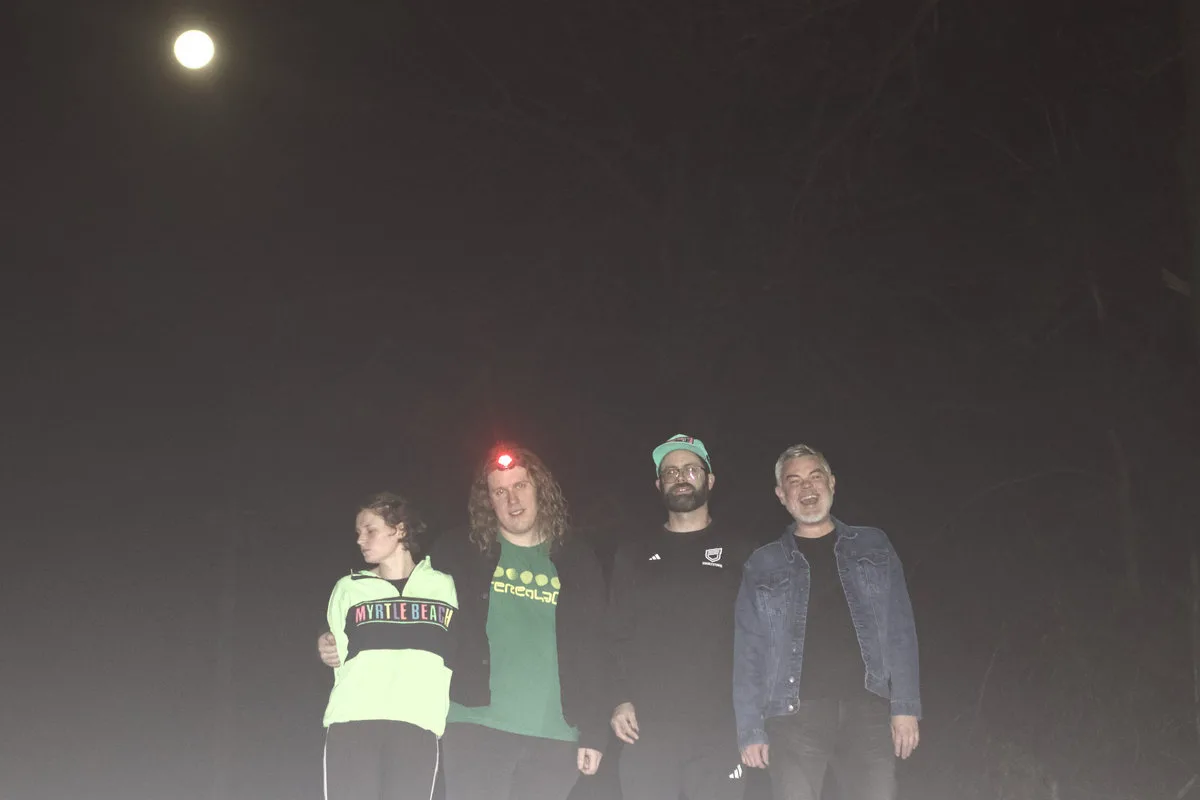
Take a scroll through Infinitefreefall’s extensive catalog and you’ll discover a band that has never been easy to pin down, genre-wise. But after chatting with frontman Maxton Stenstrom, I really don’t think he would have it any other way.
Since launching the project out of Charleston, South Carolina, he’s spent the better part of a decade shapeshifting through electronic pop, dream pop, shoegaze, krautrock, and post-punk. Each album pushes further out than the last. What started as a solo laptop project has gradually evolved into a full band, now in its fifth iteration. Belief Systems, their 2024 full-length, felt like their biggest step forward, generating some buzz from media outlets and music fans alike.
Now, with Cursed Object due July 31, Infinitefreefall has managed to outdo themselves on their fifth LP. One built largely in rehearsal rooms and home studios with a band that, by his own account, he’s been trying to assemble his whole life.
What have you been listening to lately?
Maxton (guitar/vocals/production): I actually listened to this Motherfuckers JMB & Co record [Music Excitement Action Beauty] recently. We got to open for them at Snug Harbor in Charlotte a few weeks ago. The drummer is a member of GWAR, it’s Geologist from Animal Collective, and a really cool dude named Mark Minsker pulling it all together with guitar and bass loops. Very Krautrock-y stuff. The new Osees live record is awesome too. I love them; they’re pretty much my favorite band at this point.
One of my friends showed me Red Clay by Freddie Hubbard the other day, and I’ve just been listening to both takes of that on repeat. Every time I need to kill ten or twenty minutes, the time just melts away. The live version has George Benson on it. Other than that, just the usual diet of Stereolab and Osees.
Loren (synth/vocals): I dig deep on SoundCloud and find weird edits and stuff. I’ve realized lately that most of what I listen to is synth-based; I just never really knew it until now. I really like the band Innerwave. Every time it gets warmer outside, I start listening to them because they remind me of summer. I also listen to a lot of Jean-Michel Jarre for synth inspiration.
Maxton: She really keeps me tethered to the electronic world. She came in as a fan of the records I made on my laptop when I was first developing the band. She plays the Korg Minilogue, which is one of the best synths ever made, in my opinion. Such a good price and sound. Her other one is either a Microkorg or a Yamaha Reface CP, so we can get pretty road sounds or completely messed-up sirens. There’s a lot of flexibility, and she embodies the experimental electronic part of what we do, which I think is what makes our sound unique.
Going back to when you were first discovering music, who was the first artist you remember really claiming as your own?
Loren: It’s embarrassing. I grew up in a religious household, so it was hymns early on. My first concert was Jars of Clay. But the one I would hold my radio for… it was the Jonas Brothers. I’m so sorry. [laughs] With the guitars, though, they were pop rock, and I liked rock and roll, so they were a gateway.
Maxton: I had my first musical awakening with Top 40 radio because that’s what my mom listened to. Especially around 2006 and 2007. I really felt like we were in a golden era of pop music. I loved Timbaland a lot. Everything he did, the Justin Timberlake album FutureSex/LoveSounds, going back to his productions for Aaliyah.
But I started getting into weird music when a friend named Patrick Gwyneth introduced me all at once to Explosions in the Sky, The Books, Maserati, and Mono. Just a bunch of Temporary Residence stuff. It blew my world open at around age 14. From there, I could see everyone having these crazy divergent careers, and I got more into the avant-garde style of music we’re trying to make now.
Maxton: I was on Tumblr a lot, and I was basically a mashup artist. That’s how I learned to make music. First, with a PSP game called Beaterator, made by Rockstar Games and Timbaland. I owe a lot to Timbaland, honestly. Taking other people’s songs and dragging them into Ableton, making dumb edits, that’s how I learned the building blocks of what makes songs good and catchy.
I was at a crossroads between being into Top 40 and loving The Avalanches, Dan Deacon, and weird electronic music, and I thought they sounded good together. That ethos still informs what I try to make. I want a little bit of everything, accessible to everyone, picking and choosing from different genres. It makes it hard to describe, but now I at least have an answer locked and loaded when people ask.

Loren, at what point did you join the project?
Loren: There was already a band setup, but I think when we really started to experiment. Just sitting there being like, “Let’s be weird with it and go everywhere,” that’s when things clicked. I had always loved music, but never got to play out, and that was always my dream.
I met Maxton at a music shop where I was working. Someone there told me about Infinitefreefall, and I was showing everyone, like, “Holy shit, listen to this.” And then he came into the store, and I was like, “What the hell?”
Maxton: I happened to need someone to play synth right at that moment. We were borrowing a synth from someone at the time, and it was such a perfect fit. The first one we had was so old the power blew out, so I drove overnight to get another one for a gig. We’re on our third one now, and we can’t quit it.
I try to let her write her own parts as much as I can, because they just come out better that way. Sometimes I’ll overdub something onto a demo, and she’ll say, “I’m not playing that, let me play this.” We try to honor the composition, however it comes about, whoever the author is.
The band I was running before I met her had a lot of people in it, but not many were super committed. Loren entered the picture, and she was like, “I want it freaky and crazy,” which is exactly what I’ve always needed. Shawn does that. Josh does that. We just keep meeting the right people.
You announced a new record coming out in July. What was the process of putting it together?
Maxton: I really wanted to do an album a year, and we were on that pace for a while. But the band’s message was clear: we don’t want to do an album in 2025, we want to take our time and do something really good. So I spent that year catching up on live albums — we had two that needed to come out — and started writing in the meantime.
I work well under pressure, and I always set hard deadlines for myself, which has usually meant finishing things right before they’re due. As it stands, I have six of the seven songs turned in for mastering, and I need to finish one more, which was supposed to be done by tomorrow. I’ll have to take a one-week knee on that. I got a flat tire on Saturday, so, you know, I’m at least getting better at planning for contingencies.
The album started as a longer, weirder record, but I pared it down. Once we wrote the title track, “Cursed Object”, I felt like I could cut some of the weaker stuff. We ended up with seven songs, which is the shortest any of our albums has ever been. Though it’s about as long runtime-wise as our last one, because we want it on a single vinyl record. Forty-four minutes feels like the right length for an album anyway, at least to me. And if you skip the eighteen-minute title track, you’ve basically got a twenty-minute EP.
The process was: I write and demo at home, bring songs to the band, we learn them, I record our rehearsals through a 24-channel mixer, and combine that with the demo. Synth, bass, and guitar all have direct outs, so it’s pretty easy to wrangle them into something that sounds like a proper studio recording. I just beat-match in Ableton since that’s how I learned to make music, so it’s basically autopilot at this point.
The exception is “Cursed Object” itself, which we wrote and recorded live as a fully improvised piece. I just said, let’s go see what happens, and it all just came out. I think I cut maybe two minutes from it total. We’d tried jams before that weren’t up to this level, but we had actually just warmed up with a different jam right beforehand, so we were ready. I’d like the next record to lean more in that direction, where we all hook into something and don’t know what’s about to come out of us.
How do you translate that expansive, kaleidoscopic sound to the live setting?
Maxton: Just listen, and listen, and listen, and listen. The tones are already there because they were recorded with the actual instruments. And whoever is feeling inspired gets to record; it’s pretty open that way.
Shawn is very particular about his drum tone. He loves MacGyvering that stuff, and he wants to make sure it sounds right. On our last record, we recorded a couple of songs at a nice studio and paid real money for it, and he said the snare sounded too poofy. Then the ones we recorded at the practice space for next to nothing and he loved those. So for this record, we just did everything at the practice space. I’m not paying anyone anything.
He and I probably went back and forth on “Cursed Object” the song for a month — with him calling me, saying it still sounds a little too overdriven or too compressed — until he got it to where it just really sits right for all twenty minutes. I can’t thank him enough. We work with some awesome people.

How important has it been to have collaborators around you now, versus doing everything solo?
Maxton: It’s just like, be bigger than the sum of your parts. Having come from doing this on your own on a laptop to now having all these super-talented musicians you can lean on to do things and envision things that are just outside your scope. It just expands and makes the whole experience richer.
It’s truly what I feel like I’ve been working towards the entire time I’ve tried to make music. I would look for guitar VSTs, like, how do I make rock music in the box? If you go back to 2017, I made an EP called Belonging, and I tried to make what I was calling then “real music with fake instruments.” It’s all VSTs. The drums I still use on everything today are Addictive Drums, and fake guitars and basses through Kontakt. I wanted a band so bad. And then I came back from L.A., and as soon as I got back, I started figuring out how to make a band. I am still on that journey.
What has your experience been like as part of the Charleston music scene? How have you built community with the people you play with?
Maxton: We are actually in an amazing place to tour out of. You’re three hours from Charlotte, four hours from Atlanta, three hours from Wilmington, two hours from Savannah, and four hours from Asheville. Savannah is such a good drive, you blink and you’re there. Killer town, too. We love playing there; we always get a really good response. We’ve got some folks down in coastal Georgia, and the same thing up in Wilmington and Charlotte.
We’re trying to build the kind of network we want to see for artists in Charleston. There are lot of rooms to play here, a lot of people putting on shows, a lot of little scenes and micro-genres. We try to color outside the lines, combine genres. I have a lot of friends in the hip-hop community, and I love doing rock shows with rappers on the bill.
I love mixed bills that are just trying to push things forward, so it’s not the same homogenous group of people going to one type of event. Get people to interact and step outside their comfort zone, maybe see something they wouldn’t normally go to because it’s on a unique bill. That’s gotten us some cool opportunities in and around town.
We have a really good thing going at the Royal American. We got to play Charleston Pour House in 2024 for our album release and that was a really good time. We play Tin Roof pretty often. There are just a bunch of rooms in town that want to have original music, and we feel spoiled for that, because there are a lot of cities where that’s not the case. Every time I go up to Greenville or Columbia, I’m like, “Where do you play?” And then the one cool place I find has just closed. The words “venue crisis” get thrown around a lot more up there. Nobody down here says “venue crisis.”
Loren: Even with all the new buzz in Charleston, the alt culture sometimes feels like it can die, but then it just doesn’t. The DIY scene was a lot different when I first moved here, but it definitely fluctuates.
Maxton: It’s a thing that passes down like an Olympic torch. We work with the kind of off-kilter artists who are into this sort of wall of sound, into the experimental approach. Sometimes they’re into the pop thing too and want to get down with the weird stuff. That’s who we’re trying to attract. That’s why we love playing with bands like Birdleaf out of Savannah, Acid Hawk from Charleston.
We also like pulling out local bands that are just our homies who we’ve known for years and getting them to take the car out of the garage for one night only. And there are cool new bands just popping up all the time, like Casita.
Loren: Our relationship with the scene is we love to see it grow, and it’s coming along in a really cool way.
Maxton: Connecting people with other people, that’s what keeps me coming back.
This interview has been edited for length and clarity.

Leave a Reply