
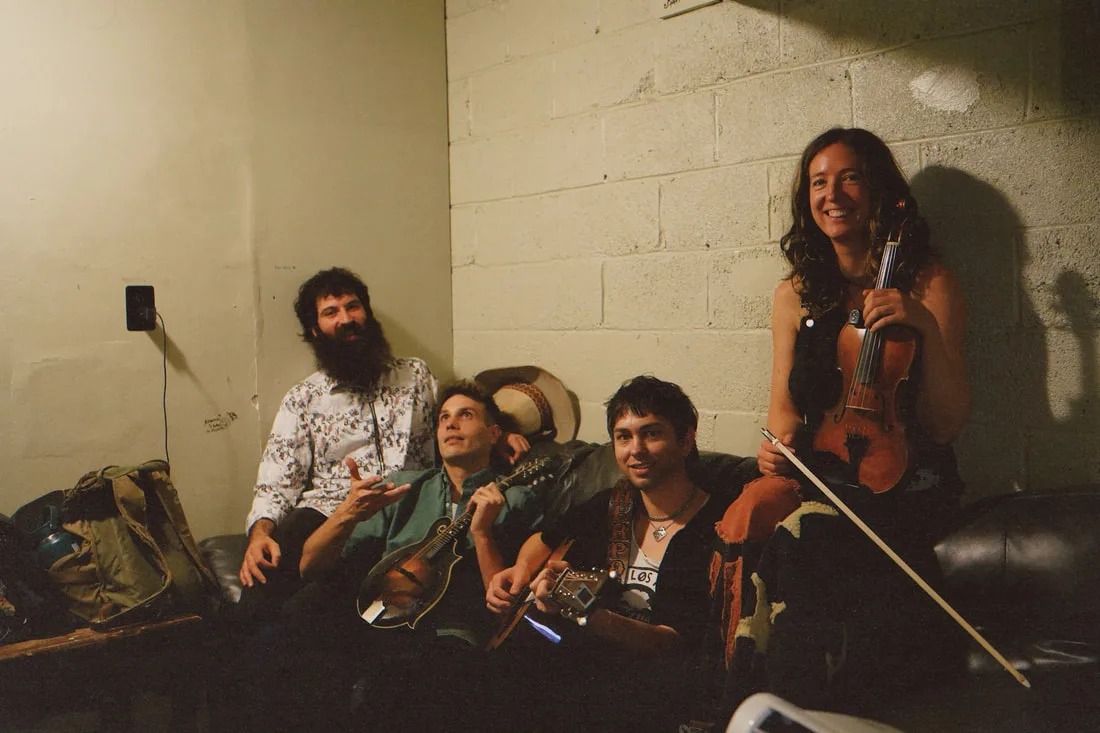
In 2023, Jason Cline told Queen City Nerve (RIP) that Featherpocket was finished with banjo and pedal steel, and that Americana had become the most milquetoast genre in music. Three years later, the Charlotte songwriter fronts Featherpocket Stringband, a bluegrass lineup built around upright bass, fiddle, and mandolin. He’s also recorded five songs with Water Tower, the punk-rock bluegrass band out of Los Angeles.
The reversal started at a low point. Cline came home from a solo West Coast tour with no band and no gigs on the calendar, and a phone call to an old friend set the next year in motion. What followed was a career gamble, a pitch to every venue in town, and an answer from audiences he didn’t see coming.
The weirder, more experimental Featherpocket hasn’t gone anywhere. Cline now splits his songwriting between the two, with a second batch of recordings already in the works.
What’s something you’ve been listening to lately, new or old?
Jason: Angela Autumn‘s new record, Believer. I’ve got a lot of that on repeat. Also Mk.gee’s Two Star and the Dream Police. Actually, Tidal just sent me my top 5 most-played artists this month, I’ve got it right here. They were: Phoebe Bridgers‘ new album [Lost Weekend], then Mighty Poplar, a bluegrass band my fiddle player put me on. Angela Autumn and Mk.gee were tied for third, and Townes Van Zandt rounded out the top five.
Going back further, who was the first artist you discovered on your own and completely latched onto?
Jason: Two answers. The first album I ever bought was Astro Lounge by Smash Mouth. I had this little green boombox, and I’d shoot hoops in my front yard with “All-Star” on repeat, like most of us probably did.
The other one is Third Eye Blind, their first two records, the self-titled one and Blue. I found those when I was 13 or 14, and I’ve probably listened to them more than any other records in my life. People think Third Eye Blind is just “Semi-Charmed Life” and “Never Let You Go,” but the production and songwriting on those records hold up incredibly well. Kevin Cadogan’s use of alternate tunings and feedback is magnificent. The guitar work in God of Wine is gorgeous and devastating.
Back in 2023 you told Queen City Nerve there’d be no more banjo, no more pedal steel, and called Americana the most milquetoast genre in music. Three years later, where’s that at?
Jason: [laughs] Yeah, I did say that. I’d forgotten. I say a lot of things. I don’t know that I’d agree with myself from three years ago. I don’t think Americana is the most milquetoast genre, but it can be. Some of it is just bland and identity-less. But early Townes Van Zandt is Americana, and he wrote some of the most beautiful songs I’ve ever heard. He’s my fifth most-listened-to artist this year. People would probably call Angela Autumn Americana-esque too, though I’d say she’s more Appalachian grunge.
As far as where Featherpocket‘s actually landed, I’ve been doing Featherpocket Stringband, which is the bluegrass version of the band. I recorded five songs with my friends Water Tower, a punk-rock bluegrass band out in LA, so I’m doing mostly bluegrass right now. I’d like a dedicated banjo player, but I haven’t found one who’s reliably available. Our fiddle player switches to banjo sometimes, but she’s mostly on fiddle.
What actually moved you from that point to making a bluegrass record with Water Tower?
Jason: Last June I came back from a solo West Coast tour, and I was bummed. I didn’t have anything resembling a band, and I had no gigs booked. Around the same time, Susto started a string band version of themselves with my buddy Clint Roberts and his band Holler Choir, backing them up. I thought it was such a cool idea to take songs and reimagine them for a different lineup, releasing them two different ways and reaching two different audiences. I already loved playing bluegrass, so I started thinking about making a record like that.
I called my buddy Kenny Feinstein from Water Tower to see if he wanted to make a record with me. What I love about Kenny is that when I call him with an idea, he says, “Yeah, let’s do it,” and then it happens. That’s not true of most people in my experience. I flew out to LA around September of last year, and we recorded the first batch of songs one instrument at a time. I went back in April, and we recorded two more songs live.
In March of this year, I quit my kitchen job at the Rhino Market. I still teach music in the afternoons, but I wanted to see if I could make the music work in whatever form that took. I started hitting up every brewery and venue that booked music, offering either full Featherpocket or the bluegrass lineup. Everybody wanted the bluegrass band. I had one venue straight up ask for the quieter version over the rock band because drums and electric guitars are just loud.
So I built the band around those gigs. Adam Har-Zvi is on upright bass; he teaches jazz at CPCC and has a doctorate in music. Julia Migner plays fiddle; she moved here from Vancouver. Beau Sigmon is on mandolin; he’s up in Hickory. Now Featherpocket proper is where I get to do whatever I want, weird recordings, going off into the weeds. The Stringband version is the focused, bluegrass-specific side of it.
You mentioned rearranging songs from one form into another. Were these recent singles written as solo songs first, or built collaboratively from the start?
Jason: It varies. “Cowboy Hat” I recorded with Justin Aswell producing, he’s a wizard. “American Spirit” was the first one I did almost entirely myself, aside from Jason Atkins (Greazy Keyz) on organ and Mariah van Kleef singing on it.
Before that, everything was more of a full-band effort, mostly because I couldn’t afford to record myself. Now I’ve got studio monitors and good microphones, which saves money and lets me take the time to actually get things right.

When it comes to releasing music, are you a “put it out when it’s done” person, or do you think more about sequencing and timing?
Jason: I just get it done and put it out. I try to promote it by posting on Instagram, TikTok, and YouTube every day. I don’t always succeed, but I’ve had two- or three-week stretches where I’ve done that. Beyond that, I don’t really know how to promote a song successfully. People will tell you they do, but who knows. I put it on my stories, hope people catch the 15-second clip scrolling by and think it sounds good, maybe follow along, maybe come see us live.
I do it for the sake of doing it. If I did it for how other people received it, I’d probably be depressed and quit by now. I think what I’m making is good. Hopefully a bigger audience finds it eventually. If they don’t, at least I made something instead of watching TV or scrolling on the internet.
Where do these singles land? Are they building toward a full Featherpocket record, a Stringband record, or a joint release with Water Tower?
Jason: Good question, one I’ve been asking myself too. The big asterisk is that there will probably be five songs with Water Tower. We recorded ten, but I don’t think I’d want to put out all ten versions, and Water Tower has blown up so much and stays so busy that I’d be surprised if we get back in the studio together soon. I’m thrilled for them because Kenny’s worked incredibly hard for fifteen-plus years, and they deserve it all.
So it’s probably five songs with Water Tower, and then the band I’ve built here in Charlotte is sounding good enough that I’d like to get them in the studio too, maybe in December, for five more. Whether that ends up cohesive on one record, or splits into a front half and back half, Water Tower first and Charlotte second, I don’t know yet. I’d have to record the songs and hear them side by side to find out.
The industry expects musicians to post constantly to find any success. How do you think about that?
Jason: Kenny from Water Tower wrote a whole book about it called More Than Talent. His line is basically that if you post every day for a year, you’ll never have to worry about money again. That’s the conventional wisdom, and some musicians have found real success doing exactly that. But it means becoming part of the machine, feeding into everyone else’s short-form video addiction while making your own and competing for attention. That’s the game we’re all playing now.
I actually keep a lockbox for my phone. Most nights around 8 p.m., I put it in, and I usually don’t open it again until noon the next day. Short-form video is a drug, modern-day crack, in my opinion, Someone should do something about it.
Having been in North Carolina since 2009, how have you seen the Charlotte and statewide scene change?
Jason: I graduated high school in 2009, so that’s my timeline for Charlotte music, minus a few months in Austin and some time in Portland, which is actually how I met Water Tower. My first shows were local: Lucky Five, some of the best musicians around then or now, and Mickey Biscuittt and the Jefferson Christ Action, a band of total lunatics. The first show I ever went to was The Lo and Beholds at Tremont Music Hall, which was Charlotte’s only all-ages venue at the time, and that’s when I knew: if I wasn’t playing shows, I was going to shows.
I’d call the golden era of Charlotte music 2013 to 2014. We had the Chop Shop in NoDa, the Double Door, we had The Roux. Scott Grether was booking everything there and then later on at The Rabbit Hole. I saw Billy Strings at The Rabbit Hole around 2015. Then Charlotte put condos on top of all of it.
That said, the scene right now has a lot going for it. I went to Sam on Sunday, a night where local musicians who don’t normally play together collaborate, and it was amazing. We have an extraordinary amount of talent here, plus people moving in from elsewhere. Both Adam and Julia in my band moved to Charlotte in the past year or two, and they’re both exceptional.
We’re a fast-growing city with good musicians arriving and good venues right now, and Charlotte does support that to a degree, Confluence is a good example. I’d just like to see the city let things that could become institutions actually remain institutions instead of turning into condos.
Any North Carolina artists you want to shout out before we wrap?
Jason: Holler Choir out in Asheville, love those guys. The Lo and Beholds, long defunct, but their two EPs are iconic, everyone should check them out. Mariah van Kleef, I play guitar in her band, she’s incredibly talented. Anna Kim, a singer here in town working on her first EP, I played some piano and mandolin on it and it’s sounding great, she’s got real songs and a great voice.
I love Paint Fumes. And honestly, the whole hardcore scene happening at the Diamond on Friday and Saturday nights right now, mostly 18- to 22-year-olds, is incredible. Great energy, great audience. Glad they’re keeping Plaza Midwood weird, despite everything.
This interview has been edited for length and clarity.

Leave a Reply