
Header image credit: NC Department of Natural & Cultural Resources
A common discussion among DIY musicians in the fight against monolithic streaming services is how we might redirect our money back into the community. Streaming is an incredible technology, but the money isn’t getting to musicians. Artists only earn royalties on songs with more than 1000 streams in the last 12 months, and even then it’s only fractions of a penny per stream.
The actual mechanics behind royalty payments are fascinating and bleak and covered in depth in Liz Pelly’s excellent Mood Machine, and they beg the question: what kind of economic model would make streaming sustainable for musicians and their audiences?
Enter the public option. America already has institutions dedicated to sharing information: public libraries. Libraries have offered music lending for decades via CDs and vinyl. We’ve worked out digital lending for e-books and audiobooks, can we do the same for music? Libraries across the country (and Canada) believe it’s worth trying.
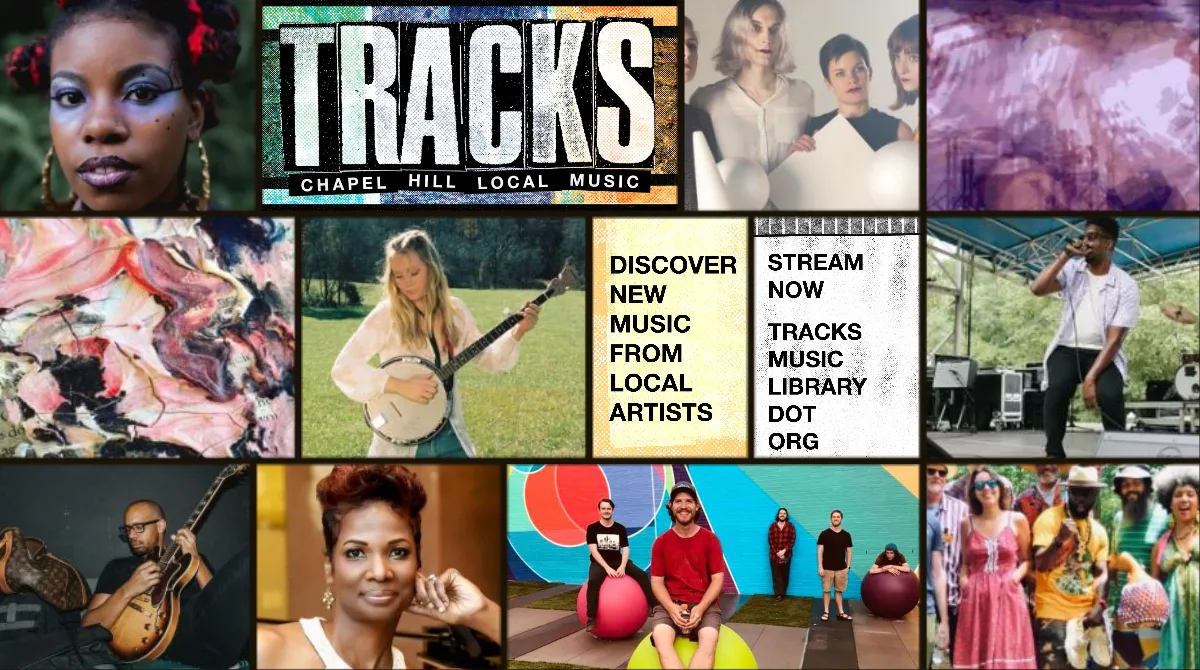
In 2020, Chapel Hill Public Library retired its CD lending program (R.I.P.). That same year, they launched Tracks Music Library (Tracks) to much media fanfare. The hyper-local program featured Triangle-area musicians curated by local experts. It’s free to stream and download for any Chapel Hill resident with a library card. The program was notable enough to be mentioned in Mood Machine (and its precursor article), where I caught wind of it.

Tracks Music Library is still online and functioning. I tried it out. The first thing you notice is that it runs on albums, closer to Bandcamp than the song-focused Spotify and Apple Music. The homepage is a simple grid of available releases. A “Featured” tab offers several dozen editorial playlists credited to various project staff and curators. There are no user playlists or points for user-to-user interaction, no share buttons, and no “users also liked” shelves.
This immediately satisfied two of my major streaming gripes: my preferred “unit of music” is a release; an EP or an LP, and I treat all recommendations and suggestions – anything algorithmic – as the same level of radioactive as traditional advertisements. Scrolling through the album covers felt like being back on iTunes, where the limited scope challenges you to delve deeper into your favorite records.

It’s clear why Tracks never caught on. Like CDs, it reintroduces moments of choice that streaming services have attempted to erase. Between the lack of social features and the lack of technical features (no mobile app, finicky DRM), the service feels like a top-down emulation of CD lending, which in turn emulates book lending. That’s not how most people engage with music anymore, especially when the catalog is also available through the service they already use. The project was short-lived. Programming ended quietly in 2022.
While learning about Tracks was exhilarating, finding it abandoned was equivalently deflating. I reached out to the curators and landed in the capable hands of Molly Luby, the library’s Community History Coordinator and the leader of the Tracks effort. Molly talks me through Tracks’s noble inception and ultimate pitfalls, both seen and unseen.

Image credit: Molly Luby
What have you been listening to lately?
Molly: Honestly, I’ve been listening to a lot of Dolly Parton this week. I can’t remember why, just before I got on this call, something else I was working on had me watching Childish Gambino videos.
Best Dolly song and Gambino video?
Molly: Well, “This Is America” was what I was just watching. It was great, nobody can deny that. Best Dolly song… golly, that’s a hard one. I have to think about that. There’s the classics; I love “Jolene”, I love all the iterations of that song. Sisters of Mercy covered it and so did Beyoncé. I mean, how can you go wrong? But I also love “Dover”, a lot of her more recent work has been great.
What’s your current role at the library?
Molly: My role now is Community History Coordinator for the Chapel Hill Public Library and the town of Chapel Hill. At the time that I started this project, my title was Special Projects Coordinator. It just so happens that now all my special projects are around history. So that’s my title slightly changed. Or totally changed.
How did the Tracks Music Library start and how did you end up on top of it?
Molly: A couple of things converged. One, Chapel Hill has a well-earned reputation as a music town, there’s been a lot of great music talent that grew up here or came here because of the schools. We had big band leaders here, you could make a case the Piedmont Blues got its bones here with Blind Boy Fuller. There was Floyd Council, “The Devil’s Stepdaddy,” who was a busker on the street in the 20’s and 30’s.
We got the beach music of the 60’s with Doug Clark and the Hot Nuts. I highly recommend checking him out. It’s not always safe for work, some of his music can be a bit raunchy. Their history is also very much entwined with Chapel Hill. If you’ve even seen Animal House, there’s a Black R&B band playing in the frat house; that’s based on Doug Clark.
This was such a Mecca for alternative music in the late 80s and the 90s. That’s when I became aware of Chapel Hill. That whole history is just amazing, with Cat’s Cradle and Merge Records.
What do you think made Chapel Hill such a musical hub?
Molly: I have no idea! Maybe it’s the university. I don’t have a great answer, but David Menconi might. He wrote a whole book about North Carolina music. He also wrote specifically about Chapel Hill; we interviewed him about it. His most recent book is called Oh Didn’t They Ramble, and it’s about Rounder Records and roots music.
Were you involved in the local scene?
Molly: I was not, I was just a fan. I’m just a person who loves music, and at the time my role at the library was bringing new initiatives.
Let’s take Tracks from the top.
Molly: So, we knew there was this music scene. On the other side, we’re a library. We had a CD collection, but circulating CDs is not awesome. Those CDs didn’t last very long. After two or three people check them out, they get very scratched, so the next person would complain. We’d buff it out and do what we can, but it wasn’t a great model.
Also, CDs weren’t being produced the same way. I don’t even have a CD player, I couldn’t play one if I wanted to. But then there’s this big gap, right? How do you have a circulating music collection without a physical object? We’ve kind of figured that out with e-books and e-audiobooks after a lot of work with publishers and DRM.
Were you at one point purchasing CDs?
Molly: Oh yeah, the library had a CD collection until 2020. Tracks was supposed to take its place, that’s why we phased it out. We stopped buying CDs in 2019. I grabbed a few for my daughter – she never grew up with CDs – it was so novel, she loved them. She took all the 90’s grunge.
I’m a little surprised CDs make for bad lending, I ripped hundreds of CDs from my childhood library.
Molly: How did they sound?
They were fine as far as I remember. But back to Tracks…
Molly: We have not cracked the code on other streaming services, whether it’s TV, movies, or music. There are services out there, but the competition is Netflix and Spotify. You will never get the access that you would with those companies. We have to have limits because we don’t want your money, we want to offer things for free. You can’t just binge anything you want all the time on Hoopla. It’s the same deal for music.
We had been in touch with a company, Rabble, Inc., who builds platforms specifically for libraries to meet this moment. That was attractive because we wanted something that would be good for local artists. We licensed directly from musicians, though that narrowed what we could offer because we needed to work with musicians who owned the rights to their music. We weren’t paying a lot of money, but it was more than those musicians would probably ever make from Spotify or a similar service.
We also had other ways we could promote, it wasn’t just having their music on the site. We liked that this option was hyperlocal, really specific to our community; it was a way of celebrating our local music and curating for our local audience. For musicians, it’s really hard to find a local audience on streaming services, so this was a way of curating bands you could see. The idea was to create a more connected musician-audience ecosystem.
That’s why we did it, but how we did it is we wrote a grant to the state treasury. The grant was only for the first year, just to get us to launch. We built a division into the budget, one half picked up by the library, the other picked up by the town’s Community Arts and Culture Department.
Where did the idea for the one-time payment licensing model originate?
Molly: We talked to other music libraries to get a sense of what they were doing. We wanted to offer as much as we could to as many as we could, especially the first year when we had the grant money. I think it was a pretty standard amount. There’s other music libraries across the country and Canada so we based around what they were doing.

Can you talk about some of the technical holdups? It’s very easy to dream of solutions; what are some of the roadblocks?
Molly: In local government, the process to pay somebody takes forever, at least three weeks. The first year, we licensed 80 artists or more. At the time, it was supposed to be two copies signed in wet ink plus a W-9. The staff time alone to process all that was too much. There were also a lot of concerns from IT about the platform’s security, then we had to get our legal department to review everything and that took a lot of time, too. We ended up contracting with Rabble to pay the artists directly, then we paid Rabble.
Did Rabble manage the back-end?
Molly: Yes, it’s Rabble’s platform, they’re hosting all of it for us.
So you were ready to go with Rabble when the grant cleared?
Molly: Pretty much. Steven Oliva (Spiderbags), who used to work with me at the library, created our logo and all the visuals for Tracks.
How were the curators chosen?
Molly: The role of curator was “champion of the project,” the goal was to reach musicians in the area to get them to submit their work. We wanted to choose curators that reflected the community and all the different genres.
We picked Steve Weiss, who is a natural because of his role with Merge Records and all of the work he’s done collecting Americana and folk music. He knows so many people. We chose Glenn Boothe (Andmoreagain Presents), he knows everybody. He was one of the most dedicated listeners. We chose Kevin “Kaze” Thomas, who’s fundamental to the Chapel Hill hip-hop scene.
We always had a spot for the general manager of WXYC, the student radio station on campus. After the first year, we started an Artist Curator role for musicians already on Tracks. We picked some of our best champions and we got younger curators that way.
It looks like there was some turnover among them, was that planned?
Molly: We wanted to give more opportunities. Some people told us they didn’t want to do it anymore but nobody got kicked out, they just moved on to other things.
Did the curators work together?
Molly: No, because of COVID. We had dreams of bringing them all together. We initially thought the curators were going to actively listen to all the submissions, but the library staff did most of it because the staff were getting paid. I would ask the curators how much time they wanted to put in, then put together a listening list for them to grade. If they listened to everything in their queue, they could go further.
Of the curators, it was really only Glenn who was into that. Steve and I listened to and rated everything, and we tried to get other staff to help. We wanted to have a variety of opinions on each submission in order to capture the diversity of Chapel Hill.

How did the launch go?
Molly: By the time we were ready to launch, it was Spring 2020. We had had big plans for in-person events and shows, Steve Weiss was going to curate a downtown pop-up, and we had to pivot hard with not a lot of time.
Because we couldn’t do the live shows, we were able to get more musicians, so we licensed more music than we intended. We also contracted with two local music producers to pick their favorite Tracks musicians and record two albums of original music. They’re great time capsules of where we were. Kaze’s album had a lot to do with Black Lives Matter, Thom Canova’s had a lot to do with lockdown. It was cool because they had to produce the music in lockdown. Both albums came out great.
We did an event called “Tracks in the Stacks.” We carefully brought in four or five artists – the library was still closed – to play here in the library and we recorded the show. One of the compilation musicians, Rowdy, hosted it like a late night talk show and interviewed them after.
That first year we had more downloads than any other year. I think in part because of lockdown, people were looking for novel ways of experiencing community and culture.
Why did it end?
Molly: Not enough use. We picked up the licensing fee for the platform – about $10,000 a year to keep it running – and that’s not insignificant for a library like ours. It was a challenge to keep that going. We could see the numbers every year going down, down, down. We found that almost nobody wanted to download the music. My colleague Steve did, but even after downloading, it took some work to get it into his library.
We would have an open call for musical submissions at least once a year and the number of submissions went down, too. There just weren’t enough people using the site to justify it. It was our most expensive platform other than the library catalog.
Was there a way to make this succeed? And if it had, does it scale?
Molly: I think if we had an app – it’s just a web platform right now – I think an app would have made it more workable.
I think Utah’s music library is statewide. That’s something I had hoped we could grow. We needed a bigger commitment from our library. I just spoke with a librarian in Charlotte who was very interested. I’d love to do a collaboration and revive Tracks if there was a way we could share the cost and workload. It’d be nice to distribute those costs more, but it’s a lot to ask and right now, libraries are not doing so great. We’re lucky to have a community that really supports the library, but we’re struggling.

You listened to everything. Were there any standouts?
Molly: I was so grateful to get submissions when we first opened it up, I was worried nobody would submit. I was just looking at the Carolina Public Humanities catalog and was reminded of Sonny Miles. I remember seeing his submission come through. He’s such an incredibly talented musician. I remember learning that he was on President Obama’s music playlist. I love BANGZZ. I really loved Hard Drive, it’s old-time bluegrass, extremely well done. Tatiana Hargreaves, who has some solo work on Tracks, plays in that. I loved Dissimilar South. Are there any on here that you’re a fan of?
BANGZZ is great, I love Certain Seas – my band had Danny (Grewen) feature on a song – it feels really “small world” scrolling through.
Molly: It’s local music, for sure.
This interview has been edited for length and clarity.

Leave a Reply