
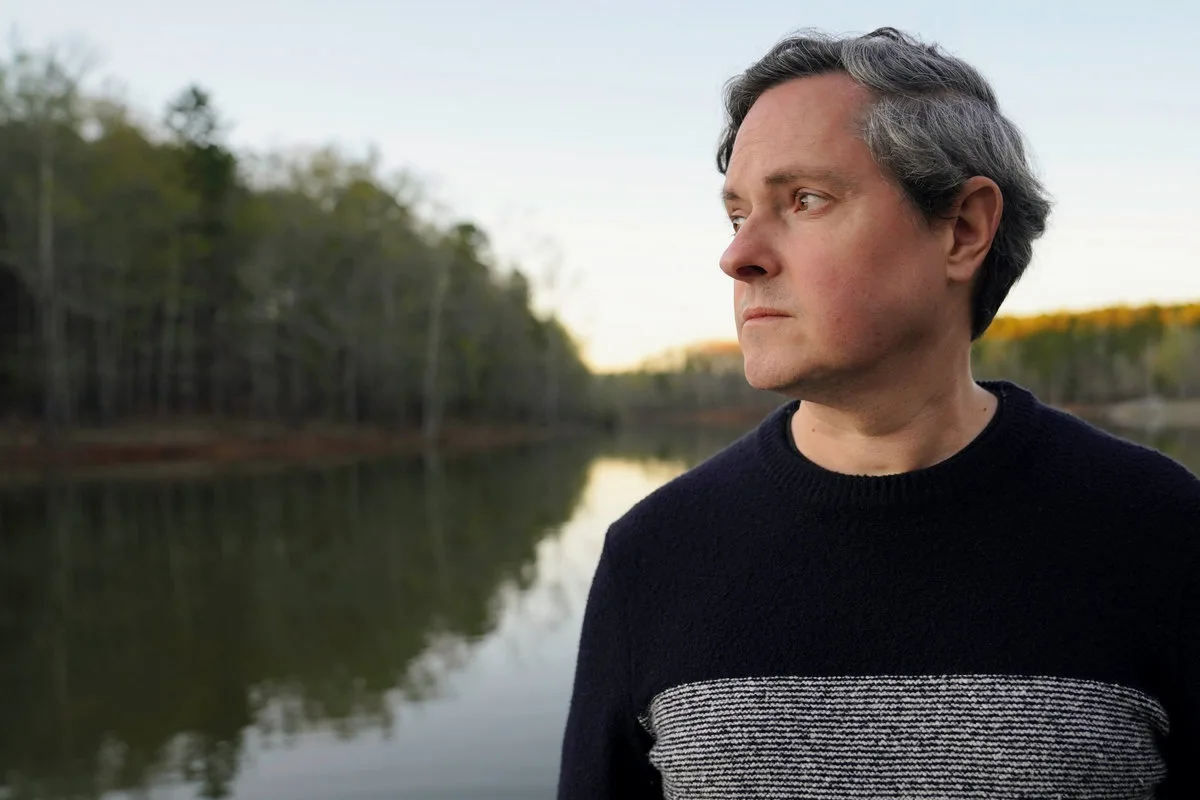
Canon Pence didn’t set out to start a band. For roughly 15 years, he barely made music. So when he picked up an acoustic guitar again around 2015, it was more meditation than ambition. The songs were private, a way to step out of a life that had gotten too busy.
In 2023, he decided to do something with them, but he did it backward, booking the recording session first. His project, Twilark, made its debut in 2025 with The Taming Ties Create. By then, he had already tracked the follow-up, recording it in the month before the first album came out.
That second record, Never Learned the Tide, arrived September 11 full of pedal steel, banjo, and fiddle from Nashville’s indie-country circle, most of it captured in a handful of takes. Its artwork is a set of invented book covers, printed on real book cloth with a 1930s press. In a world overflowing with AI “art” slop, Canon’s approach is tactile in a way that just feels necessary right now.
Is there anything you’ve been listening to lately, something new or that’s been stuck in your head?
Canon: I’m a voracious consumer of new music, so I’m constantly listening to new stuff. But my favorite album of the summer is Jessie Gray‘s The Muse. She’s based in Nashville, it’s her first full album, and it’s superb sort of whimsical, intimate indie folk. I really love her stuff.
And then The Innocence Mission out of Pennsylvania are a longtime favorite. I’ve been reconnecting with their catalog, learned one of their songs recently, and have been listening to them a lot more, too. They’re one of my favorite bands of all time.
Who’s the first musician you remember discovering, or being introduced to, that you took on as your own and got obsessed with?
Canon: I was young, so it’s far from obscure, but the first band I was obsessed with as an independent music listener was The Cure. I remember in fifth grade we did a music project where you had to change the lyrics of a song to deal with the subject matter of the class, and I did a Cure song, which felt very progressive to me at the time, musically advanced. All throughout high school, my walls were covered in Cure posters and t-shirts.
When did you first start performing or learning an instrument, and eventually making your own music?
Canon: I was in bands in high school and college, both in North Carolina. My high school band was pretty serious, so the first concerts I ever went to were our own. We played Gastonia, Charlotte, and Asheville. It was an improbable blend of Bauhaus, early Archers of Loaf, and Sex Pistols, a sort of punky, gothy ’90s indie thing, depending on which band member’s influence you were hearing.
I was mostly just the singer. We were all writing the songs together, but I wasn’t the one showing up with a new song for everybody to learn. By the college band, I was the songwriter, guitarist, and singer. That was early high school, when I started in bands.
What was the transition point from being in those bands to a more solo-focused singer-songwriter project?
Canon: That stuff was a long time ago. The college band carried over a little past college, but it was never that serious, and then I was focused on life and career for a long time. There was maybe a ten- or fifteen-year period where I basically wasn’t making music at all. Work and life got really intense, and eventually I started messing around with guitar again.
The big turning point was getting an acoustic guitar, which I’d never owned before. Having it around, I was able to pick it up almost like a substitute for meditation, a way of stepping out of other parts of my life. It was a self-therapy tool, really private and personal, starting around 2015. I wrote a lot in that period, but it was just for me.
It wasn’t until pretty recently that I thought maybe I could do something more with it. I decided to pursue it in 2023, and I did it kind of backward from how you’re supposed to: I started with an album recording session. I got to work with one of my favorite current musicians as producer, Zac from Saintseneca, and Dominic Billett rounded out that studio crew, and the three of us recorded the first album. At that point, Twilark didn’t exist publicly. The project became public when that album came out last year. We recorded it in ’24 and released it in ’25. This is all really new for me. Brand new.
Looking at the release dates, you went from that first record in 2025 to a second full-length about a year later. What was that turnaround like?
Canon: We recorded the second album within the month leading up to the first album’s release, which was a strange experience. It’s not fair to that first album to say I was over it, but my head was already in the second album’s material, because that’s what I was working on intensely at that time. It was a weird feeling, and I don’t think I’ll do that again.
But all that said, I do want to record a third album. I’m eager for that. It still takes a while to actually get a record out, this one will come out within about a year of recording, give or take, which still feels a little slow to me. But I can’t complain too much.

When you bring other musicians into songs you’ve written alone, how do you think about handing that material over? Do you let people bring their own flair, or do you rein it in to match what you’ve already envisioned?
Canon: I’m committed to songwriting as an isolated act, just me and my guitar. My personal rule is that I have to say the most emotionally true thing, even when it’s an uncomfortable thing to say or sing about. I tell myself we’ll deal with what happens to the song later; right now, the job is to make the song feel powerful. I don’t want to complicate songwriting by thinking about what happens to it afterward. But once the songs are written and I know what I want to do for the album, I start picking musicians, and I go into the studio with just the acoustic song, lyrics, and voice. That’s it.
Then we craft a vision for the album together, the instrumentation, and I work with the producer to find people to play on it. At that point I’m more like a curator. On the second album, Maya de Vitry did banjo and later added fiddle. She’s a super accomplished, full-time professional musician, really successful in the Indie Americana world, and I’m just a novice. These musicians are learning the songs blindingly fast; we’re recording first, second, third takes depending on the song.
There’s one song that’s just me and Maya, acoustic guitar and voice, her on banjo and voice, and that was a first take. I’m not really directing her. I might say “let’s lean into that” if something sounds cool, but it’s mostly collaboration and instinct rather than me telling anyone exactly what to play.
This record leans heavily on the Nashville indie-country scene. What does that cross-pollination mean for you?
Canon: The pop-country Nashville thing isn’t for me, but the indie country scene down there is full of wonderful musicians, great people, and this record definitely taps into that community. Spencer Cullum did pedal steel on both albums, and he’s one of the best studio pedal steel players in the business. He’s also got his own group, the Spencer Cullum Coin Collective, who just put out an album.
Erin Rae is another example. Dominic, the producer, had been in her band before, and she contributed vocals to five of the songs on this record. When I found out that was a possibility, I was really excited, because I’m a fan of her music first and foremost. That’s what these collaborations have felt like across the board: I’m a fan, and I’m lucky to get to work with people this talented.
The album art for this one is letterpress, printed onto real book cloth, clearly handmade. What’s your process for putting that together, and what draws you to that medium?
Canon: I think of it as album cycle art, the cover and the singles together. I like having a cohesive art vision for each cycle. For the first album, I worked with Kent Ambler, who blends two of my favorite aesthetics, Japanese ukiyo-e woodblock printing, Hiroshige and that tradition, with a rural Southern sensibility. He’s based in rural South Carolina and has these wonderful woodblock prints of Carolina birdlife and nature scenes; the cover and every single from that album used his original art.
For the first album, I worked with pieces he’d already created, so it was more collaborative in that we selected them together, but he wasn’t making it for me specifically. For this one, the art is original to Twilark. I was in Scotland a couple of years ago and saw the work of Charles Rennie Mackintosh, who did design, architecture, furniture, all kinds of things, but also book covers. The museum had original cloth-bound covers, faded and worn, and they reminded me of my grandparents’ house in the North Carolina mountains, where we’d get sent for part of the summer. They had all these old books that had belonged to my dad and my uncles, youth novels from the ’50s with the jackets long gone, just the worn cloth-bound covers, a kid’s cowboy novel from the ’40s or whatever. That’s what we grew up playing with.
Seeing the Mackintosh books brought that back, and I thought, what if we could do that? So I worked with a printmaker out of Asheville, Laura Ladendorf, who does things the old-fashioned way, to create original fake book covers: a mystery novel, a cowboy novel, something in an Edward Gorey style, a secret-garden type cover. They’re printed with printing plates onto real book cloth on an old 1930s press, mounted on book board.
I love how they turned out. I didn’t set out to make a statement about the crossroads art is at right now, but I was probably drawn to something tactile partly because of the general unease going around the world these days. It mattered to me that, like the rest of the album, this stayed analog. We recorded with upright bass, banjo, fiddle, acoustic guitar, drums, no software, and the covers are the same, done the old-fashioned way.

Given how much AI-generated “art” and content is out there right now, does that context sharpen your commitment to doing things the analog way?
Canon: I think there’ll be a pull back toward that kind of authenticity once the alternative is just samey slop. Even if you’re not explicitly chasing that as a reaction, it reflects your personal experience and the direction your brain goes in a way a computer or a language model can’t replicate. There’s beauty in human quirks and imperfections. I don’t want something perfect; I want it to be authentic, to speak to the actual vision of a creator making something new in the world. Perfect doesn’t really exist in art anyway, because it’s all subjective.
Who are some of your favorite North Carolina musicians you’d want to shout out?
Canon: There’s a really rich scene in Durham. I’m based in Raleigh, and sometimes they feel further apart than I’d like, but there’s Lou Hazel, a world-class indie folk artist, and then what I’d call avant-garde folk built on traditional string instruments coming out of Durham: Magic Tuber Stringband and Weirs.
That scene has a lot of side projects and bands that share members; Sluice and Fust are basically the same group of people, and they’re all doing awesome stuff. Out west, Twain, that’s Mat Davidson along with his partner Natalie Jane Hill and Alexa Rose, are all indie Americana and folk artists near Asheville. And Lyle de Vitry, Maya de Vitry‘s brother, his stuff is amazing.
That’s not an exhaustive list, but I’m not supporting the North Carolina scene out of obligation; I’m listening to these artists because the music is challenging, interesting, and really good.
Anything you want to add before we wrap up?
Canon: I feel grateful for the opportunity to be part of this community, to work with the artists I’ve gotten to work with on this record, and to play shows locally. I’ve got a band now that includes a guitarist from my high school band, so I can play shows either solo or with a full group. After basically twenty years as just a music fan, I get to participate on the creative side again, putting new music out and playing live, integrating into the North Carolina music community that way too. It all feels new and exciting.
The band came together really organically, almost without trying, which surprised me, I thought it would be harder than it was. Some of the other members came from Porch Light Apothecary, a three-piece that had been active for about a decade before splitting up when one of them moved away. We were friends with them, and when two of them were suddenly available, that ended up forming most of the rest of the local lineup. It felt right.
This interview has been edited for length and clarity.

Leave a Reply